Only use these instructions if your urology team has asked you to remove the stent yourself.
This information is for urology patients at any sites within Frimley Health NHS Foundation Trust.
What is a ureteric stent?
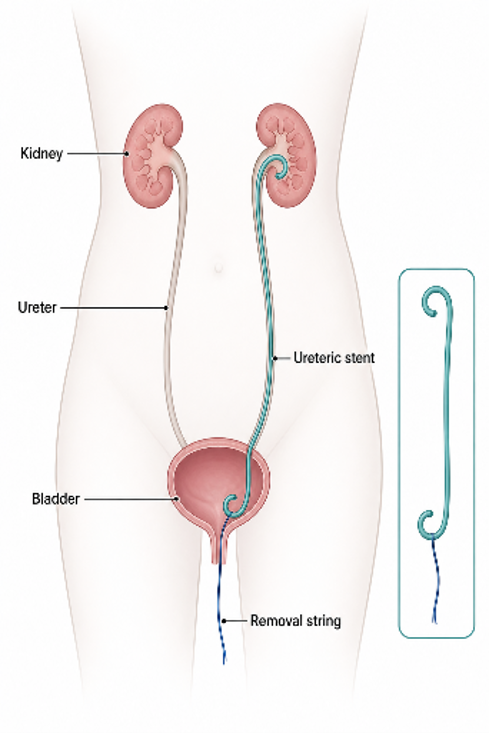
A stent is a soft plastic tube. It helps urine flow from your kidney to your bladder after your operation.
The tube from your kidney to your bladder is called the ureter.
A thin string is joined to the stent. The string comes out where you pass urine.
It may be taped to your thigh or private area. You can pass urine as normal.
What symptoms are common?
While the stent is in, you may:
need to pass urine more often
need to pass urine in a hurry
feel burning or stinging when you pass urine
see pink or red urine
feel pain in your bladder, groin or private parts
feel pain in your back or kidney when you pass urine
feel worse after walking or exercise.
Contact the urology team if these problems get worse or are hard to cope with.
Protect the string
Do not pull, cut or shorten the string.
Take care when you wash, dry or get dressed.
Take care when you use the toilet.
Do not catch the string on clothes or towels.
Do not have sex while the string is outside your body.
Do not try to move the string or stent.
Call the urology team if the string is lost or breaks.
Call us if the string gets much longer.
Call us if the stent starts to come out.
Before you begin
Take the stent out in the morning. It is easier to call the hospital team then.
Check that today is the right day.
Check if you have one or two stents to take out.
Pass urine as normal.
Wash and dry your hands.
Choose a place where you feel at ease. You can use the bathroom or lie on a bed.
Sit, stand or lie in a position that feels right for you.
How to remove the stent
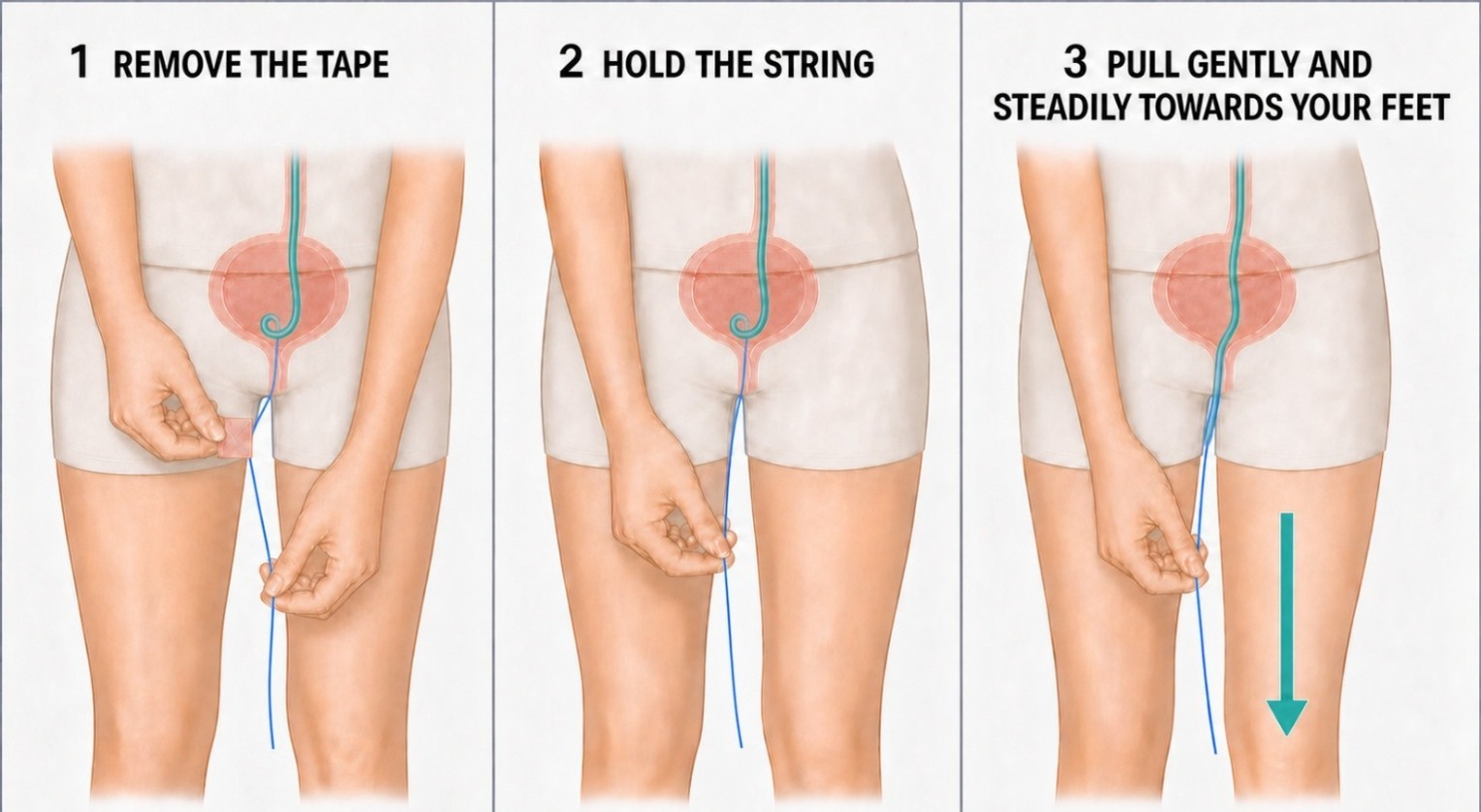
Take off any tape holding the string.
Relax as if you are passing urine.
Hold the string.
Pull the string slowly and gently towards your feet.
Do not use short, sharp pulls.
Keep pulling in one smooth move until the whole stent is out.
You may feel some pulling or mild pain.
You may feel this in your bladder, back, kidney, penis or vagina.
Taking the stent out should only take a few seconds.
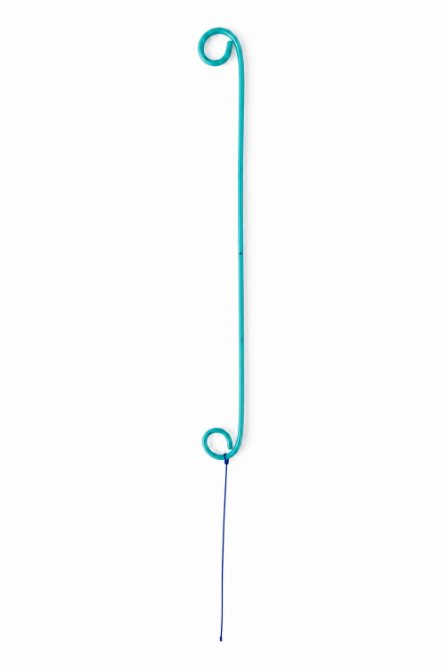
The stent is long, thin and soft.
It may look longer than you thought.
Stop and call us if:
The stent feels stuck.
It is hard to pull.
You have very bad pain.
The string breaks.
Only the string comes out.
Part of the stent comes out and gets stuck.
You cannot find the string.
You are not sure the whole stent is out.
Do not pull harder. Do not use any tools. Do not push the stent back in.
Check the removed stent
Put the stent on a clean tissue or towel.
It should be one piece. It often has a curl at each end.
The curls may not return to their usual shape straight away. If the stent looks broken or incomplete, keep all pieces and contact the urology team.
After successful removal
You do not need to call us if the stent comes out as planned.
Put the stent in your bin.
Call us if it looks broken, a piece is missing, or you are worried.
After the stent is out
For 1 to 2 days, you may:
feel some burning when you pass urine
pass urine more often
see pink or red urine
have mild pain in your bladder, back or kidney.
Remember:
Take the pain medicine we told you to use if needed.
Drink as normal.
These problems should get better. Call us if they get worse or do not start to get better.
If the stent comes out early
Do not try to put it back.
Keep the stent or take a photo.
Call the urology team that day.
Get urgent help if you have:
a fever of 38°C or more
shaking, chills or sweats
you are sick or feel very unwell
very bad pain in your back, side or tummy
pain that does not get better with your pain medicine
you cannot pass urine or find it very hard
a lot of blood in your urine or large blood clots
Contact the urology team, or NHS 111 for help.
Go to the Emergency Department (A&E) if you need urgent care. Call 999 in an emergency.
Surgical helplines
Frimley Park Hospital surgical helpline: 07990 528061
For advice from 7am to 8pm, Monday to Sunday.
You can use the accessibility toolbar at the bottom of your screen to:
Change the text size
Adjust the font
Modify the colour contrast
Use the translate function
If you would like this information in another format, such as Braille, audio, or easy read, please speak to a member of staff.
You can also print as well as download as PDF using the “Print this page” button at the end of the page.
Staff will print a copy for you on request
Important note
This page provides general information only. It is developed by clinical staff and is reviewed regularly every 3 years for accuracy. For personal advice about your health, or if you have any concerns, please speak to your doctor.