

Advice after your nerve block for surgery
On this page…
Introduction
Unpaid carers play a vital role in the healthcare system providing essential support to family members and friends who are ill, disabled, or elderly.
At Frimley Health, we recognise the immense contribution of unpaid carers and strive to support them in their crucial role.
The Trust honours John’s Campaign in upholding the right of patients to be supported at all times by their carers.
For further information concerning John’s Campaign, please visit johnscampaign.org.uk.
Who is a Carer?
- A carer is someone who, without payment, helps another person, usually a relative or friend, in their day to day life. The other person would not manage without this support.
- Caring can change your relationship with the person you care for and with others in your family or network. You may feel unprepared for how your life has changed.
- Many carers would still not recognise themselves under the term ‘carer’. They are just people trying to cope as best they can while helping to look after a relative, immediate family member or friend who is unable to fully look after themselves.
What is the Role of a Carer?
Carers perform a variety of tasks, including:
- Personal Care: Assisting with daily activities such as bathing, dressing, and eating.
- Medical Support: Managing medications and attending medical appointments.
- Emotional Support: Providing companionship and emotional reassurance.
- Household Tasks: Helping with cooking, cleaning, and shopping.
Frimley Health NHS Foundation Trust’s Carers Promise
|
Looking after yourself as a carer
Register as a carer with your own GP
They will be able to provide you with support and information, including your entitlements and services such as:
- free annual health checks.
- the annual flu jab and Covid-19 boosters as advised.
- access to a 'Carer's Champion' who can support you in your caring role.
- support with your physical and mental health to enable you to carry out your caring responsibilities.
- additional authorised leave from your employer.
Request a Carers Needs Assessment
A Carers Needs Assessment is not an assessment of your ability to care but rather looks at what support you might need to help you cope
- If you provide care and support to an adult friend or family member, you may be eligible for support from your local council; parents of a child with additional needs also have a right to a Carers Needs Assessment.
- If you are a carer and you require support, get in touch with the council covering the area where the person you care for lives. The council will be able to give you information and advice about how the assessment will work.
- Councils now have a legal duty to assess any carer who requests an assessment or who appears to need support.
- A Carers Needs Assessment is a discussion between you and a trained professional, either from the council or a partner organisation.
- This needs assessment is not a test and there are no right or wrong answers.
- The assessor will explore what support the carer needs, such as respite care, financial aid, counselling, or training; it may be conducted face-to-face, over the telephone or online.
Tips to help you with hospital care
Carers Support Scheme
Please speak to the nurses in charge of the ward your friend or relative is in, who will be able to issue you with a carer’s badge.
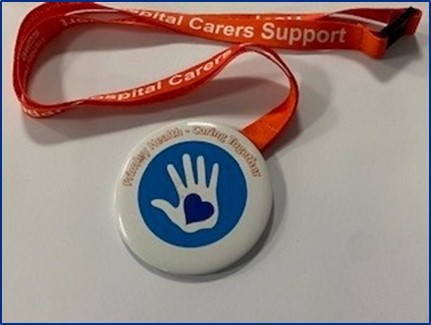
Make sure you are recorded as the principal carer along with your contact details.
The Trust has a policy of offering open visiting to carers; meaning you can spend as much time, as frequently as you want, and at whatever time of day or night with the person you care for. While it’s not mandatory, wearing a carers badge or a carers lanyard while on site will ensure staff are aware of your status and you will not have to explain why you are on site.
- When the friend/relative who depends on the care you provide is admitted to hospital, it is natural for you to worry. We recognise that some carers like to continue to contribute to caring for their friend/relative during their hospital admission, working alongside our hospital staff where possible.
- Please note that it is not assumed that you will continue caring for them and it is and will remain your choice, not an obligation. If you do choose to undertake the role of carer, then make yourself known.
Some other ways in which you can help during the hospital stay include:
- Safety - please make sure the nurse-call bell, drink, glasses etc. are within easy reach before you leave your friend or relative. If you have any concerns about patient safety, please discuss these directly with ward staff.
- Infection Control - please speak to the nurses looking after your friend or relative to check there are no precautionary measures you need to be taking. If disposing of any waste contaminated with bodily fluids, please use the orange bins provided in each clinical area or ask the nursing team looking after them.
- Encouraging good fluid intake - (6-8 cups a day) may improve mental capacity and reduce the chance of constipation and urine infections which can result in increased confusional state in elderly patients.
- Encouraging a healthy diet - if you are assisting at meal times, please inform the nursing staff if your friend or relative’s appetite deteriorates. Poor nutrition can result in weight loss, constipation and breakdown of muscle and skin condition.
- Sticking to normal routines - e.g. toileting, regular contact with family/friends or reading a familiar newspaper may help reduce the chance of disorientation.
- Mobilisation - if your friend or relative is not as mobile as usual, you may like to ask the nurse or physiotherapist for advice on safe techniques to help them to mobilise.
- Oxygen therapy - if your friend or relative is having oxygen, encourage them to keep the oxygen mask or prongs in place as lack of oxygen can lead to confusion. Please inform the nursing or medical staff if your friend or relative is not coping well with the oxygen mask or prongs.
- Medication - please advise the doctor if you are concerned about a change in your friend or relative’s usual medication regime or if they are not tolerating their medication.
- Mouth care - if your friend or relative is not allowed anything by mouth and is unable to clean their teeth, the nurses will show you how to gently clean their mouth. If they are having oxygen therapy, please do not apply any lip balm containing petroleum jelly (Vaseline) as this may be flammable.
- Drips and lines - if your friend or relative is allowed nothing to eat or drink, they are likely to have a drip in their vein or a tube in their nose to help give them fluids. If you are worried about these becoming dislodged, please discuss this with the nurse.
- Pressure care - if you are helping your dependent relative or friend with personal hygiene, please inform the nurse if you notice any breakdown in skin condition, e.g., areas of redness or broken skin.
While we greatly appreciate your input in helping with hospital care but please do not feel obliged to participate. It is our aim to work in partnership with you, so we can learn from each other and provide the best possible care for the patient.
General Information on our Hospitals
Parking
Farnham Hospital
Car parking is free and there is good disabled access.
Food and drink There is a small cafeteria that serves sandwiches and drinks. Opening hours: 9.00am to 5.00pm. Located in the foyer next to the cafeteria is a vending machine providing hot/cold drinks and snacks.
Visiting times are generally relaxed and relatives can usually visit any time after breakfast or during breakfast if they wish to help or encourage their relative.
Frimley Park Hospital
Car parking There are parking facilities for patients at the front of the hospital with disabled spaces available. (Please note that entrance B, although further away from the main entrance, is easier to access from the car park for wheelchair users).
| Up to 20 minutes - free | 3-4 hours - £6.50 |
| 20 minutes-2 hours - £4.00 | 4-5 hours - £7.50 |
| 2-3 hours - £5.50 | Over 5 hours - £8.50 |
Parking prices correct at time of going to print.
We do not offer automatic free parking for Blue Badge holders.
You can claim back cost of parking if you receive the following: Welfare Support: working tax credit (with tax credit exemption certificate), Income based employment & allowance, guaranteed pension credit or a valid HC2 or HC3 certificate.
A seven-day pass costing £18 or 30-day pass costing £55 can be purchased from the ‘Pay on Foot’ parking machines There are parking bays close to the hospital for disabled people.
Food and drink There are a number of places where visitors can buy hot or cold food and beverages at Frimley Park Hospital:
- Pinetrees restaurant first floor, accepts payment by cash and cards. Opening hours (7 days a week) from 7:30 to 20:00
- RVS shop located on the ground floor close to reception
Opening hours:- Monday to Friday – 8.30am to 7p,
- Saturday: 9am to 5pm
- Sunday: 10am to 4pm
- Café Glade located on the ground floor just past the hospital’s main entrance reception
Opening hours:- Monday to Friday – 9.00am to 7.00pm
- Saturday and Sunday – 10.30am to 6.00pm
- Vending machines There are a number of vending machines throughout the hospital offering a variety of drinks and snacks. They are accessible 24 hours a day.
- Cash machine There is a free of charge cash machine located on the ground floor, just beyond the main entrance and Café Glade, before the stairs on the left-hand side.
- Second Hand Book Shop Located at the main entrance to the hospital opposite the reception desk.
- Patient advice and liaison service (PALS) The PALS office at Frimley Park Hospital can be found in the main reception at the front of the hospital. PALS staff are there to offer information and advice and to help address any concerns you may have.
PALS Frimley Park Telephone number: 0300 613 6530
Need a listening ear? You don’t need to be religious to get help from our spiritual and pastoral care team. Please contact the Chaplaincy team on 0300 613 4184
Heatherwood Hospital
- Car parking There are parking facilities for patients and visitors at the front of the hospital with disabled spaces available. When you arrive at the car park your car number plate will be automatically read (ANPR) at the car park gate. You'll need to take a ticket to be let into the car park. When you're ready to leave you'll need to pay at the machine, entering your car number plate. As you drive to the exit barrier this will raise as you approach.
| Up to 20 minutes - free | 3-4 hours - £6.50 |
| 20 minutes-2 hours - £4.00 | 4-5 hours - £7.50 |
| 2-3 hours - £5.50 | Over 5 hours - £8.50 |
Parking prices correct at time of going to print.
We do not offer automatic free parking for Blue Badge holders.
You can claim back cost of parking if you receive the following welfare support: working tax credit (with tax credit exemption certificate); income based employment & allowance; guaranteed pension credit; or have a valid HC2 or HC3 certificate.
Cashpoint There is a cash machine outside the entrance, at the front of the hospital.
Food and drink
Café Glade at the main entrance
Opening hours: Monday to Friday 7:30am to 5:30pm.
Infopoint Telephone This telephone is located in the main entrance. It is free to use and available to call taxis, Traveline, the chaplaincy service, NHS111, the Frimley Health Patient Advice and Liaison service (PALS) and the Bereavement Advice Line.
Heatherwood Patient Advice and Liaison Service (PALS) The staff of the PALS team at Wexham Park are able to offer information and advice and to help address any concerns you may have.
PALS Wexham Park & Heatherwood Telephone: 0300 615 3365
Wexham Park Hospital
Car parking There are parking facilities for patients at the front of the hospital. Charges apply as follows:
| Up to 20 minutes - free | 3-4 hours - £6.50 |
| 20 minutes-2 hours - £4.00 | 4-5 hours - £7.50 |
| 2-3 hours - £5.50 | Over 5 hours - £8.50 |
Parking prices correct at time of going to print.
A seven-day pass costing £18 or 30-day pass costing £55 can be purchased from the ‘Pay on Foot’ parking machines, with the exception of the one pay-and-display by entrance Gate 4 and one near the Postgraduate Medical Centre. There are parking bays close to the hospital for disabled people.
We do not offer automatic free parking for Blue Badge holders.
You can claim back cost of parking if you receive the following Welfare Support: working tax credit (with tax credit exemption certificate), Income based employment & allowance, guaranteed pension credit or a valid HC2 or HC3 certificate.
Car park entrances direct to zones
Car Park A via Gate 2 - entrance for Blue zone
Car Park B via Gate 2 - entrance for Blue / Pink zones
Car Park C via Gate 4 - entrance for Orange / Green zones
Gate entrances
Gate 1 - Accident & Emergency, Rehabilitation & X-ray
Gate 2 - Main Entrance, Reception, Information & Outpatients Blue zone
Gate 3 - Maternity & Children Green zone
Gate 4 - Day Surgery & Maternity Orange / Green zones
Cashpoints There are three cashpoints. One is located in the Courtyard Restaurant, another is located at the main entrance and one at the Day Surgery entrance.
Food and drink There are a number of places where visitors can buy hot or cold food and beverages at Wexham Park Hospital.
- RVS shop at the hospital entrance
Opening hours:
Monday to Friday 7:30am to 6.00pm
Saturday 9.00am to 5.00pm
Sunday 10:00am to 4.00pm
- Café Glade just past the main reception inside the main entrance
Opening hours:
Monday to Friday 9.00am to 6.00pm.
- Courtyard Restaurant located on the ground floor just a short walk from the main reception in the blue zone
Opening hours: Monday to Sunday 7.15am to 7.45pm.
- Cross Roads Café
Opening hours: Monday to Friday 6:30am to 6.00pm
Saturday and Sunday 8.00am to 5.00pm.
Charity Book Store Located at the main entrance to the hospital opposite the reception desk
Patient Advice and Liaison Service (PALS) The PALS office at Wexham Park Hospital is situated opposite the Chapel. The staff are there to offer information and advice and to help address any concerns you may have.
PALS Wexham Park & Heatherwood Telephone: 0300 615 3365
Macmillan Cancer Information and Support Centre Located adjacent to the main entrance, this office is open Monday to Friday, 9am – 4pm (excluding Bank Holidays) with staff to offer information and advice on cancer care. Email: fhft.macmillan.information@nhs.net or Telephone: 0300 615 4886
Need a listening ear? You don’t need to be religious to get help from our spiritual and pastoral care team. Please contact the Chaplaincy team on 0300 615 3660.
Hospital Discharge/Going Home
(transfer of care)
When planning for your friend/relative’s discharge from hospital, together with social services departments and primary care colleagues, we aim to:
- Ensure patients are always treated as individuals and involve the patient’s next-of-kin and carers
- Provide continuity of care as patients transfer from one area of care to another
- Identify and agree joint priorities for change
- Ensure best practice
- Ensure that essential items – medication, paperwork and personal items such as dentures and hearing aids remain with the patient to ensure a smooth transition and a positive experience.
For the majority of patients, preparing to go home from hospital is simple and uncomplicated. The process of going home from hospital ensures that the planning is straightforward, understood by all those involved and meets the needs of your loved ones, as well as utilising the hospital services appropriately and responsibly.
As a carer we recognise that you are central to the planning of care and the success of your loved one going home. We aim to ensure that everyone involved will be able to participate and feel able to contribute to all decision-making.
Since March 2020 national government guidelines have introduced a discharge to assess model with the intention of supporting more people to be discharged to their own home. This means that when patients are medically fit for discharge from hospital they may either go home with support (if needed) or be moved to an interim place of care. This is in order for assessments to take place to identify their longer term care needs.
More information is available from the Government website https://

Alternatively, please talk to the ward staff about any concerns you have; particularly if you feel you are not being adequately involved in the planning of your loved one going home.
This information from Carers UK may be useful to you when planning for discharge:
https://
Hospital's Duty to Carers at Discharge
- Communication: The hospital should provide clear communication regarding the patient's condition, discharge plan, and any specific care requirements.
- Education: Hospitals are responsible for educating carers about post-discharge care, including how to manage medications, wound care, and any necessary therapies.
- Resource Provision: The hospital should provide information about available resources, such as home health care services, equipment rentals, and community support.
- Discharge Instructions: Carers should receive comprehensive written discharge instructions, including information on what to monitor, when to seek help, and how to manage the patient’s recovery at home.
- Support in Transition: Hospitals may also facilitate referrals to social services or case managers who can assist with the transition to home care.
Preparing to go home checklist
You may like to use the following checklist to make sure the person you care for is discharged appropriately.
| Does your friend/relative need a face-to-face language or British Sign Language interpreter, or have other communication needs? | |
| Have you been involved in assessments of your friend/relative and has your caring role been considered? | |
| Has a minimum of 24 hours’ notice been given to you before the discharge of your friend/relative? | |
| Has transport home been arranged for your friend/relative if needed? | |
| Do you have the medicines you need for your friend/relative and have they been discussed with you? | |
| Are keys available for your friend/relative’s home? | |
| Have your friend/relative’s valuables or property been returned? | |
| Has any essential equipment needed at home for your friend/relative been supplied or fitted and have you been shown how it works? | |
| Have you been given appropriate training, for example in moving and handling or any on-going exercises or needs? | |
| Have you been given information about the medical condition of your friend/ relative, any symptoms to watch out for and where to get help if needed? | |
| If a care plan is in place for your friend/relative has this been shared with you? | |
| Have your wishes, feelings, needs and the care you intend to provide been fully considered? | |
| Do you have all contact names and numbers for any on-going care or health needs such as social care team number, physiotherapists, occupational therapists, care providers or other appropriate people? |
When you are home
When your friend or relative returns home after their hospital stay you may wish to prepare a ‘hospital bag’ so that you are prepared in the event that they have to come to hospital again. This may save vital time and ease any fear and confusion that may have happened during this hospital stay. You can keep it in a safe place, so that it is ready in case it is ever needed.
We recommend you keep the following in your ‘hospital bag’:
- A nightdress or pair of pyjamas
- Day clothes (if you would like)
- A dressing gown and well-fitting slippers or sensible shoes
- Items that may help with the unusual surroundings, such as photographs for your friend or relative
- Toiletries, including soap, a toothbrush, toothpaste, shampoo and conditioner, a razor and shaving materials and a comb or hairbrush
- Things to occupy your friend/relative such as books, magazines or puzzle books
- A small amount of money to buy things such as newspapers, phone calls and anything you may want from the hospital shop or ward trolley.
- A current list of medications
- A notebook and pen to write down any questions you have when the doctor is not available
- A copy of important phone numbers, such as the next of kin details, GP address and telephone number
There are a number of support services available to carers at a national and a local level. We have included some of these below. Depending on your friend/relative’s condition, you may be able to find more condition-specific support groups.
Local GP
Carer’s Prescription
Please ask your GP if you are eligible for the carer’s prescription scheme. This scheme aims to support unpaid carers and promote their own good health and wellbeing by providing them with a flexible break/ respite or referral on to other appropriate support.
Other GP support mechanisms
- Access to counselling or referrals to specialised support for stress, anxiety or burnout.
- Carers Register: Many GP services maintain a register to support unpaid carers with tailored assistance.
- Guidance on local services , respite care options and benefits available to carers.
- Flu vaccinations other preventative care measures to protect your health.
National carers support services
Visit the Trust website www.

Provides an expert telephone advice and support service.
Helpline open Monday to Friday, 9:00am to 6:00pm.
Tel: 0808 808 7777
www.
________________________________________

Helps carers to maintain their own health and wellbeing and supports them so they do not feel isolated.
Tel: 0300 772 9600
www.
________________________________________

An information point of carefully selected items that will, hopefully, make life better, safer, or more comfortable for those who experience mobility problems, need care or are caring for others.
Tel: 0800 069 9784
www.
________________________________________

The country’s largest charity dedicated to helping everyone make the most of later life. We believe in a world where everyone can love later life and we work every day to achieve this. Age UK help more than 5million people every year providing support, companionship and advice for older people who need it most.
Tel: For information and advice: 0800 055 6112 For all other enquiries: 0800 678 1602
(Lines open 8am-7pm, 365 days a year) www.
________________________________________

Specialist dementia support and expert advice for families through our Admiral Nurses who work hand in hand with families, helping them cope with the fear, uncertainty and daily reality of dementia.
Tel: 0800 888 6678
www.
Local carers support services
Local carers support services – Berkshire

Information and advice about local resources and organisations; short-term care (respite) at home for the person you care for to give you a break from caring; support if you have an emergency and are unable to provide your usual support (Emergency Respite Scheme); connect with other carers; carers needs assessments and more.
www.bracknell-forest.gov.uk/support-carers
Tel: 01344 351500
________________________________________

For information about services and support that may be available to you and your family.
Tel: 01635 503050
www.
________________________________________

Information, guidance and advice for carers of people living in the Windsor and Maidenhead area.
Tel: 01628 683800
https://www.rbwm.gov.uk/adult-social-care/support-carers
________________________________________

Information, guidance and advice for carers, young carers and parent carers in Slough.
Tel: 01753 475 111
www.
_______________________________________

Information, guidance and advice for carers of people living in Slough.
Tel: 01753 303 428
Email: sloughcarers
________________________________________

Provides free support, information, guidance, networking, advice & learning to unpaid carers who care for someone in Bracknell Forest.
Tel: 01344 266088
Email: info
www.signal4carers.org.uk
_______________________________________

Activities are focused on enhancing your life outside of caring. This looks like free trips to Thorpe Park, barbecues and beach trips in the summer, bowling and an annual Christmas dinner. We are also committed to ensuring you reach your potential. We try to help young carers in Slough stay healthy with sessions designed to help you look after your physical and mental health.
Tel: 01753 875510
Email: youngcarers
www.
________________________________________

Provides timely, personalised information and support to make caring for a loved one easier offering support and information for carers across Reading and West Berkshire.
Tel: 0118 324 7333
Email: berkshire
https://
________________________________________
Local carers support services – Buckinghamshire

Carers Bucks supports the health and wellbeing of unpaid carers and supports unpaid carers of all ages and in different caring roles. Carers Bucks provides a number of services for the benefit of carers in Buckinghamshire, including a Caring for Older Carers (75+) service, young adult carers support and a Carers support service in the Bucks Hospitals. All carers contacting Carers Bucks are able to speak to an experienced Support Worker in confidence.
Tel: 0300 777 2722
www.
_______________________________________

A website for adults in need of care and support – and their families and carers – in Buckinghamshire, offering information and advice including details of ways to assess your own needs, community support and care products and services.
Tel: 01296 383 204
https://
________________________________________

Young Carers Bucks is part of Carers Bucks supporting children & young people in Bucks aged 6-18 who have a caring role.
Tel: 0300 777 2722
Email: mail
https://
Local carers support services – Hampshire

Online advice, information and support for staying safe and connected in your community
https://www.connecttosupporthampshire.org.uk/
________________________________________

Carers Support and Dementia Advisor Service - supporting all adult carers across mid and north Hampshire, providing information and advice, carers peer support groups, one to one support.
Tel: 01264 332297
https:/
________________________________________

Carers Together is a carer-led charity that offers support for unpaid carers living anywhere in Hampshire including Southampton and Portsmouth.
Tel: 01794 519495
www.
________________________________________

Services include: Information, advice and guidance, advocacy and representation, liaison with statutory bodies, access to training and education, support groups, carer’s clinics, carers hubs, opportunities for respite, regular support groups, free counselling with voluntary qualified counsellors, regular newsletters, a listening ear, emergency planning for carers, Alzheimer’s Café. We are here to support you in your caring role and if we don’t know the answer, we will find out. The work we do is tailored to the needs of each individual carer and our services are completely confidential and free of charge.
Tel: 01264 311680
www.
_______________________________________

For information about all the services that may be available to you and your family.
Tel: 0845 603 5630
Tel: 0845 600 4555 (Out of hours)
www.hants.gov.uk
_______________________________________

Aims to share and deliver good working practice in line with Every Child Matters and support young people with significant caring responsibilities and strengthen relationships with other agencies by means of a single county-wide voice.
Tel: 023 8090 2465
www.
Local carers support services – Surrey

Helps carers of all ages, right across Surrey, with information, emotional support, and advice. If you are looking after a friend or family member who couldn’t manage without your help, we can support you. We provide a number of specialist services including: information, advice and activities for young carers; moving and handling information; and advice and support on issues relating to learning and work.
Tel: 0303 040 1234
www.
________________________________________

A charity committed to offering support, information and advice to unpaid carers, their families and the individuals they care for. With over 40 years of experience in caring for the Surrey community.
Tel: 01372 869970
Email: enquiries
www.crossroadscaresurrey.org.uk
________________________________________

For information about services that may be available to you and your family.
Tel: 0345 600 900
www.
Surrey County Council also provide an excellent online guide concerning hospital admission through to discharge accessible via this link: https://www.surreycc.gov.uk/hospital-discharge-guide
_______________________________________

We support young carers all across Surrey and from every type of family. We can provide support and opportunities to meet – and have fun with – other children and young people in similar positions. And we really understand how these extra responsibilities can affect your daily life, schoolwork and time for friends. We provide a range of support depending on your situation, from activities to provide time out from your caring role and meet children in a similar position, to more intensive groups and tailored one-to-one help, for young carers in a more difficult situation.
Tel: 01483 568 269
Email: syc
www.
About this information
Reference:
DD/012
Approval date:
1 February 2025
Review date:
1 February 2027
Click ‘show accessibility tools’ at the bottom of the page

Then click ‘select language’

Alternative formats
You can use the accessibility toolbar at the bottom of your screen to:
-
Change the text size
-
Adjust the font
-
Modify the colour contrast
-
Use the translate function
If you would like this information in another format, such as Braille, audio, or easy read, please speak to a member of staff.
You can also print as well as download as PDF using the “Print this page” button at the end of the page.
Staff will print a copy for you on request
Important note
This page provides general information only. It is developed by clinical staff and is reviewed regularly every 3 years for accuracy. For personal advice about your health, or if you have any concerns, please speak to your doctor.