

Advice after your nerve block for surgery
On this page…
Booking your appointment
At Wexham Park and Frimley Park hospitals, we do not accept walk in blood tests: All appointments should be booked via SwiftQueue online using this link below:
www.
Please select from the Children’s blood tests option; you can choose between Wexham Park
and Frimley Park.
If your GP has requested a blood test for your child, you will need to bring the completed
blood form with you.
What you need to do before your appointment
Before your blood test appointment, it will help if your child has a lot to drink (water if fasting)
and you keep them warm prior to their appointment.
If you/the child is anxious, you can apply Local anaesthetic/Emla cream or its equivalent to both inner elbows 90 minutes before the test; please see information about this below.
Applying local topical anaesthetic cream before having a blood test
It is recommended that any child over 1 month of age is to be offered a local anaesthetic cream prior to their procedure. This helps to reduce pain caused by the insertion of the needle.
Your GP can prescribe anaesthetic cream, or you can buy it over the counter at a pharmacy. The places suggested to take blood or cannulate include the back of both hands and both antecubital fossa (inside elbow).
The healthcare professional taking the blood will select the best site when your child is in the blood test centre. The local anaesthetic should be applied to all four areas (back of both hands and the creases of both elbows as shown below) prior to the procedure
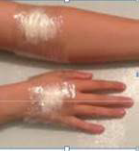
It may be necessary to apply the cream to the top of the feet if there have been difficulties obtaining blood in the past.
We recommend that you do not leave the cream on for longer than the suggested time as this gives no further benefit. Cream should NOT be applied to broken skin or wounds, or if the child has active eczema.
Please do not let your child lick the cream. If this happens, encourage them to drink plenty of water and call 111 if you are concerned that they have swallowed a large amount.
Approved creams
| Blood Test | Cannula | Number of tubes allowed (max) |
|
| Ametop | 30minutes | 40minutes | 1 tube under 5years 5 tubes over 5years |
| LMX4 | 30minutes | 60minutes | 1g tube under 1year Up to 2.5g over 1year |
| EMLA/ Nulbia |
60minutes | 60minutes | 1 tube under 5 years 2 tubes over 5 years |
Where and how to apply the cream
- Apply a pea-sized amount of cream to the back of both hands and inside of the elbow in the crease. DO NOT RUB IN.
- Cover with the dressing supplied. If you do not have a dressing, wrap 3 layers of cling film around the areas, ensure the cream is covered.
- See table above for the suggested time the cream needs to be in place. Please do this before coming to the hospital as it will delay other patients if applied at appointment time, and you may be asked to re-book.
- After the suggested application time, your nurse will remove the dressing and cream and will locate the best spot to take blood or insert cannula.
- Cream should not be left on for longer that the stated time as this can cause irritation and will have no benefit to the procedure.
- The areas will remain numb for up to 4 hours.
Contact us
If you have any queries relating to this information, please contact the Paediatrics service.
About this information
Service:
Paediatrics
Reference:
P/074
Approval date:
1 June 2026
Review date:
1 June 2029
Click ‘show accessibility tools’ at the bottom of the page

Then click ‘select language’

Alternative formats
You can use the accessibility toolbar at the bottom of your screen to:
-
Change the text size
-
Adjust the font
-
Modify the colour contrast
-
Use the translate function
If you would like this information in another format, such as Braille, audio, or easy read, please speak to a member of staff.
You can also print as well as download as PDF using the “Print this page” button at the end of the page.
Staff will print a copy for you on request
Important note
This page provides general information only. It is developed by clinical staff and is reviewed regularly every 3 years for accuracy. For personal advice about your health, or if you have any concerns, please speak to your doctor.