

Advice after your nerve block for surgery
On this page…
Categories:
What are varicose veins?
Veins are the vessels that carry blood back to the heart. Varicose veins are visible just below the surface of the skin. In the leg there are deep veins which carry the majority of the blood back up the leg to the heart and superficial veins which drain blood from the skin and connect with the deep veins at various points in the leg.
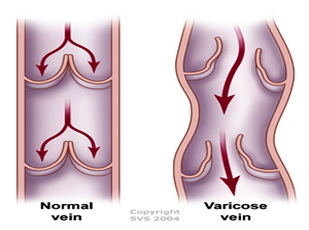
Veins become varicosed due to a fault in the one-way valve in the superficial veins. Instead of allowing blood to flow up the leg in these veins, the valves leak; and this backward flow down the veins leads to increased pressure. This causes them to swell and become varicosed. The fault with the valve is often inherited so varicose veins tend to ‘run in families’.
Diagram of varicose veins
The treatment
We are not currently permitted to operate on varicose veins unless you have complications arising from the veins. Complications include of varicose veins may include:
Recurring phlebitis
Phlebitis is when the veins become hot and tender and the colour of the surrounding skin changes.
Eczema
In some cases the varicose veins irritate the surrounding skin, making it dry and flaky
Ulceration
Sometimes the varicose veins cause an ulceration to the skin around the ankle. Early signs of ulceration may be a brawny staining of the skin.
The most common operation to deal with your veins is called a long saphenous vein strip. Sometimes your veins may be suitable for laser treatment (please see a separate leaflet). Your surgeon or specialist nurse will discuss your options with you.
If you are considered a candidate for intervention your GP may have to make an individual funding request (IFR). This will be discussed at your clinic appointment.
What is Endovenous treatment?
Endovenous treatment is a minimally invasive way of treating varicose veins.
What are the advantages of endovenous treatment compared to conventional varicose vein surgery?
- Endovenous treatment can be performed with a local anaesthetic as a day case, taking about 45 minutes on average for each leg.
- Patients often feel less pain and discomfort following endovenous treatment.
- A groin crease wound is avoided with endovenous treatment, thus there is a lower risk of wound infection.
- Skin numbness is less common with endovenous treatment compared with conventional varicose vein surgery.
- Following Endovenous treatment , the recurrence rates for varicose veins are lower (1 to 3%) compared to conventional varicose vein surgery.
- Patients can resume normal activity faster with Endovenous treatment compared with conventional open surgery. Many return to work the following day.
What are the risks associated with endovenous treatment?
Patients undergoing endovenous treatment have a small risk of thermal injury, e.g., minor skin burns; thrombophlebitis (painful and inflammatory thigh veins); blood clots in the leg veins, e.g., deep venous thrombosis (DVT); patchy skin numbness or a dull aching sensation due to nerve injuries and minor skin wound infections.
What can I expect after endovenous treatment?
Lower thigh discomfort is typically most prominent 5-7 days following surgery. It is not unusual for patients to experience some degree of mild discomfort for the first week following treatment which can often feel worse in the second week.
The other common symptoms following treatment include the following:
- Skin lumpiness is the result of small amounts of left over blood underneath the skin where the varicose veins used to be. These can feel hard and tender in the first 4 weeks. They take about 3 months to clear up completely.
- Skin bruising and swelling occurs in about one in twenty patients. This is a common side effect of Endovenous treatment and can persist for up to 6 weeks following your operation.
- Minor bleeding sometimes occurs following endovenous treatment and avulsions. This will usually stop with pressure on the wound and leg elevation for about 10 minutes. If bleeding continues, please phone your GP.
- Skin numbness (1 in 100 patients) can occur if the nerve supply to the skin is injured during the procedure. This numbness can take several months to resolve.
- Varicose veins can recur in about 3 to 5% of patients following endovenous treatment. The options are to try again with further endovenous treatment or to leave alone.
How should the compression stockings be worn following endovenous treatment?
Patients should wear a short stocking on the operated leg for the first week. Thereafter a stocking is no longer required. Should you wish to wear a stocking for longer or are in a position where you stand for long periods of time then you can continue to wear the stocking for 2-4 weeks.
What can I do at home after endovenous treatment?
After treatment, patients are advised to walk around for 15 minutes, have a drink and then go home. At home, it is important that the leg treated is elevated whenever the patient is able to sit down to rest.
Patients should not be driving for the first two weeks following endovenous treatment. Patients who wish to drive earlier should sit in a stationary vehicle and practise the emergency brake procedure. If their leg still hurts, it is safer to wait until the pain clears up altogether.
There should be no stitches to remove after treatment. Normal activity, including work, can be resumed as soon as patients feel comfortable to do so.
What are the different types of endovenous treatment?
There are different methods of sealing your vein. Your consultant will discuss your individual treatment with your at your clinic appointment.
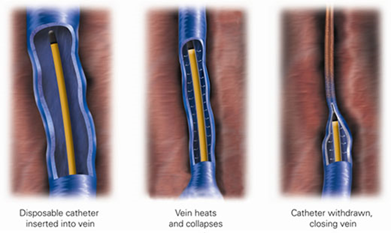
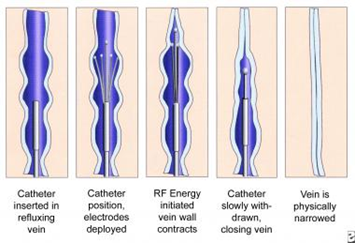
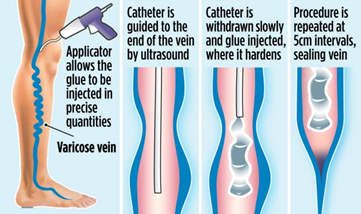
The following diagrams show the different procedures:
Laser ablation
Radiofrequency ablation
Glue
Advice and Guidance
| Bathing | No bathing for two weeks post treatment. |
| Showering | Please wait 48 hours before having a shower post treatment. |
| Working | Please discuss this with your consultant prior to having your treatment. |
| Driving | You should not drive for at least 2 weeks post treatment. After that you need to be able to safely do an emergency stop and a hill start before you can drive. It is also advisable to check with your insurance company. |
| Flying | You will not be able to fly for 4 weeks after your treatment. |
| Sporting Activities | You may exercise as you feel able, it will not have a detrimental effect on your recovery. |
| Contraceptive Pill & HRT | On discussion with your consultant it may be advised you must stop taking the contraceptive pill or HRT for up to 4 weeks before and after your treatment. If this applies to you, please ensure you are using alternative contraceptive methods. |
| If you take supplements such as garlic or ginseng please ensure you tell your consultant about these prior to your treatment as you may be at an increased risk of bleeding. | |
Contact Details
Secretaries at Frimley Park
Mr D J Gerrard & Mr N Dastur: 01276 604772
Mr K Jones & Mr M Cleanthis: 01276 604291
Mr P F S Chong & Mr A Bajwa: 01276 522141
North Hants Hospital Secretary: 01256 313569
Wexham Park Hospital Secretary: 01753 633450
Vascular Specialist Nurses
Claire Martin
Tracey Craig
Andrea Croucher
Katie Fitzcosta
Jean Nixon
01276 526302
or 01276 604604 and ask for bleep 407 / 452 (Frimley Park)
01753 633910 (Wexham Park)
Contact us
If you have any queries relating to this information, please contact the Vascular surgery service.
About this information
Service:
Vascular surgery
Reference:
Y/039
Approval date:
16 August 2018
Review date:
1 April 2021
Click ‘show accessibility tools’ at the bottom of the page

Then click ‘select language’

Alternative formats
You can use the accessibility toolbar at the bottom of your screen to:
-
Change the text size
-
Adjust the font
-
Modify the colour contrast
-
Use the translate function
If you would like this information in another format, such as Braille, audio, or easy read, please speak to a member of staff.
You can also print as well as download as PDF using the “Print this page” button at the end of the page.
Staff will print a copy for you on request
Important note
This page provides general information only. It is developed by clinical staff and is reviewed regularly every 3 years for accuracy. For personal advice about your health, or if you have any concerns, please speak to your doctor.