


Advice after your nerve block for surgery
On this page…
What is asthma?
Asthma is a condition that affects the lungs. The tubes in the lungs can become narrow and inflamed (swollen) and this makes it harder to breathe. When children come into contact with an ‘asthma trigger’, their lungs may react by the muscles around the airways tightening, the lining swells and thick mucus can build up inside the airways. Children with asthma may have a tight chest, a dry cough, difficulty taking in a full breath or wheeze (a high-pitched whistling sound when they breathe out).
How is asthma treated?
Asthma can and should be well controlled in order for children to live a happy, healthy life.
Preventer inhalers:
This treatment must be taken every day even when you/your child is well. Preventer inhalers contain steroids which reduce inflammation in the airway and prevent episodes of asthma. Another type of preventer inhaler is a combination inhaler. This contains a steroid and a long-acting reliever to help reduce inflammation and keep the airways open for longer.
Add on preventer treatments:
Montelukast helps to control inflammation and is taken once a day. You may be given a chewable tablet or granules. The granules can be mixed with soft food such as yoghurt.
Reliever inhalers:
Reliever inhalers are usually blue (Salbutamol) however, in some cases your combination inhaler may be used as a reliever inhaler (Symbicort) as part of a maintenance and reliever (MART) regime or anti-inflammatory reliever (AIR) regime. This should be used only when needed and you/your child has symptoms of asthma (wheeze, difficulty breathing, tight chest or when coughing).
The reliever inhaler helps to relax the muscles around the airways and help you/your child breathe. Needing your reliever inhaler regularly is a sign asthma is not well controlled and you/your child should seek a medical review.
How do I use my inhaler?
A spacer device should be used with a pressurized metered-dose inhaler no matter how old you are.
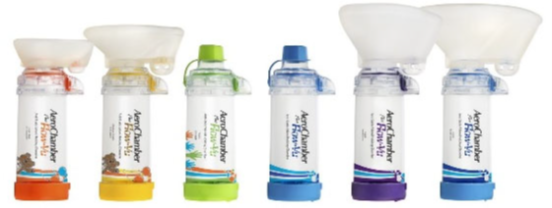
- Shake the inhaler and remove the cap
- Insert inhaler into the open end of the spacer
- Ensure you have a good seal with the mask or around the mouthpiece. Tip: you should see the valve moving with no whistling
- Hold spacer upright and press the inhaler once, followed by 5 slow breaths or count to 10 seconds (watch the valve move forward/back with each breath)
- Return to step one and repeat for each puff of inhaler as needed
Mask spacers are usually not required over the age of 4. Spacers should be cleaned monthly and replaced annually. Please provide a spacer to your school at the start of the Autumn term.
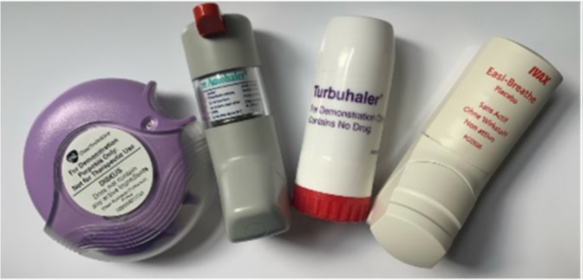
Some inhalers do not require a spacer (see photo left to right: Accuhaler, Easyhaler, Turbohaler, Easi-Breathe). These are used in older children, and you should be assessed before these are prescribed to you.
If you do not know how to use your inhaler or need help, please contact your GP, asthma nurse or pharmacist. Alternatively, visit Asthma & Lung UK for video resources https://
GET AN ASTHMA ACTION PLAN IN PLACE
Having a written personalised asthma action plan makes it four times less likely you will go to hospital due to your asthma.
UNDERSTAND HOW TO USE INHALERS CORRECTLY
Poor inhaler technique is a key indicator for poor asthma control. Knowing how to use you/your child’s inhaler means more of your medication will get into your lungs. Always remember to rinse out you/your child’s mouth after using a steroid inhaler.
SCHEDULE AN ASTHMA REVIEW
Having an asthma review with a trained professional annually and after every attack helps to work out what went wrong and you/your child’s asthma management plan can be adjusted.
CONSIDER AIR POLLUTION & IMPACT ON LUNG HEALTH
Did you know you can recycle your used inhalers? Please return to your local pharmacy for them to dispose
If you would like to learn more about asthma, please visit Frimley Healthier Together: http://

Post attack/discharge plan
|
You/your child should take the preventer medication as prescribed. Regularly record your peak flow readings if you have been trained to do so. |
| Look out for signs of wheeze, chest tightness, shortness of breath, coughing or difficulty breathing. |
| If you/your child has asthma symptoms, take 2 puffs of the blue inhaler via the spacer. Wait 2 minutes and repeat if necessary until you have given 6 puffs. |
|
You/your child should feel better after a few minutes and these effects should last 4 hours. If you/your child do not feel better, Please refer below immediately.
|
|
If you/your child:
They are not getting better, and you need to take action now:
If your child is continuing to need 10 puffs of the blue inhaler every 4 hours, you should get a more urgent review (within the next few hours). If your child is having difficulty breathing not relieved by 10 puffs of salbutamol or needs 10 puffs more often than every 4 hours, You should call 999 and if the ambulance has not arrived within 10 minutes, repeat step 1. If after repeating step 1 you/your child’s symptoms have not improved, call 999 again immediately to update. |
Post attack/discharge plan MART inhalers
If you/your child are prescribed a MART inhaler, you should take your maintenance dose as normal. Please ensure the steroid course is finished.
Are asthma symptoms present? (Chest tightness, shortness of breath, coughing or difficulty breathing) -
If you/your child feels well, no action is needed but keep monitoring for asthma symptoms
If you/your child has asthma symptoms, take 1 inhalation of the inhaler. Wait 10 minutes and repeat up to the maximum advised doses at a single time. The effects should last 4 hours. Your asthma plan will advise the maximum total inhalations in can take in a 24 hour period. Do not exceed this.
If the maximum inhalations at a single time do not relieve symptoms or you have taken the maximum total daily inhalations and it is not controlling symptoms or you are concerned get urgent medical help or call 999
You/your child should start to feel better after 2 days and be needing your inhaler less often or be going longer between doses.
After an attack, we advise a review with your GP within 48 hours (or the next working day) to ensure the attack is over and is an opportunity to identify how to prevent this happening again.
Contact us
If you have any queries relating to this information, please contact the Paediatrics service.
About this information
Service:
Paediatrics
Reference:
P/076
Approval date:
30 June 2026
Review date:
1 June 2029
Click ‘show accessibility tools’ at the bottom of the page

Then click ‘select language’

Alternative formats
You can use the accessibility toolbar at the bottom of your screen to:
-
Change the text size
-
Adjust the font
-
Modify the colour contrast
-
Use the translate function
If you would like this information in another format, such as Braille, audio, or easy read, please speak to a member of staff.
You can also print as well as download as PDF using the “Print this page” button at the end of the page.
Staff will print a copy for you on request
Important note
This page provides general information only. It is developed by clinical staff and is reviewed regularly every 3 years for accuracy. For personal advice about your health, or if you have any concerns, please speak to your doctor.