

Advice after your nerve block for surgery
On this page…
Introduction
Following a ‘Mediterranean style’ diet can keep your heart healthy.
It consists of lots of vegetables, fruits, cereals, beans and wholegrain foods. It also includes moderate amounts of fish, white meat and low-fat dairy foods.
Unsaturated fats such as olive oil are used instead of butter/lard/ghee.
Try to:
- Eat a wide variety of foods
- Where you include fats in your diet, choose healthy fats including monounsaturated, polyunsaturated and omega 3 fatty acids
- Reduce your intake of saturated fats
- Eat high fibre or whole grain, starchy foods e.g. wholegrain breads, rice, pasta, potatoes
- Eat lots of fruit, vegetables and salads - aim for at least five servings per day
- Reduce your salt intake by avoiding table salt (sodium chloride), salty foods and many convenience foods
- Reduce your intake of sugar and sugary foods
- Keep alcohol intake within recommended limits
- Be active - try to make time to do at least 30 minutes of exercise per day
- Quit smoking - smoking is one of the greatest risk factors for heart disease
- Achieve and maintain a healthy weight
Do I Need to Lose Weight?
Body mass index (BMI) can be used to work out which four categories you fall into to - underweight, ideal weight, overweight or obese. You can calculate BMI using your height and weight. If you are overweight or obese you are at an increased risk of various health conditions, including heart disease. You can help to reduce your risk and manage existing health problems by losing and maintaining a healthy weight.
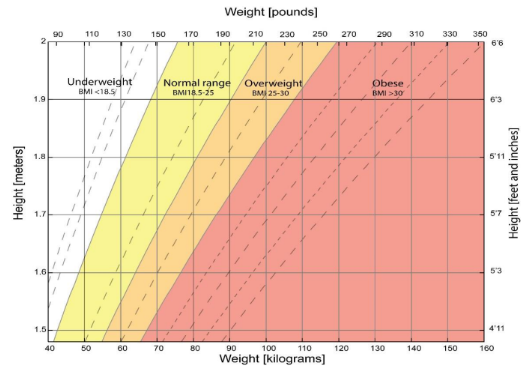
Tip:
To work out your BMI:
- Find your weight along the top or bottom of the above chart, then follow the line straight up or down to find your height on the left or right
- Mark where the two lines meet and this will show you which BMI category you are in
Waist Circumference
In addition to checking BMI, it is also important to measure your waist circumference. Fat around your middle can increase your risk of heart disease.
To check your waist circumference, find the bottom of your ribs and top of your hips and measure around your middle at the midpoint between these.
| Increased Risk | Severe Risk | |
| Men (White European) | Over 94cm (37”) | Over 102cm (40”) |
| Men (African-Caribbean, South Asian and some other minority ethnic groups) |
- | Over 90cm (35.5”) |
| Women (White European) | Over 80cm (32”) | Over 88cm (35”) |
| Women (African-Caribbean, South Asian and some other minority ethnic groups) |
- | Over 80cm (32”) |
Weight Loss Goals
If your BMI and waist circumference show you are at an increased risk and/or are overweight, making small changes can help you to lose weight.
5-10% weight loss off your current body weight can significantly benefit overall health. It is important to set realistic goals and targets, so starting with 5-10% weight loss over 3-6 months is a great way to do this.
Once you have achieved this initial weight loss, you can always reset your target to lose another 5-10% off your new weight until you achieve a healthy weight.
Targets
- To work out 5% weight loss, divide your weight by 20
- To work out 10% weight loss, divide your weight by 10
Benefits of 10% Weight Loss
- Lowers blood pressure and cholesterol levels reducing your risk of coronary heart disease and stroke
- Reduces risk of diabetes or improves control of diabetes
- Increases mobility, reduce breathlessness
- Reduces strain on joints and improve back/joint pain
- Improves mood and self esteem
Ways to Lose Weight and Eat Healthier for a Healthy Heart
Following a low-fat diet helps to reduce your risk of heart disease. This is especially important if you have high levels of cholesterol in your blood and/or have to lose weight, fat is the most calorie dense part of the food that we eat.
Cholesterol
Cholesterol is found naturally in the body. It is a type of fat produced by the liver and circulates in the blood. High blood cholesterol is one of the most important risk factors for heart disease. Blood cholesterol levels are influenced by the amount of fat in your diet, especially saturated fat and there are two types of cholesterol:
- High Density Lipoprotein (HDL) which transports excess cholesterol from the blood to the liver for excretion: a ‘good’ cholesterol
- Low Density Lipoprotein (LDL) transports cholesterol from the liver to the blood: a ‘bad’ cholesterol
Medication will help to lower your cholesterol level, but by changing to a healthier lifestyle including diet, the risk of heart disease may be reduced.
What About Eggs and Cholesterol?
Eggs do contain cholesterol, but it is a myth that they raise your blood cholesterol. Too many fried eggs and cheesy omelettes may raise your cholesterol, but it is the added fat from frying or the addition of cheese which is high in saturated fats. Healthier alternatives would be poached eggs or a cheese omelette using reduced fat cheese.
Fats to Avoid
Saturated Fat
Saturated fats can lead to an increase in LDL cholesterol. These are mainly found in animal sources such as fat in and on meat, cheese, butter, cream, lard, dripping, ghee, coconut oil and palm oil.
Trans Fats
Trans fats occur naturally in small amounts in dairy foods and meats but are mainly produced when food companies turn various vegetable and animal oils into solid fat.
The final product of this process is called hydrogenated fat or hydrogenated vegetable oil. Trans fats can be found in foods such as cakes, pastries, biscuits and deep-fried foods.
These fats can lead to an increase in LDL cholesterol and a decrease in HDL cholesterol.
Trans fats are not always listed on ingredient lists of foods; however, hydrogenated fat/vegetable oil is usually declared on the ingredient list. Most food manufacturers avoid using trans fats now.
Fats to Have in Small Amounts
Unsaturated Fats
Unsaturated fats are generally liquid or soft at room temperature and are mainly found in plant sources. They can be used in small quantities in place of saturated fats to help lower cholesterol levels; there are different types of unsaturated fats:
- Monounsaturated Fats (MUFA’s): Olive, rapeseed (canola), peanut and walnut oils and spreads are good sources of MUFA’s. Nuts, including almonds, Brazil nuts, hazelnuts and walnuts are also good sources, as are avocados. MUFA’s are thought to lower both total and LDL cholesterol, whilst maintaining HDL cholesterol. Try choosing a reduced fat spread if you are trying to lose weight.
- Polyunsaturated Fats (PUFA’s): Sunflower, sesame, soya and corn oils and spreads, are all good sources of PUFA’s. Omega-3 fatty acids are also a type of PUFA and are found in oily fish such as tuna (fresh, not tinned), salmon, pilchards, sardines, mackerel, herring and anchovies.
As part of a healthy diet, fish should be included at least twice a week; one of these should be an oily fish. PUFA’s are thought to lower both total and LDL cholesterol. Omega-3’s are thought to help reduce blood clots and decrease levels of total cholesterol and help regulate the heart rhythm.
Try to Eat Less Fat
| If you have | Alternatives |
| Fried foods | Grill, bake or steam foods instead. If you use oil in cooking, measure with a teaspoon or use a spray oil |
| Butter/margarine/spread | Use lower fat products. Use less and spread thinly. When choosing a spread, margarine or oil, it is important to find a product that contains monounsaturated and polyunsaturated fats instead of saturated fats |
| Chips/roast potatoes | Have boiled, mashed or jacket potatoes Use lower fat oven chips occasionally |
| Fatty meat/meat products | Buy lean cuts of meat Remove skin and visible fat from meat Avoid processed meats like sausages and bacon |
| Milk, cheese and yogurt | Semi-skimmed or skimmed milk. Grate cheese for cooking so that less is used and use a cheese with a strong flavour. Try the lower fat varieties e.g. Edam, half fat cheddar or cottage cheese, Ricotta Use a low-fat natural yoghurt, fromage frais |
TIP:
- If a product is labelled as ‘low fat’ or ‘fat ‘free’ do not assume these are the healthiest option. Many of these products have lots of sugar added to make up the flavour
- Opt for a low fat and low sugar option by checking the food label (see page following pages)
Fibre
Foods high in certain types of fibre have been shown to help lower cholesterol. They are generally low in fat and are filling, therefore eating these foods makes controlling your weight easier. There are two types of fibre in our diet:
- Insoluble fibre, which is found in wholegrain cereals, fruit and vegetables, may help to keep your bowels healthy and functioning and prevent constipation
- Soluble fibre, which is found in oats (porridge and oatbran cereals), pulses (peas, beans and lentils) and fruit and vegetables, may help to reduce the amount of cholesterol in the blood by binding to the cholesterol in the stomach and therefore preventing it from being absorbed into the blood
Ways to Increase Fibre
- Choose wholemeal or granary bread
- Select high fibre cereals e.g. Shredded Wheat, All Bran, bran flakes, porridge
- Try potatoes cooked in their skins
- Substitute some of the meat in stews and casseroles with vegetables and pulses e.g. beans, lentils
- Replace half of the white flour with wholemeal flour when baking
Read the Label
High fibre: >3g fibre/100g product
Low fibre: <0.5g fibre/100g product
Aim to eat 30g of fibre per day. If your present diet is low in fibre, increase your intake gradually. Whilst increasing your fibre intake aim to drink 8-10 cups of fluid a day.
Fruit and Vegetables
Fruit and vegetables are good sources of fibre. They are also high in vitamins A, C and E and beta-carotene, which are known as ‘antioxidant vitamins.’ These help to protect against heart disease.
Folate has also been found to protect the heart by decreasing a substance in the blood called homocysteine. Folate is abundant in fruit and vegetables (especially green leafy vegetables and strawberries). Aim to eat at least five portions of a mixture of fruit and vegetables (fresh, frozen, tinned, juiced, or tinned).
One portion of fruit and/or vegetables can be:
- 1 small glass of fruit juice
- 1 apple, 1 orange, 1 banana
- 1 slice of pineapple or melon
- 2 plums, 2 apricots, 2 satsumas
- 1 cupful of raspberries, strawberries or grapes
- 2-3 tablespoons of fruit salad (fresh, frozen or tinned)
- 1 tablespoon of dried fruit e.g. raisins
- 2 tablespoons of cooked vegetables (fresh, frozen or tinned)
- 1 cereal bowl of mixed salad leaves
Practical ideas to increase intake:
- Minimum of two vegetable portions with main meal
- Make a smoothie by blending your favourite fruits with fruit juice or low-fat yogurt
- Dried fruit or sliced fresh fruit on cereal
- Small salad with snack meal
- Glass of fruit juice with breakfast
- Vegetable soup
- Fruit as snacks between meals
How Can I Use Less Salt?
A high intake of salt may raise your blood pressure, so it is sensible to use
less salt.
Tip: SALT = (Sodium) x 2.5
The recommended maximum amount of salt for adults per day is 6g salt (1 teaspoon). However, 75% of this is already added to the foods we eat e.g. soups, sauces, savoury snacks, breads, breakfast cereals or pizza. Some food labels refer to sodium instead of salt however, you can use the tip above to work out how much salt is in the foods you eat. Reduced salt alternatives may not be suitable for people with kidney problems or heart failure. Please check with your doctor before using them.
Tips for reducing your salt intake:
- Avoid adding salt at the table and in your cooking - your taste buds will adapt
- Make sauces and gravies with low salt stock cubes, soy sauce or jerk spices
- Cut down salt gradually so that you can get used to the taste change
- Adding herbs and spices instead can help
- Eat more fresh or unprocessed foods
- Use salt sparingly in cooking. If you steam or microwave vegetables, you will probably find that you do not need to add salt
- Use fresh or frozen vegetables rather than vegetables tinned in brine
- Cut down on processed foods such as salty meats, crisps, salted nuts, salty ‘take-aways’ and ‘ready meals’
- Use lemon, garlic, ginger or chilli to flavour your food
Food Labelling
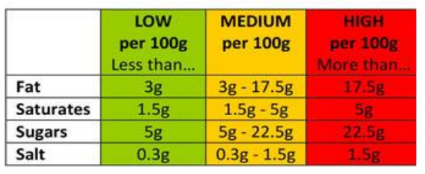
Most foods have nutritional information printed on the label. Find the ‘per 100g’ column and then compare them with the figures shown below.
Portion Sizes
A guide to help you remember your portion sizes:
- Meat and fish - a serving of meat or fish should be the size of a deck of cards
- Cooked starchy foods (rice, pasta) - a serving of cooked rice or pasta should be the size of a tennis ball
- Potato (baked or mashed) - a serving of potato should be approximately the size of a computer mouse
- Cheese - a serving of cheese should be about the size of a matchbox
- Nuts or pretzels - a serving of nuts/pretzels should be about a handful
- Oil - a serving is roughly the size of a thumbnail
Alcohol
There may be some benefit to your heart health from moderate drinking (1-2 units per day). However, this is not a reason to start drinking alcohol if you don’t already. There are healthier ways to protect your heart, such as doing more exercise and stopping smoking.
It is important to remember that alcohol has a high calorie content and is important to consider if you’re trying to lose weight. It can also lead to high blood pressure, damage to your heart muscle and abnormal heart rhythms.
The recommended intake is no more than 2-3 units of alcohol per day for women and 3-4 units for men. It is also important to have two alcohol free days during the week.
How do I know how Many Units of Alcohol are in My Drink?
One unit is:
- ½ pint normal strength beer/lager or ⅓ pint strong beer/lager
- 1 small glass of wine
- 1 single measure of spirit
- 1 single measure sherry
Most bottles now state the amount of units of alcohol in the drink but if you are unsure, you can multiply the volume of the drink in ml by the ABV% figure and then divide the result by 1000.
For example, a 300ml bottle of beer of 5% ABV = 300 x 5 ÷ 1000 = 1.5 units of alcohol
TIP:
Use the British Heart Foundation’s online alcohol calculator to work out how many units you drink at www.
Physical Activity
It is recommended that we do 2.5 hours exercise of moderate intensity per week (NICE, 2013). This can be split up into:
- 30 minutes moderate activity five days per week
- This can be split into three 10-minute sessions
Check with your GP before you start any new type of exercise regimen
Methods to increase Activity
- Walk instead of drive for short journeys
- Take the stairs instead of the lift or escalator
- Take a short walk during your lunch break
- Park further away from the supermarket entrance so that you have a further walk
- Get off the bus a stop earlier than you need and walk the last part of your journey
- Walk up and down the stairs during television advertisement breaks
| Suitable Foods | Foods to Have in Moderation | Foods to Avoid |
|
Dairy Products Skimmed and semi-skimmed milk, skimmed milk powder, soya milk, fat-free and low-fat natural and fruit yoghurt, low fat fromage frais, fat-free and low-fat cottage cheese |
Half fat hard cheeses, low fat soft cheese e.g. Philadelphia Light, low-fat cheese spreads, half-fat crème fraîche, Ricotta | Full fat (whole) milk, full fat yoghurts, Greek style yoghurt, condensed and evaporated milk, full fat milk powder, coffee creamers, cream, and artificial creams, ice cream, full-fat hard cheese, full-fat cream cheese, Mascarpone, crème fraîche |
|
Fats and Oils Unsaturated low-fat spreads, e.g. Flora Extra Light, Olivio |
Vegetable oils and margarines e.g. sunflower, corn, rapeseed (canola), olive, walnut, groundnut, sesame; low fat spreads; soft margarine |
Butter, lard, dripping, vegetable margarine, blended or hydrogenated vegetable oils and palm and coconut oils, coconut cream |
|
Eggs Poached, boiled and scrambled (without using butter) |
----- | Fried in butter or vegetable margarine |
|
Drinks Tea, coffee, no added sugar squashes, diet fizzy drinks, soda water, mineral water, fruit juices (100%) |
Milky drinks made with low-fat milk, reduced-fat chocolate drinks. | Vending machine drinks, instant milky drinks, hot chocolate, fizzy drinks, full fat milk |
|
Fish White and oily fish e.g. mackerel, sardines, herring, trout, salmon. Fresh, frozen or tinned fish, fish fingers (grilled), molluscs e.g. oysters, mussels |
Battered fish (frozen or take-away), fish pâté, fried fish | Battered fish (frozen or take-away), fish pâté, fried fish |
|
Meat and Alternatives Chicken and turkey (without skin), venison, rabbit, veal, textured vegetable protein (e.g. soya mince), tofu, quorn |
Lean meats e.g. ham, pork (trimmed), beef, lamb, lean bacon (back/middle), lean mince, offal (liver, kidney, heart, sweetbread), corned beef, meat pastes | Visible fat on meat, crackling, pâté, salami, luncheon meat, sausages (including low-fat varieties), duck, goose, streaky bacon, belly of pork, meat pies and pasties, pork pies, haggis, black pudding, beef burgers (including low fat varieties), poultry skin |
|
Bread and Cereals Wholemeal breads and |
White or brown breads and rolls; sugary breakfast cereals e.g. Frosties, Coco and Strawberry Pops, Shreddies, Alpen Original; white rice; white pasta |
Fancy breads e.g. croissants, brioches, ciabatta; toasted muesli; fried rice |
|
Pastries and Puddings Tinned/packet/homemade skimmed milk puddings and custard, sugar-free |
Reduced fat ice cream e.g. Weight Watchers, homemade pastries and puddings using suitable fats |
Shop bought pastries, puddings and desserts |
|
Fruit and Vegetables Fresh, frozen or tinned fruit (in natural juices) and vegetables; pulses e.g. lentils, kidney beans, butter beans, chickpeas, split peas |
Low-fat oven chips, avocado pears, olives, hummus; chips or roast potatoes cooked in suitable oil |
Crumbed, creamed and au gratin vegetables, chips or roast potatoes cooked in unsuitable oil or fat |
Snack Meal Ideas
- Soup e.g. lentil, split pea, vegetable with wholemeal bread
- Jacket potato, wholemeal sandwich or roll filled with:
- tuna and low-calorie salad cream/mayonnaise
- cottage cheese with various flavours
- wafer thin meats
- Sardines on toast
- Baked beans on toast
- Pasta or bean salad
Main Meal Ideas
- Lean roast meats, casserole and stews
- Shepherd’s pie or cottage pie with extra vegetables
- Pasta with tomato and vegetable sauce
- Spaghetti Bolognese made with lots of vegetables
- Chilli con carne with rice and salad
- Vegetable or bean curry with rice
- Fish and potato pie
- Mackerel fillet with potatoes and vegetables
Dessert Ideas
- Tinned, packet or homemade skimmed milk puddings or low-fat custard with fruit
- Low-fat yoghurt or fromage frais
- Jelly, meringues, sorbet or low-fat ice cream
Useful Websites
British Heart Foundation
http:/
Healthy Eating—NHS Choices
http://
Contact us
If you have any queries relating to this information, please contact the Dietetics service.
About this information
Service:
Dietetics
Reference:
DT/002
Approval date:
31 August 2025
Review date:
30 August 2028
Click ‘show accessibility tools’ at the bottom of the page

Then click ‘select language’

Alternative formats
You can use the accessibility toolbar at the bottom of your screen to:
-
Change the text size
-
Adjust the font
-
Modify the colour contrast
-
Use the translate function
If you would like this information in another format, such as Braille, audio, or easy read, please speak to a member of staff.
You can also print as well as download as PDF using the “Print this page” button at the end of the page.
Staff will print a copy for you on request
Important note
This page provides general information only. It is developed by clinical staff and is reviewed regularly every 3 years for accuracy. For personal advice about your health, or if you have any concerns, please speak to your doctor.