

Advice after your nerve block for surgery
On this page…
What is Diabetes?
Diabetes is a health condition where the body has trouble controlling the amount of glucose (a type of sugar) in the blood.
When we eat foods that contain carbohydrates (like bread, pasta, fruit, or sugary foods), our body turns them into glucose. We all need glucose because it gives us energy.
The pancreas, an organ in the body, makes a hormone called insulin. Insulin helps move glucose from the blood into the body’s cells, where it can be used for energy.
If someone has diabetes, one of these things may happen:
- Their pancreas doesn’t make enough insulin.
- The insulin they make doesn’t work properly.
- Their pancreas stops making insulin completely.
When this happens, glucose builds up in the blood. If blood glucose stays high for a long time, it can cause damage to different parts of the body. Diabetes is a serious condition, but keeping blood glucose levels under control can help prevent problems.
People with diabetes also have a higher chance of getting heart disease. Eating a healthy diet can help lower blood pressure, cholesterol, and fats in the blood, which reduces this risk.
If you want to learn more about diabetes, ask your healthcare team at your doctor’s surgery. They can tell you about local education courses that can help you understand and manage diabetes.
How is Diabetes Controlled?
- Diet only
- Diet and tablets
- Diet and insulin, with or without tablets
If you are overweight it is more difficult to control diabetes, so try to reach and maintain a sensible weight.
Steps to Healthy Living with Diabetes
- Try to reach or stay at a healthy weight.
- Be active. Exercise helps your body use insulin better and can help with weight. Try to be active for 30 minutes, five times a week (like walking, cycling, swimming, gardening, or sports). You can split this up during the day. Doing muscle-strengthening activities twice a week is also helpful.
- Eat regular meals. Include some starchy foods at each meal, such as bread, potatoes, pasta, rice, or cereals. Choose wholegrain versions when you can.
- Eat less fat. Try to swap saturated fats (like butter or fatty meat) for unsaturated fats (like olive oil, nuts, seeds, and oily fish).
- Have fewer sugary foods and drinks.
- Eat more fruit and vegetables. Aim for at least five portions a day.
- Use less salt in your food.
- Drink alcohol only in moderation (if you drink alcohol).
- Stop smoking.
- Take your medication as prescribed and go to all your regular diabetes check-ups.
Balancing Your Diet
Everyone needs a balanced diet to stay healthy. This is extra important if you have diabetes.
Some people with diabetes check their blood glucose before and after meals to see how their body reacts to different foods. This can be helpful, but it is not always needed if your diabetes is controlled by diet alone or by Metformin.
| One portion is equivalent to | |
|
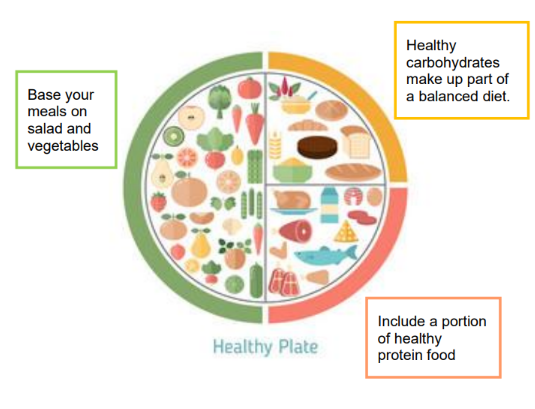
Starchy carbohydrate foods Starchy foods contain 5-14 portions per day If you are trying to lose weight, aim You would only need to consume |
|
|
Fruit and Vegetables 5 portions a day (at least) from a mixture of fruit, vegetables and salad |
|
|
Dairy Products 2-3 portions of dairy products per day Dairy products contain calcium which is important for bone and |
|
| Meat, Fish, Eggs and Pulses |
|
Check your plate at your next meal and see if you have a healthy balance.
What are the Benefits of Weight Loss?
If you are overweight, losing some weight can help you manage your diabetes better and lower your risk of heart disease. Even losing 10% of your body weight can make a big difference. It can help to:
- lower your blood pressure
- reduce certain fats in your blood
- help your body use insulin better
Setting a Goal
It’s helpful to set a clear weight-loss goal and talk about it with a healthcare professional. For example: If you weigh 95kg (15 stone), losing 9.5kg (21lbs) could improve your health.
How Fast Should You Lose Weight?
A safe and realistic amount of weight to lose is:
- 1–2 lbs (0.5–1kg) a week
To lose this amount, you usually need to eat about 600 fewer calories each day than your body normally needs. Being more active will also help you burn more calories and lose weight more effectively.
Choosing the Right Eating Plan
There are many ways to lose weight. Research shows that the best plan is the one you can stick to. Small, realistic changes are more likely to work in the long term. Try to make a plan that:
- you enjoy
- fits with your daily life
- feels manageable
People who write down their goals are more likely to reach them.
Making Changes
Complete the action plan table at the end of this booklet
Why do I Need to Eat Less Sugar?
Naturally occurring sources of sugar, such as those found in fruit and milk should be included as part of a healthy diet as these foods are nutritious.
Added sugar e.g. table sugar, is found in foods such as confectionery, cakes and biscuits. Reducing the amount of these foods in your diet is sensible for several reasons:
- These foods are a poor source of essential nutrients, and are frequently high in calories and fat
- Some very sugary foods, especially sugary drinks, can cause sudden rises in blood glucose levels
Low Calorie Sweeteners
If you like your food or drinks to taste sweet, you can use low-calorie sweeteners. These sweeteners do not raise your blood glucose. They come in three types:
- Tablets – good for adding to hot drinks.
- Liquid sweeteners – useful for things like custard or sauces.
- Powder sweeteners – can be sprinkled on cereals.
Some sweeteners do not work well with heat, so it’s best to add them after cooking, or when the food has cooled down.
Sweeteners to Avoid
Do not use:
- Fructose
- Polyols (like Sorbitol)
These can still contain calories and some sugar. Polyols can also cause stomach upset or diarrhoea if you eat a lot of them.
What About “Diabetic” Foods?
You do not need to buy special “diabetic” foods. They are often high in fat, expensive, and do not offer any health advantage.
| Foods containing a lot of sugar | Choose low sugar/sugar-free alternatives |
| Sugar, glucose, dextrose and sucrose | Artificial sweeteners e.g. Splenda, Hermesetas, Canderel, Stevia |
| Jam, marmalade, honey, lemon curd, treacle and golden syrup | Reduced sugar jams and marmalades, pure fruit spreads |
| Sweet drinks e.g. cola, fizzy drinks, full sugar fruit squash/cordial, lucozade, milk shakes, fruit juice, smoothies | Diet fizzy drinks, no added sugar squash, soda water, mineral water, milk |
| Sweets, chocolates, mints | Sugar free chewing gum e.g. orbit, extra, sugar-free mints/sweets e.g. sula, extra mints |
| Sugar or honey coated breakfast cereals e.g. sugar smacks, frosties | Lower sugar breakfast cereals e.g. weetabix, shredded wheat, porridge, unsweetened museli, special K |
| Chocolate coated and cream filled biscuits | Plain biscuits in moderation e.g. rich tea, digestives, crispbreads, oatcakes |
| Some yoghurts, fromage frais | Greek or natural yoghurt, lower calorie yoghurts and fromage frais e.g. ski smooth, muller light, high protein yoghurts e.g. arla protein, kvarg, skyr |
| Sweet puddings, crumbles, sponge puddings, trifle, cheesecake, mousse, instant and tinned puddings, fruit in syrup | Fruit in natural juice, sugar-free jelly, no added sugar/sugar-free puddings, e.g. instant whip custard, low sugar rice pudding, home made sugar-free puddings e.g. rice, custard (with sweetener) |
| Cakes, pies, tarts | Low sugar baked food (use half amount of sugar) e.g. scones, tea breads, hot cross buns |
| Sweetened condensed milk, drinking chocolate | Evaporated milk, cocoa, 'Lit' varities of milky drinks e.g. highlights, options, ovaltine light |
How Can I Eat Less Fat?
It’s important to cut down on fat, especially saturated fat (found in animal foods) because this can increase the risk of heart disease. All fats are high in calories, so eating less can also help with weight loss.
- Choose healthier fats. Use oils like olive oil or rapeseed oil, or spreads made from sunflower, corn or soya. If you use butter, use only a small amount because it is high in saturated fat.
- Cook food in healthier ways. Try grilling, baking, steaming, poaching, microwaving, or making casseroles instead of frying. If you need to add oil, use a teaspoon so you don’t use too much.
- Choose lean meat. Cut off any fat you can see, and take the skin off chicken. Eat less pâté, corned beef, beefburgers and sausages. In stews and casseroles, replace some of the meat with extra vegetables, beans, or lentils.
- Choose lower-fat milk. Use semi-skimmed or skimmed milk instead of full-fat milk. Use skimmed milk when making custard, sauces or desserts.
- Look out for hidden fat. Foods like pies, pastries, chips, mayonnaise, crisps and cream contain a lot of fat. Oven chips are lower in fat but should only be eaten sometimes.
- Be careful with cheese. Cheese is high in fat, so choose lower-fat types and use small amounts. Grating cheese can help you use less. Try to eat cheese as part of a meal rather than as a snack.
- Be mindful with nuts. Nuts contain healthy fats, but they are high in calories, so include them in meals rather than eating them as extra snacks.
- Eat more oily fish. Fish like mackerel, sardines, herrings, kippers, pilchards, salmon and trout contain Omega-3 fats, which are good for your heart. Aim for two portions of fish a week, including one portion of oily fish
How Can I Eat More Fibre?
Fibre is important for keeping your body healthy. It helps your digestive system working well, stops constipation, and helps you feel full after meals.
Where to Get Fibre
- Wholemeal or wholegrain bread
- Wholegrain cereals
- Fruit and vegetables
- Pulses (beans, lentils, chickpeas)
- Oats
Fibre that comes from fruit, vegetables, beans, and oats is called soluble fibre. This type of fibre can help lower cholesterol and reduce the risk of heart disease.
When you eat more fibre, you need to drink more water to stop constipation. Aim for 8–10 cups of fluid a day (this includes water, tea, coffee, milk, and sugar-free drinks).
Being physically active also helps your bowel work properly and reduces constipation.
How Can I Use Less Salt?
A high intake of salt may raise your blood pressure and increase your risk of heart disease, so it is sensible to use less. It is very important to control blood pressure when you have diabetes.
- Don’t add salt at the table. Try tasting your food first—you might find you don’t need it.
- Use only a small amount when cooking. If you steam or microwave vegetables, you will probably find they taste fine without salt.
- Cut down on processed foods such as salty meats, crisps, salted nuts, and ready meals. These often contain a lot of hidden salt.
- Reduce salt gradually. Your taste buds will get used to the change over time.
- Use herbs and spices to add more flavour instead of salt.
- Avoid salt substitutes, as they can contain too much potassium, which may not be safe for some people
Alcohol
Most people with diabetes can have alcoholic drinks but check with your doctor first. The recommended limit for men and women is 14 units per week. If you are trying to lose weight, it is helpful to remember that alcohol contains a lot of calories, which can make weight loss harder.
1 unit = ½ pint of beer, lager or cider (standard strength)
or
¼ pint of strong lager, beer or cider
or
1 pub measure of spirits e.g. whisky (25ml)
or
1 small glass of wine of 12% ABV (90ml)
This should only be used as a rough guide as the alcoholic content of drink varies greatly.
- Spread your units of alcohol throughout the week. Have some alcohol-free days and avoid ‘binges’.
- Avoid ‘diabetic’ and strong beers and lagers, e.g. Pils, as they are higher in alcohol and calories.
- All alcohol is high in calories. If you are trying to lose weight, reducing the quantity you drink will also reduce your calorie intake.
- Choose low calorie, sugar-free or slimline ‘mixers’ with spirits e.g. diet cola, low calorie tonic.
Try not to drink a lot of alcohol, and don’t drink on an empty stomach unless you will be eating soon after.
Alcohol can slow down the liver’s normal release of glucose, which can make your blood sugar drop too low (hypoglycaemia). This is especially important if you take insulin or tablets like Gliclazide.
Sample Menu Ideas
Breakfast ideas
- Wholegrain cereal or porridge with skimmed/semi-skimmed milk, topped with berries and a spoon of chia seeds
- Wholegrain/granary toast topped with scrambled eggs, poached egg, or mashed avocado
- Low-fat, no-added-sugar yoghurt and a handful of berries and aspoonful of nuts/seeds
Snack Meal Ideas
- Soup e.g. lentil, split pea, vegetable with wholegrain/granary bread
- Wholegrain/granary sandwich or roll filled with chicken, tuna, egg or hummus with salad.
- Mixed salad with chickpeas, lentil, tuna or cottage cheese with an olive oil and lemon dressing. Piece of fruit for dessert
- Jacket Potato (Small) topped with beans, cottage cheese or tuna with a side salad
Main Meal Ideas
- Lean roast meats, casseroles/stews with vegetables and new potatoes
- Shepherd’s pie with extra vegetables
- Stir-fry – mixed vegetables with tofu, prawn or chicken served with wholewheat noodle or rice. Use low salt soy sauce
- Spaghetti Bolognese made with lots of vegetables
- Vegetable or bean curry with basmati rice
- Fish pie with potato topping and vegetables
Between Meals
If you include snacks in between meals choose fruit, raw vegetable sticks with lower fat hummus, small portion of nuts/seeds, diet yoghurt or plain biscuits, such as rich tea or digestives.
Drinks
Tea and coffee without sugar, sugar free drinks or water can be taken freely throughout the day.
Reading Food Labels
Understanding food labelling can help you to make informed choices about your diet.
| Per 100g | |
|
A lot (means these amounts or more) |
A little (means these amounts or less) |
| 22.5g of total sugars | 5g of total sugars |
| 17.5g of fat | 3g of fat |
| 5g of saturates | 1.5g of saturates |
| 3g of fibre | 0.5g of fibre |
| 0.6g of sodium | 0.1g of sodium |
| 1.5g of salt | 0.3g of salt |
- Use the “per 100g” column to compare similar foods, like different yoghurts.
- Use the “per serving” column when comparing very different foods, like a lasagne and a fisherman’s pie.
- Think about how much you will eat. The more you eat, the more sugar, fat and energy you are taking in.
- Try to limit foods that are high in sugar to 0–2 servings per day.
- Be careful with foods that are high in fat and try to eat them only in small amounts.
- Foods that say “reduced fat” or “reduced sugar” must legally be at least 30% lower than the normal version. But they can still be high in fat, sugar or salt, especially foods like crisps, cheese and cakes. These should only be eaten occasionally.
Locally Available Support for People with Type 2 Diabetes
GP Referral
For those living in Farnborough, Fleet, Aldershot, Yateley, or Farnham, ask your GP to refer you to the following:
DESMOND (Diabetes Education and Self-Management for Ongoing and Newly Diagnosed). For those who have recently been diagnosed with type 2 diabetes. Once your referral form is received you will be offered the course with a choice of three formats:
- A one-day, face-to-face group session in the community – currently held in Farnborough, Aldershot and Yateley.
- An online course called MyDesmond which can be done at home at a time of your choosing and covers all the course content.
- Virtual Desmond - an interactive course delivered via an online group chat platform called Teams. It can be done at home, over three, 2-hour sessions (1 session per week for 3 weeks).
For more information go to https:/
For those living in Camberley, Ash Vale, Frimley, Lightwater and
Bagshot, Please ask at your GP surgery what Type 2 Diabetes courses are available in your area.
Self-Referral
The following are available to all patients with type 2 diabetes in any area:
NHS healthy living https://
- information about type 2 diabetes and its treatments
- advice on emotional and mental wellbeing
- advice with adopting and maintaining healthy behaviours with food and exercise
Diabetes UK learning zone https:/
Low Carb Program https:/
Contact us
If you have any queries relating to this information, please contact the Dietetics service.
About this information
Service:
Dietetics
Reference:
DT/028
Approval date:
1 March 2026
Review date:
1 March 2029
Click ‘show accessibility tools’ at the bottom of the page

Then click ‘select language’

Alternative formats
You can use the accessibility toolbar at the bottom of your screen to:
-
Change the text size
-
Adjust the font
-
Modify the colour contrast
-
Use the translate function
If you would like this information in another format, such as Braille, audio, or easy read, please speak to a member of staff.
You can also print as well as download as PDF using the “Print this page” button at the end of the page.
Staff will print a copy for you on request
Important note
This page provides general information only. It is developed by clinical staff and is reviewed regularly every 3 years for accuracy. For personal advice about your health, or if you have any concerns, please speak to your doctor.