

Advice after your nerve block for surgery
On this page…
Why Do I Need to Lose Weight?
Your health is affected by your weight, what you eat and the amount of exercise you take. Achieving a healthy weight for height has a number of benefits including:
- Being less out of breath
- Being able to find clothes that fit better
- Helping to reduce the risk of becoming an overweight adult and reducing the risk of heart disease and type 2 diabetes
Why Do I Need to Eat Healthily?
It is especially important to eat a healthy diet whilst you are growing so you will have:
- Strong bones
- Can concentrate at school
- Keep all your joints strong e.g. knees
- Can enjoy playing sport and exercising
What is the ‘Science Bit’ about Losing Weight?
Your body needs a certain amount of energy or number of calories to function properly. A ‘calorie’ is a measure of energy which is mentioned on food labels as ‘kcals. When more calories are taken in than used, the extra energy is stored as fat. To lose weight, less energy must be taken in and more energy used up.
What is Healthy Weight - How is a Healthy Weight Assessed?
Your current weight and height will be measured to calculate your Body Mass Index (BMI), which is a ratio of your weight and height. Your BMI will be compared to a growth chart to see how much weight you need to lose to become healthier.
What Can I Do to Improve My BMI?
- Take in fewer calories (that is less energy) than your body needs by eating less
- Increase the amount of energy your body uses, by exercising and being more active
- Reduce sedentary activities e.g. watching television, playing on a computer
The best way to lose weight is a combination of all three.
What About Activity?
The recommendations are for children and young people to have at least 60 minutes of activity each day. Regular exercise/activity is important for everybody.
Most children seem to be on the go most of the day but to keep healthy the activity should be the kind that leaves them out of breath or slightly sweaty. Increasing the amount of exercise will increase the amount of energy the body uses and therefore helps to control weight.
Regular exercise can mean taking part in sports such as playing football or going swimming (these are excellent ways of keeping fit) but we can also be more active by thinking about what we do in our daily activities. Try and find some opportunities to be active after school and at weekends. Family activities/challenges can be fun particularly if you are learning it together.
The benefits of being active for at least 60 minutes a day are:
- Can enjoy playing sport and exercising
- Improves cardiovascular health
- Maintains a healthy weight
- Improves bone health
- Improves self confidence
- Develop new social skills
Moderately Active Activities
- Walking upstairs
- Getting off the bus a stop or two early and walking further
- Walking to school rather than taking the bus or car
- Helping a parent walk the dog
- Cleaning your room
- Helping to wash the car, clean the house, garden
- Playing ‘active’ computer games, e.g. Wii Fit
- Put some music on and dance
- At home YouTube workout video
Very Active Activities
- Swimming
- Playing football
- Trampolining
- Cycling
- Dancing
- Gymnastics
- Fast running
- Scootering
Aim to do 60 minutes every day, this doesn’t need to be all in one go!
The Eatwell Guide
The Eatwell Guide shows how to eat a healthy, balanced diet. Aim to eat food in the proportions shown below on your plate at mealtimes.
All the food from each group does not need to be eaten at each meal. The Eatwell Guide below gives examples of the foods in each group.
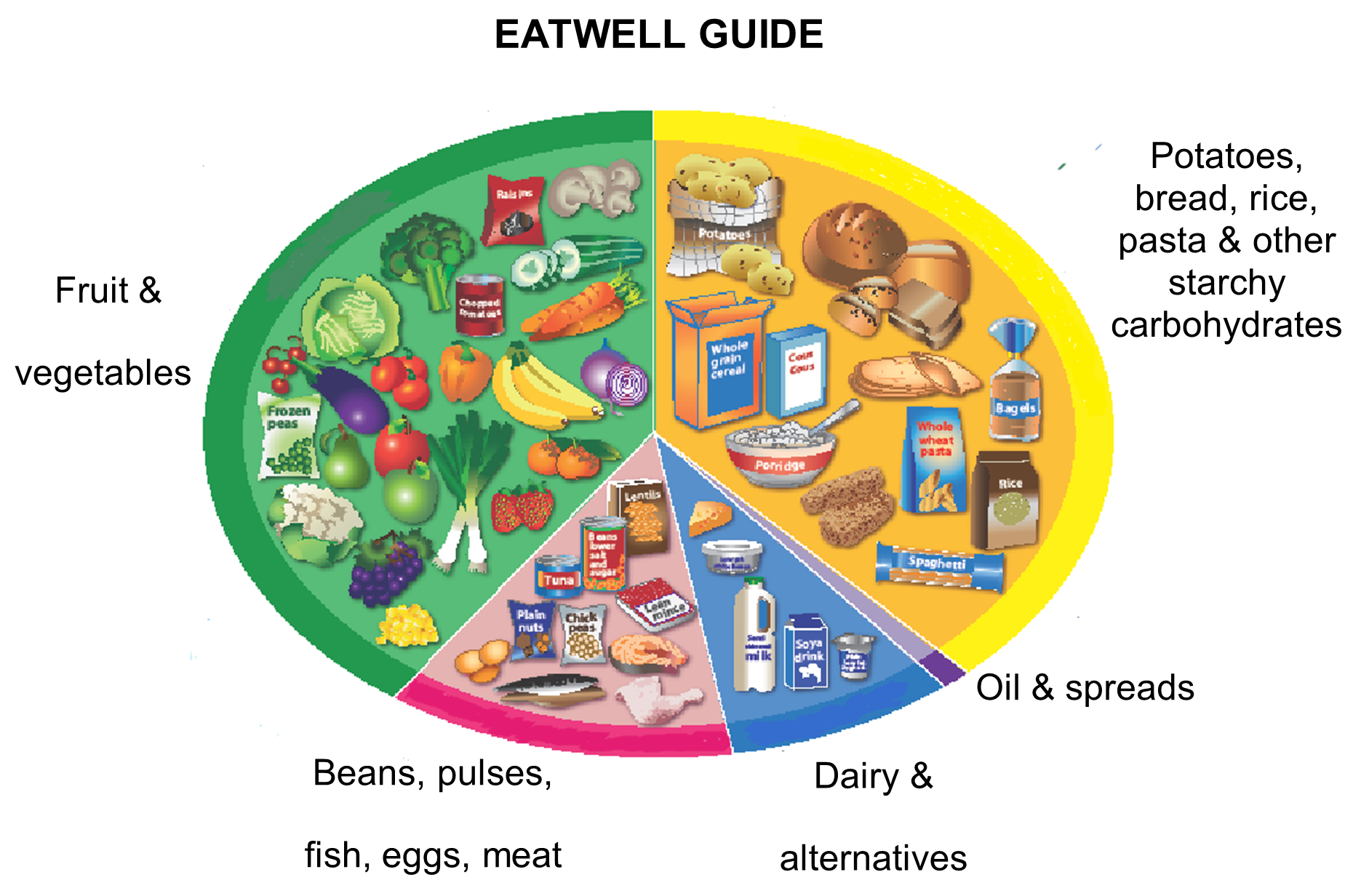
Potatoes, Bread, Rice, Pasta and Other Starchy Carbohydrates
These are called starchy carbohydrates, providing energy, nutrients and fibre, every meal should contain some carbohydrate foods.
Choose higher fibre versions where possible e.g. whole meal or multigrain breads, brown rice, jacket potatoes. Fibre helps to keep the bowel healthy and prevents constipation.
Starchy carbohydrates are naturally low in fat so avoid adding fat to them - boil, steam or microwave the food rather than fry or roast.
Fruits and Vegetables
Fruits, vegetables and salad should also form a large part of a meal. Eat at least five portions of these foods each day (as per the Eat Well Guide)
Fruit and vegetables can be a healthy snack, however, limit fruit juice to one glass (150mls) a day as it contains concentrated sugars and no matter how much you drink it only counts as one portion of your five.
Vegetables tend to contain less calories, so they include more of these than fruit.
Fruits and vegetables are low in fat and calories and provide essential vitamins, minerals and fibre.
Beans, Pulses, Fish, Eggs and Meat
These are protein rich foods. Protein foods and other proteins should be included in two meals a day. Protein is important to help the body grow and repair body tissues. Lentils, pulses, tofu and Quorn are also included in this group.
Choose lean meat or low-fat products and remove any visible fat e.g. take the skin off poultry and avoid frying.
Oily fish e.g. sardines and mackerel contain healthy oils that can help to prevent heart disease. Aim to have two portions per week.
Diary and Alternatives
Dairy foods provide calcium which is important for healthy teeth and bones. Aim for three portions of milk and dairy foods every day. One portion is the equivalent to a third of a pint of milk, a pot of yoghurt or 25g cheese.
Choose lower fat products for children over two years and young adults e.g. semi-skimmed or skimmed milk. Choose ’no added sugar’ or ’diet’ yoghurt. Low fat natural yoghurt can be used as an alternative to cream.
Choose reduced fat cheeses e.g. Dairylea light triangle, Babybel light or a smaller quantity of stronger cheese.
Oils and Spreads
Healthy choices are olive, rapeseed, sunflower or vegetable oil. Use only small amounts when cooking. Spread butter or spread thinly when used in sandwiches or on toast.
What About Salt?
Salt contains an ingredient called sodium which our bodies need. However eating too much salt can cause high blood pressure, which is unhealthy.
Do not add salt to the table. If needed in cooking add to the water during cooking.
Experiment with adding different flavours to food, such as herbs and spices, and limit high salt savoury snacks e.g. crisps, salted nuts. Also watch the number of ready meals and takeaway meals eaten in a week.
What Snacks Should I Choose Then?
Here are some ideas for healthy snacks
- Fresh fruit (do not exceed 5 portions a day)
- Vegetable sticks e.g. carrot, celery, peppers, baby sweetcorn
- Child or young person’s handful of dried fruit
- Rice cakes or crackers with light cheese or cheese spread
- One slice of toast or chapatti
- Small roll/crumpet/half a hot cross bun and reduced sugar jam
- Slice of malt loaf with low fat spread
- Bowl of homemade vegetable soup
- Small bowl of plain cereal
- Diet or low-calorie yoghurt — plain or with fruit
- 1 plain biscuit
- Small handful of nuts
- 1 tablespoon of houmous/guacamole/tomato salsa dip to go with vegetable or bread sticks
Understanding Food Labels
Food labels contain a lot of useful information to help you choose healthier foods although this can sometimes be confusing.
Foods and Drinks High in Fat and Sugar
These foods generally provide lots of calories but very little nutrients. Everyone should aim to eat less of these foods for a balanced diet.
Foods that are high in fat e.g. crisps, biscuits, chocolate, cake, butter, margarine and oil, pies and pastries should be limited, and lower fat alternatives are better choices. The table below gives an idea of food and drinks high in fat and sugar and better choices.
Get the Change4Life ‘Be Food Smart’ app to see how much sugar, saturated fat and salt are in your food and drink.
|
Foods High in Fat and Sugar |
Better Choices |
|
|
|
|
|
|
|
|
|
|
|
|
|
|
What About My Eating Pattern?
To achieve your healthy weight, choose a regular eating pattern for breakfast, lunch and tea/dinner. Snacks are only needed if there is a long gap between meals (over four hours).
Regular meals will help control your hunger, this way you will be less likely to snack on unsuitable foods. Do not be tempted to miss meals as this will mean you are more likely to eat too much at the next meal.
What About Portion Sizes?
As well as looking at the types of foods eaten it is important to consider the portion of the food and meals you eat.
Choosing the right types of food is important, but eating too much of any type of food, however healthy it is, will mean that you have more energy than your body needs and this will be stored as fat.
Over the years portion sizes have increased. For example, in 1970 a packet of crisps was 25g. Today, 35g or 50g bags are commonly seen in the supermarkets and in the 1980’s bagels used to be three inches (7.5 cm) in diameter and are now six inches (15cm).
Ask your dietitian for advice about suitable portion sizes according to the age of your child.
For Ages 1-4
First Steps Nutrition: www.firststepsnutrition.org
The Infant & Toddler Forum: www.
For Ages 5-11 and 12-18
Caroline Walker Trust: www.
What Do Labels Mean?
- Always look in the ‘per 100g’ column, not the ‘per serving’ or ‘per pack’ columns
- Total sugar should be less than 5g per 100g except in dairy foods or those containing fruit e.g. yoghurt, because the natural sugars called lactose and fructose will be included
- Avoid yoghurts with ‘added sugar’ on the label
- Total fat should be less than 5g per 100g. If the sugar or fat content exceeds 5g per 100g then it is not healthy food
Traffic Light System
This uses the colours of the traffic light (green, amber and red) to decide whether a food has a low, medium or high number of calories, fat, saturated fat, salt and sugar. The information will be either per serving or per 100g and this will be specified. Two products can be compared using this system to choose the ‘best’ choice.
The following website has useful information regarding this:
http://
What Can I Do?
Firstly, look at the size of plate your child uses on a daily basis. It could be that the portion given looks ‘right’ on their plate. You may be able to give a smaller portion by using a smaller plate. Try using the following suggestions for plate sizes:
- Seven-inch plate (18cm) is recommended for toddlers
- Nine-inch plate (23cm) is recommended for children up to about eight years
- Eleven-inch plate (28cm) is recommended for older children, teenagers and adults
Try the following fun activity at home:
- Pretending it is breakfast time and you are hungry
- Everyone in the family should measure out the amount of cereal they usually eat into your cereal bowl
- Using scales or a tablespoon measure the amount of cereal in the bowl
- If you have used scales compare this to the portion size suggested on the packet
If you have used tablespoons a ‘typical serving’ is three tablespoons
What About Eating Out?
Just because you are choosing to eat more healthily it doesn’t mean that you cannot eat out in restaurants or have fast food ever again.
The Eatwell Guide shows that foods high in fat and sugar should be limited and the lower fat options chosen where possible. The following guidelines should help when you go out to eat.
|
Choices High in Fat and Sugar |
Better Choice |
|
Chinese Sticky rice, egg fried rice, crispy noodles |
Plain boiled noodles or rice |
|
Shredded beef, crispy duck, fried vegetable or tofu dishes Sweet and sour pork/chicken |
Stir fried meats or tofu with vegetables |
|
Indian Naan, fried poppadum, pilau rice |
Chapatti, roasted poppadum, basmati rice |
|
Korma, vindaloo, madras, potato dishes |
Tikka, Balti and tandoori dishes |
|
Italian Deep pan pizza, ravioli, carbonara, lasagne, fried meat |
Thin crust pizza, grilled chicken, pasta with tomato-based sauces |
|
Fast Food e.g. McDonalds, Burger-King, KFC Burgers with cheese and mayo |
Chicken salad or chicken burgers, Quorn or veggie burger with no mayo |
|
Milkshakes, normal fizzy drinks |
Water, diet drinks, semi skimmed milk, no added sugar squash or 150ml glass of fruit juice |
|
Large fries |
Regular fries |
Healthy Meal Ideas
Many traditional family meals can be adapted to make them healthier, by changing the cooking methods or increasing/decreasing certain ingredients.
Your child is more likely to succeed in managing their weight if you use some familiar foods and introduce new ones slowly. Remember to use these meal ideas in conjunction with the information on portion sizes.
Breakfast
- Boiled, scrambled or poached egg and toast
- High fibre cereal e.g. Weetabix, Oatibix, Shreddies, Shredded Wheat, Ready Brek or porridge. Try adding fruit on top
- Fresh fruit salad or canned fruit in natural juice, with low calorie or diet yoghurt or fromage frais
- Baked beans or low-fat cheese on toast
- Try homemade smoothies, using one portion of fruit, 1-2 vegetables and low calorie or diet yoghurt or semi-skimmed milk
- Wholemeal pancakes with fresh fruit or yoghurt
- Toast with marmite, reduced sugar jams or marmalade, mashed banana, peanut butter, tinned or fresh tomatoes
Packing a Healthy Lunch - What should my lunch include?
1. Starchy Food
As well as sandwiches, try pitta bread, wraps, bagels, rolls or crackers. Choose high fibre options like whole meal or granary bread, high fibre crackers
2. Protein Foods
Try one of the following fillings: tuna, ham, low fat cheese, low fat hummus, butter spread thinly, chicken, turkey or egg
3. Dairy Foods
Include a pot of low-fat yoghurt or fromage frais, custard or rice pudding
4. Fruit and Vegetables
Include one piece of fruit or try a small pot or tin of fruit in natural juice for a change.
Add salad vegetables to either the filling or cut into finger sized batons e.g. cherry tomatoes, celery, cucumber, pepper or carrot.
5. Fluids
Water is the best choice for a drink at lunchtime. No added sugar squash is an alternative
Main Meals
Meat Dishes (e.g. spaghetti bolognaise, shepherd’s pie)
- Use lean meat, dry fry and drain off the excess fat before adding the other ingredients
- Add plenty of vegetables to the meat to bulk it out, e.g. onions, mushrooms, carrots, courgettes. Adding lentils or tinned beans can make the meat go further
Roast Meats
- Use lean cuts of meat and trim off any excess fat or skin. Cook with a minimum of added fat/oil
Casseroles
- Buy the leanest meat you can and trim any excess fat
- Add plenty of extra vegetables and try using lentils or tinned beans, instead of meat
Fish Dishes
- Use white and oily fish, grill or bake in the oven with lemon juice, rather than cooking in butter or frying in oil
- Make a healthier white sauce using a lower fat milk and cornflour to thicken the sauce
Pasta Dishes
- Use a tomato-based sauce rather than cream or cheese-based varieties
- Add lots of extra vegetables to the sauce – you can count this as part of your five a day!
Vegetarian Dishes
- Use pulses or soya products rather than cheese as the main ingredient e.g. bean casserole or lentil and vegetable bake
Snack Meals
Sandwiches
- Use a variety of breads, including wholemeal and granary, rolls or pitta bread
- Fill with lean roast meats or fish, low fat cheeses, or egg and salad vegetables
- Use low fat/calorie mayonnaise/salad cream if necessary
Other filling ideas:
- grated cheese, raisins, grated carrot and chopped pineapple
- cottage cheese, chopped peppers and grapes
- tuna, sliced spring onion, sweetcorn and tomato ketchup
Soups
- Homemade, tinned or packet soups are good choices; avoid cream-based varieties
- Add more vegetables, lentils or pulses to homemade varieties
Toast
- Top with baked beans, tinned spaghetti, tinned or grilled tomatoes, scrambled or poached egg
Jacket Potatoes
- Baked beans, tuna and sweetcorn or cottage cheese with pineapple
- Leave out the butter
- Include a side salad with it and it will count as part of your five a day
Pizza
- Make your own with lower fat toppings such as lean ham, sweetcorn, pineapple, mushrooms, onions, tomatoes or sliced peppers
- Avoid using fatty meats such as salami, pepperoni and grate cheese thinly on top
- Try ½ a pizza and add a side salad to fill you up
Avoid ‘full fat’ coleslaw or potato salad as an accompaniment
Desserts
Traditional desserts can be very high in fat, and sugar therefore limit to once a week. Include a portion of fruit with dessert e.g. pineapple to sponge cake, banana to rice pudding
Other Ideas
- Fruit – all types, fresh, tinned (in natural juice) or frozen
- Sugar free jelly
- Low calorie ‘diet’ yoghurt, natural yoghurt with berry fruit
- Low fat custard and fruit
- Low fat rice pudding and fruit
- Low fat instant whip desserts and fruit
- Low fat frozen yoghurt
More Information
More information on helping your child can be found by looking at the following websites:
www.
www.
https://
Contact us
If you have any queries relating to this information, please contact the Dietetics service.
About this information
Service:
Dietetics
Reference:
DT/102
Approval date:
1 June 2026
Review date:
1 June 2029
Click ‘show accessibility tools’ at the bottom of the page

Then click ‘select language’

Alternative formats
You can use the accessibility toolbar at the bottom of your screen to:
-
Change the text size
-
Adjust the font
-
Modify the colour contrast
-
Use the translate function
If you would like this information in another format, such as Braille, audio, or easy read, please speak to a member of staff.
You can also print as well as download as PDF using the “Print this page” button at the end of the page.
Staff will print a copy for you on request
Important note
This page provides general information only. It is developed by clinical staff and is reviewed regularly every 3 years for accuracy. For personal advice about your health, or if you have any concerns, please speak to your doctor.