

Advice after your nerve block for surgery
On this page…
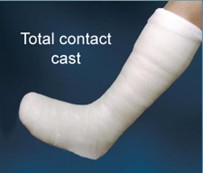
What is a Total Contact Cast (T.C.C) and what is it for?
Studies have shown that the Total Contact Cast (TCC) is one of the most effective ways to treat ulcers on the soles of the feet, especially when conventional methods have failed.
Most ulcers will heal after six weeks; however, treatment can take as long as three months, sometimes longer. The TCC is designed to reduce pressure on an ulcerated area by distributing weight-bearing forces over the entire foot and lower leg area. The cast will have minimal padding and it will be carefully moulded to ensure that it makes ‘total contact’ with the skin and soft tissues of the lower leg and foot.
TCC’s are also very effective in the treatment of Charcot Foot (a condition which causes weakening of the bones in the mid-foot that can occur in people with Neuropathy). The cast allows the symptoms associated with Charcot Foot, (swelling, redness, heat and pain), to settle down.
How often will I need to visit the Plaster Room?
A Multidisciplinary team (MDT), consisting of a Consultant, Podiatrists, Orthopaedic Casting Practitioners, Tissue Viability Nurses and Orthotists will manage your care. You will initially need to attend the Plaster Room on a weekly basis. At each visit your cast will be removed, the Podiatrist will carry out any necessary treatment to your foot before the Orthopaedic Casting Practitioners apply a new cast.
During your treatment, you will be assessed by a member of the MDT, who will decide when your cast will be removed and when you will be ready to have specialist footwear/insoles made by the Orthotist. You will continue to remain in a TCC until your new shoes are ready.
Will I be able to walk with the cast on?
The cast is designed so that you will be able to walk on it as soon as it has been applied. However, in some cases, particularly if you have an evolving Charcot Foot, you may be required to be non weight-bearing. The doctor will advise you on your weight-bearing status. The cast is constructed from Plaster of Paris, which is the most suitable product for moulding, and Fibre Glass, which will give the cast strength. It will take approximately 24-48 hours to completely dry.
What about getting around?
Initially you will feel a little unsteady when you walk. This is due to the fact that you will have lost ankle movement on the affected side, and the cast may be slightly higher than your usual shoe. You will be given a cast shoe with a rocker sole to help compensate for the loss of ankle movement, and also to protect your cast from wear and tear.
You will need to use any walking aids you may have to help keep you stable. Please take extra care when walking on slippery or uneven ground.
What else do I need to be aware of?
- Rest and elevate your leg as much as possible as the weight of the cast can sometimes cause your hip and/or knee to ache. Elevation will also help to reduce any swelling.
- You must NOT get your cast wet. A waterproof cover can be purchased or is available on Prescription to allow bathing or showering. If you do accidentally get your cast wet, you MUST contact the Plaster Room as soon as possible. A wet cast can cause skin problems.
- Do not drive. You will not be in full control of your vehicle. You may be allowed to drive if it’s your left leg that is affected and you own an automatic car. You must ask guidance from your Consultant and Insurance company first.
- Do not put anything inside your cast to ‘scratch’ as this can easily damage your skin underneath, which in turn can cause further complications.
- Do not try to remove the cast yourself!
- In bed, you may cover your cast with a pillowcase to keep your bedding clean. A pillow or blanket may be placed between your lower legs to protect the unaffected leg from accidental knocks in the night.
- You must contact the Plaster Room if you have any problems, worries or concerns about your cast. It is much easier to deal with a small problem, than to end up with a more difficult problem!
Possible problems may include:
- Cast becoming too loose
- Dents/Cracks in the cast
- Any offensive smells
- Any foot/leg discomfort
The cast will only work if it is comfortable. A damaged or uncomfortable cast could result in further injury to your foot!
This information sheet has been designed to offer you some help and advice but will not cover every aspect of your particular care plan. The MDT will always be happy to answer any further questions you may have. If you think of any questions you wish to discuss at your next visit to the hospital, please write them down and bring them with you.
As mentioned before, if you have any worries or concerns with the cast, please contact the Plaster Room to speak with one of the Orthopaedic Casting Practitioners, who will be happy to help you.
The Plaster Room at Frimley Park is open:
Monday – Friday 9am – 5pm
Direct phone number: 0300 613 4339
Contact us
If you have any queries relating to this information, please contact the Plaster room service.
About this information
Service:
Plaster room
Reference:
N/046
Approval date:
1 November 2025
Review date:
1 November 2028
Click ‘show accessibility tools’ at the bottom of the page

Then click ‘select language’

Alternative formats
You can use the accessibility toolbar at the bottom of your screen to:
-
Change the text size
-
Adjust the font
-
Modify the colour contrast
-
Use the translate function
If you would like this information in another format, such as Braille, audio, or easy read, please speak to a member of staff.
You can also print as well as download as PDF using the “Print this page” button at the end of the page.
Staff will print a copy for you on request
Important note
This page provides general information only. It is developed by clinical staff and is reviewed regularly every 3 years for accuracy. For personal advice about your health, or if you have any concerns, please speak to your doctor.