

Advice after your nerve block for surgery
On this page…
What is Muscle Tension?
Many voice disorders involve a level of muscle tension, but it is the primary feature of Muscle Tension Dysphonia (MTD), which is a type of ‘functional’ dysphonia. It involves imbalance in the muscles of the larynx, and certain muscles can be ‘over-working’ when producing the voice. MTD can occur for many reasons, including vocal over-use, poor vocal patterns, a virus or laryngitis, or emotional factors such as stress.
What is constriction?
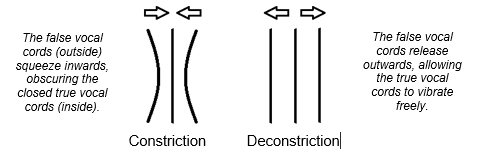
Constriction is a type of muscle tension that involves the muscles of the larynx squeezing inwards. Constriction can also occur because of irritants such as reflux, as the larynx tries to protect the airway.
Constriction can easily become a habit, as the muscles get used to producing the voice in a particular way. This is detrimental to the voice, as the larynx needs to be relaxed and ‘open’ in order to produce a clear, efficient voice. A pattern of constriction when voicing may lead to vocal fatigue and voice loss.
Deconstriction
Deconstriction means releasing this tension from the larynx, particularly the false vocal cords. This allows the true vocal folds to vibrate freely, reducing the effort needed to produce the voice, and improving its sound.
The following exercises will help you to deconstrict your larynx. They need to be practiced regularly throughout the day, in order to ‘retrain’ your voice. This is important as the voice easily reverts back to old habits. Aim for one minute ten times a day
Deconstriction exercises
Only do the exercises the therapist has advised.
Without voice
1. Inner smile
- As you breathe (through your nose), imagine an inner smile in your throat. Feel your throat being wide and spacious.
- Having a slight smile on the lips, and ‘smiley eyes’, will help. Make sure it is not a grin or grimace, as this will introduce tension.
- If advised, cover your ears and listen to your breathing (through the mouth) while you do this. Noisy = constricted, silent = deconstricted.
2. Silent gasp of wonder
- As you breathe in, ‘gasp’ silently with wonder and delight – imagine something amazing! It can help to do wide, smiley eyes.
- Notice the feeling of space in your throat.
- Then try it with your mouth closed, breathing through your nose.
With voice
3. Yawn and sigh
- Try to make yourself yawn. This will allow your larynx to drop and widen. Feel the space it creates in the throat.
- As you breathe out, sigh (with voice, ‘ah’) whilst keeping the open feeling in your throat. Let the voice be easy and gentle. Try this on different sounds e.g. ‘ee’ or ‘oo’.
4. Humming or ‘ee’
- Thinking of the ‘inner smile’ and open throat, hum or say ‘ee’ gently at a comfortable pitch. Focus on maintaining the open, relaxed feeling in your throat.
- Keep your face and jaw relaxed.
- The voice should sound clear and gentle, and not feel strained. Compare this to how your ‘tight’ voice feels and sounds – you should notice the difference.
- If advised, move the pitch up and down gently, and try different vowel sounds.
5. Vowel sequences
- Once you have found an easy, deconstricted voice, practice it with vowel sequences e.g. ‘eyeyeyey’, ‘oyoyoyoy’, ‘ayayayay’.
- Move up and down in pitch, using speech like intonation.
- Have a conversation with yourself (or someone else!) in this way.
Contact us
If you have any queries relating to this information, please contact the Speech and language therapy service.
About this information
Service:
Speech and language therapy
Reference:
VV/030
Approval date:
27 September 2024
Review date:
1 September 2027
Click ‘show accessibility tools’ at the bottom of the page

Then click ‘select language’

Alternative formats
You can use the accessibility toolbar at the bottom of your screen to:
-
Change the text size
-
Adjust the font
-
Modify the colour contrast
-
Use the translate function
If you would like this information in another format, such as Braille, audio, or easy read, please speak to a member of staff.
You can also print as well as download as PDF using the “Print this page” button at the end of the page.
Staff will print a copy for you on request
Important note
This page provides general information only. It is developed by clinical staff and is reviewed regularly every 3 years for accuracy. For personal advice about your health, or if you have any concerns, please speak to your doctor.