

Advice after your nerve block for surgery
On this page…
Nipple reconstruction following a breast flap or mastectomy is considered the final optional step to achieving a restored natural appearance to the breast.
This totally depends upon personal choice and how a woman may perceive herself to be normal
in relation to body image and self-esteem.
What is a nipple reconstruction?
Making a nipple following a breast reconstruction is normally done months after the original operation giving the reconstructed breast a chance to settle and heal into its final shape.
There is an option to have a silicone stick-on nipple made by the prosthetist if you wish
How is the nipple made?
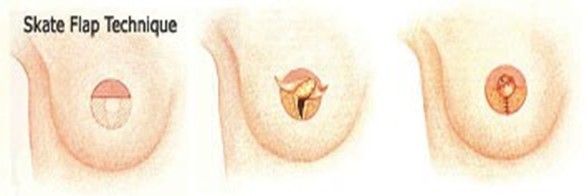
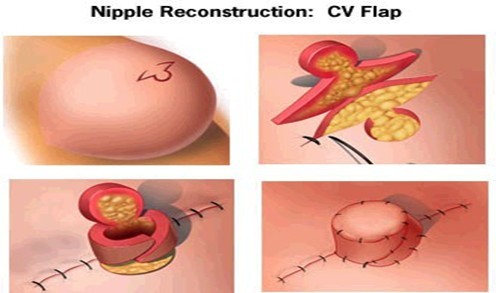
The surgeon will use tissue and skin from the reconstructed breast and stitch it together to form a projecting nipple, as shown in the diagrams below.
What are the risks?
No surgery is risk free, but problems can be minimized by good patient care and communication.
Risks can include:
- Bleeding.
- Infection.
- Nipple necrosis (lack of blood supply to the nipple) (very rare)
- There is also a risk that the nipple projection may flatten, and further surgery may be needed to get the desired effect and result.
The operation is done under a local anaesthetic.
You will be able to go home the same day.
The surgeon will mark up the position of the new nipple in symmetry with the other side The operation takes about 30-60 minutes as there is little or no sensation in the area immediately post operation.
What happens after the procedure?
You will be asked to wear sponge dressing in the shape of a polo ring over the nipple for 2 weeks
This will stop the nipple projection from flattening.
We advise you not to wear a Bra for 2 weeks until the nipple starts to heal and becomes robust.
The polo ring supports the nipple whilst healing
Will I have much pain?
This is a fairly pain free procedure
Most women have little or no sensation at this point.
However, everyone has a different pain threshold; some patients may experience more pain or discomfort than others.
Paracetamol may be sufficient.
How do I care for my wound?
Upon discharge you will be given an appointment to see Breast Specialist Nurse until then keep the dress clean and dry
Keep the polo sponge in place.
The nurse will advise you accordingly when to shower and how often you will need to change the dressing
When will I be able to drive / return to work?
You should be able to go back to work and drive a few days after the procedure.
A sick note can be obtained on discharge/GP if you need longer than 7 days
Where can I go for help and advice?
You can contact
• Kamal Paul Clinical Lead Nurse for Plastics and Breast, on 0300 615 3031 (8-4)
• Plastic Surgery Dressing Clinic on 0300 615 3031 (8-4)
• Aaran Gavin prosthetics Maxillofacial Prosthetist 03006154077 (8-4)
• Any problems out of hours please go to A&E or contact your GP.
For specific advice, email and send photos to fhft.plasticsurgentcare@
Alternatively for general advice call your GP or the NHS 1111 service.
Contact us
If you have any queries relating to this information, please contact the Plastic surgery service.
About this information
Service:
Plastic surgery
Reference:
T/021
Approval date:
20 February 2026
Review date:
1 February 2029
Click ‘show accessibility tools’ at the bottom of the page

Then click ‘select language’

Alternative formats
You can use the accessibility toolbar at the bottom of your screen to:
-
Change the text size
-
Adjust the font
-
Modify the colour contrast
-
Use the translate function
If you would like this information in another format, such as Braille, audio, or easy read, please speak to a member of staff.
You can also print as well as download as PDF using the “Print this page” button at the end of the page.
Staff will print a copy for you on request
Important note
This page provides general information only. It is developed by clinical staff and is reviewed regularly every 3 years for accuracy. For personal advice about your health, or if you have any concerns, please speak to your doctor.