

Advice after your nerve block for surgery
On this page…
One of the tendons that bend your thumb has been repaired. At this stage the tendon is very weak and at risk of rupturing (snapping).
It will take at least 8 weeks before your tendon is strong enough to perform certain activities and at least 12 weeks before you can return to heavy activities.
Potential problems
Please contact the therapy department if you suffer any of the following problems:
- increase in swelling/stiffness/pain
- skin irritation/soreness
- the splint is rubbing
- the splint is too tight or causing pressure points
- your hand or fingers turn blue, feel cold or tingle
- check straps are not too tight
- the splint feels loose
- you are unable to move your thumb or finger/s.
Swelling
It is important to reduce any swelling as quickly as possible.
Keep your hand elevated as much as possible until the swelling has gone down. Every hour move your arm, exercising your elbow and shoulder.
Skin Care
- Wash all areas not covered by the splint
- Avoid wetting unhealed areas or dressings.
- Use moisturiser if your exposed skin becomes dry.
- When bathing/showering, cover your splint in a plastic bag taped to your arm. Keep your arm away from the hot water as this may change the shape of the splint.
Splint Wear
- Keep your splint on at all times until you are instructed to take it off. This will probably be at 4 weeks following your surgery.
- Don’t take the splint off to bath, dress etc. as the repaired tendons may break.
- The splint will only come off to change the dressings and adjust the splint by the Therapists.
- Avoid direct contact with heat, (e.g., radiators / hairdryers and the bath) as this may alter its shape.
Do not
- use your thumb for any activity (including buttons)
- lift anything heavy with your hand
- drive or operate machinery
- participate in any sporting activities
- push your thumb straight.
Exercises
Complete all exercises 10 reps every 4 hours, unless stated on your sheet. Only remove the minimal number of straps to complete each exercise.
Active Wrist Flexion
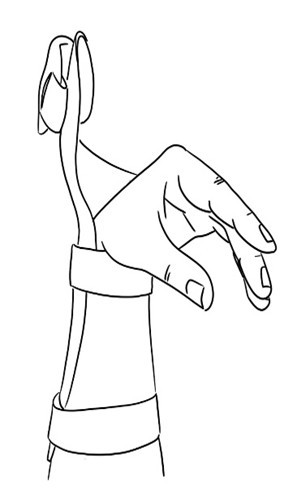
- Remove strap from across your palm and thumb.
- Move your wrist forward away from the splint. Hold for 2 seconds.
- Then take your hand back to the splint.
Passive Thumb Flexion
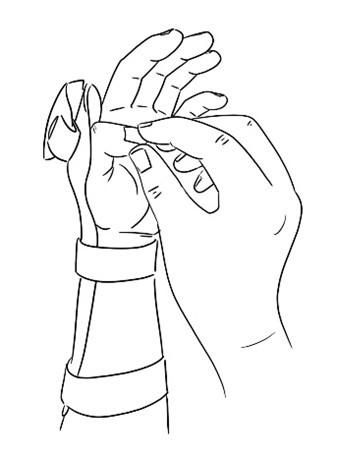
Reattach palm strap. Using your uninjured hand, push the tip of your thumb into a bend. Then, without any help from the other hand, straighten the thumb back into the splint. Do not push it back. Hold it there for 5 seconds then relax.
Active Thumb Top Joint Flexion
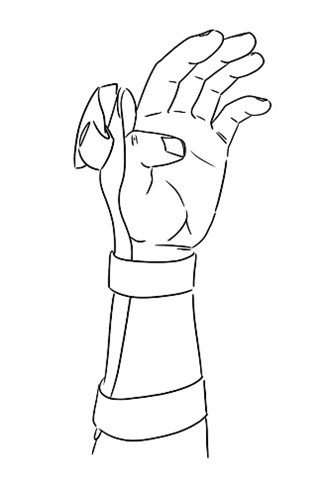
Using your own muscles, bend the tip of the thumb, then, straighten it back to the splint. Hold for 2 seconds.
Active Full Thumb Flexion
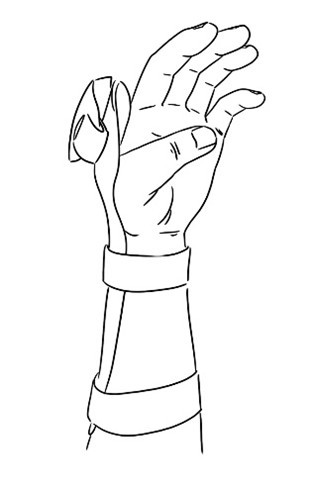
Using your own muscles, bend your thumb across your palm, bending the tip as much as you can, then straighten it back to the splint. Hold for 2 seconds.
Active Composite Fist
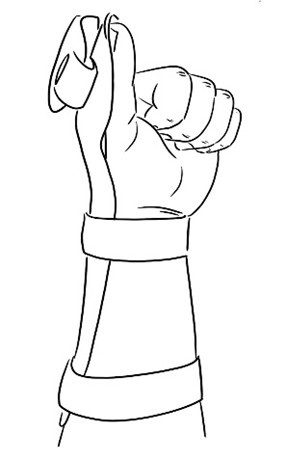
Actively make a full fist with all your fingers, hold 2 seconds, and relax.
Contact details
Hand therapy departments: (Lines open 8.30-15.30, Monday – Friday). In an emergency, seek medical advice from a GP or local accident or minor injuries unit.
0300 6133396 for Frimley
0300 6140540 then Option 2 Wexham or Option 3 for Heatherwood
Plastic Dressing Clinic - 0300 6153031
Contact us
If you have any queries relating to this information, please contact the Hand therapy service.
About this information
Service:
Hand therapy
Reference:
UU/007
Approval date:
19 February 2026
Review date:
1 February 2029
Click ‘show accessibility tools’ at the bottom of the page

Then click ‘select language’

Alternative formats
You can use the accessibility toolbar at the bottom of your screen to:
-
Change the text size
-
Adjust the font
-
Modify the colour contrast
-
Use the translate function
If you would like this information in another format, such as Braille, audio, or easy read, please speak to a member of staff.
You can also print as well as download as PDF using the “Print this page” button at the end of the page.
Staff will print a copy for you on request
Important note
This page provides general information only. It is developed by clinical staff and is reviewed regularly every 3 years for accuracy. For personal advice about your health, or if you have any concerns, please speak to your doctor.