

Advice after your nerve block for surgery
On this page…
What is Psychological Trauma?
Trauma can occur when you experience or witness an event that involves actual or feared threat to life or serious injury to you or others. There are lots of different circumstances which can cause a traumatic event to occur, so it’s easier to separate different types of trauma (on this page and the next). It is important to remember that everyone is different, so one child may find an experience traumatic, meanwhile another may not. It depends on how the event has been perceived at the time.
Single Event Trauma
Single event trauma happens when we experience a sudden distressing event which is outside the range of normal everyday life. This event would be unexpected, meaning it appears out of nowhere, and can quickly make us feel very scared and stressed. Sometimes these strong emotions can continue after the event has stopped, and you might need some help and support to understand your experiences and how it affects your thoughts, feelings and behaviour.
Some examples where people might perceive a threat to their life in a single event trauma are:
- An assault
- A mugging or robbery
- Witnessing a natural disaster
- A road traffic accident
Chronic trauma
Chronic trauma happens when you experience a highly distressing (traumatic) event repetitively for a long period of time. This can make you feel angry, tired, sad, lonely, misunderstood, stressed, and lots of other things! Because this trauma happens for a long time it can make you feel quite hopeless, and like there is nothing you can do to stop the event from happening. If you feel like this it is important to speak to an adult who can help you understand your experiences and think about ways to prevent this trauma from continuing.
Some examples where people might perceive a threat to their life during chronic traumatic events are:
- Emotional abuse
- Physical abuse
- Bullying
- Neglect
Traumatic Bereavement
It is really difficult when someone important in your life dies, and in addition to feeling sad you may feel unsafe, angry, worried or frightened. Often traumatic bereavement occurs when someone dies in an unexpected, unfair or cruel way. However, that is not always true as it depends on what the death means for you, and how it impacts your life.
Grief is the word that people use to explain all of your feelings when you miss someone who has died. It can be helpful to think about grief like stepping in and out of puddles. Typically when someone dies people can sometimes step out of the grief puddle, and they can enjoy doing fun things for a while, even though the sadness doesn’t disappear. However, when the bereavement is traumatic it can feel like the grief puddle is so big and deep that it is impossible to step out of. This makes it really difficult to cope.
It is important to remember that it is not your fault if you are struggling more than those around you, and you need some extra support to find your way out of the grief puddle. The first step is to speak to an adult you trust, they can then help you find whatever support would be most helpful for you. Some examples of where traumatic bereavement is more likely to occur are when a person dies suddenly due to suicide, murder, illness, natural disaster or in an accident.
Medical Trauma
Childhood medical trauma happens when children experience single or multiple extreme and/or distressing medical events, such as pain, injury, serious illness, medical procedures, and invasive or frightening treatment. Experiencing these medical events can make you feel lots of strong emotions that can be difficult to deal with by yourself. For example, you may feel angry, upset, unsafe, frightened, worried or powerless. Some people will also spend a lot of time thinking about the traumatic event and even replaying it in their mind. If you experience these thoughts and feelings regularly it can impact your day-to-day thoughts and behaviour, increase your recovery time and prevent you from following your medical treatment plan.
The first step is to talk to any adult that you trust about how you are feeling. However, sometimes it is helpful to talk to someone different (e.g. a psychologist) who can help you think about and understand your experience, how it made you feel, and how it affects you.
Some examples where people might perceive a threat to their life during a medical trauma are:
- Being diagnosed with a life-threatening condition
- Being diagnosed with a chronic illness (such as cystic fibrosis or type 1 diabetes)
- Having surgery
- Living with chronic pain
- Experiencing seizures
- Experiencing a spinal cord injury
What is Post-traumatic Stress Disorder (PTSD)?
PTSD is an anxiety disorder that some people develop after experiencing or witnessing something very distressing or traumatic.
Around 1 in 3 people who experience a traumatic event develop PTSD, but we are not 100% sure why some people develop it and others do not.
You don’t always develop PTSD immediately after the traumatic event, sometimes it won’t occur until weeks, months or years after.
People with PTSD might experience:
- Nightmares/flashbacks
- Hypervigilance (being alert) to signs of danger
- Avoidance of situations that remind them of the event
- Feeling guilty
- Feeling alone
- Sleeping problems/insomniac
- Hallucinations
- Anxiety
- Depression
- Lapses in memory
- Anger
This is not a complete list. There are further symptoms discussed further on but it may be that you experience other symptoms too as PTSD impacts everybody differently. This is normal.
Currently there is not a medicine that can cure PTSD. But we do know that talking to a psychologist can really help.
PSTD happens similarly in children and adults, however, children are often less able to explain and talk about their emotions so instead they typically react physically to feelings like fear or anxiety e.g. by screaming or kicking.
How Does Your Trauma Affect You?
Experiencing a traumatic event can often mean you experience lots of other changes in your body and mind. It’s important that you can notice these changes so we can support you with as many difficulties as possible.
Here is a list of potential symptoms of Medical Trauma/PTSD:
- Anger
- Sweating
- Eating difficulties
- More worries/fear than usual
- Sadness
- Feeling numb
- Trembling
- Flashbacks
- Easily startled
- Physical pain
- Poor concentration
- Not wanting to be around anyone
There are many more symptoms that you may experience. If you think of any write them down.
How does your brain respond to trauma?
When you have experienced something traumatic, it can change how your brain reacts to circumstances which make you feel scared/threatened or remind you of the traumatic event. The way you react is called your fight – flight - freeze response, this is your brain trying to protect you as it thinks you’re in danger. It’s important to remember that everyone has a fight-flight-freeze
response, but it is likely that yours is used more often because more situations might feel scary after you’ve experienced/witnessed a traumatic event.
When you are put in a scary situation (e.g. seeing a lion) your brain and body either:
- Prepares you to fight the danger (e.g. fight the lion)
- Prepares you to flee the danger (e.g. run away from the lion)
- Helps you freeze (e.g. hide from the lion)
How is your Memory Affected by Trauma?
Usually our memories are stored in lots of different parts of the brain, including the front part (the Prefrontal Cortex). But when we are in a scary or threatening situation, the only part of our brains that is active is the Amygdala, which helps us to fight, escape or stay completely still in order to best survive. So the memories you have of that time will be stored differently to our everyday memories, and when you think back to that time the Amygdala will become active again.
This can mean that when we remember we feel scared again and we can’t remember all of the details in order. Some people experience flashbacks, which is where our brains re-live the scary event as if it happening in the here and now, rather than in the past. In this way, the trauma can feel ongoing rather than a memory, and sometimes we might have images or fragments of the memory come back to us when we least expect it.
The good news is, there are lots of things we can do to remind our brains that we are safe now, and the scary event was in the past. For example:
- Tell yourself “I am safe now, the scary event was in the past”
- Try holding something that makes you feel safe (e.g. a teddy) to remind you of where you are NOW
- Focus on your breathing
- Seek comfort from a pet/parents/friends
- Try the relaxation and ground techniques
Progressive Muscle Relaxation
| 1 | Get comfortable in a distraction free environment. You can either lay down or sit upright in a chair. Closing your eyes will help you focus on the different muscle groups, but you do not have to if you don’t want to! For all steps, hold the tense position for a couple of deep breaths, or however long is comfortable for you, then relax. Repeat each step three times. |
| 2 | Draw a deep breath in through your nose and feel your abdomen rise as you fill your body with air. Then slowly exhale from your mouth, pulling your belly-button towards your spine. |
| 3 | Start with your feet. Clench your toes with your heel pressing towards the ground. Squeeze tightly for a couple of breaths and then release. It may help to say ‘relax’ whilst you release the tension. Next, flex your feet with your toes pointing towards your head. |
| 4 | Next move to your legs. Stretch your leg out, with your toes pointing towards the sky, feel the back of your leg tightening. Hold this for a couple of deep breaths and then release. Then, point your toes down into the ground with your leg straight for a couple of deep breaths. |
| 5 | Now move onto your glutes. Squeeze your buttocks muscles for a couple of deep breaths. Remember, you should only feel tension and not pain. |
| 6 | To tense your stomach and chest, pull your belly button in towards your naval as tight as you can. Breath in deeply, filling up your chest and lungs with air. |
| 7 | Next, tense your shoulder blades and back. Push your shoulder blades backwards, as if you are trying to get them to touch. This will push your chest forwards. |
| 8 | Now tense the muscles in your shoulders as you bring your shoulders up towards your ears. |
| 9 | Be careful when tensing your neck muscles! Face forward, and SLOWLY pull your head back to look up at the ceiling. |
| 10 | Squeeze your teeth together to tense your jaw. Open your mouth as wide as you can, as if you are yawning, to relax your mouth and jaw. |
| 11 | To tense your eyes and cheeks, squeeze your eyes tight shut. |
| 12 | Raise your eyebrows as high as they will go, as if you were surprised, to tense your forehead. |
| 13 | To tense your upper arms, bring your forearms up to your shoulder to ‘make a muscle’. |
| 14 | Finally, to tense your hand and forearm, make fists with both of your hands. |
Practice means progress. Only through practice can you become more aware of how your muscles respond to tensions and relaxation. Training your body to respond differently to stress is like any training – practice is the key!
Calming The Body: Deep Breathing
During periods of anxiety, the body triggers the Fight or Flight Response. Breathing is shallow, uncontrolled, and muscles become tense. Deep breathing triggers the Relaxation Response, whereby breathing becomes deeper, controlled, slower, and the symptoms of anxiety reduce.
| Sit or lie down comfortably. Close your eyes if it makes you feel more comfortable. Place your hand on your stomach, if you breath deeply enough, you should notice your hand rising and falling with each inhalation and exhalation. Imagine a balloon blowing up in your stomach as you breath in, and deflating as you breath out. |
 |
Inhale. Breathe in slowly through your nose for 4-8 seconds. |
 |
Pause. Hold the air in your lungs for 4-8 seconds (however long is most comfortable for you). |
 |
Exhale. Breathe out slowly through your mouth for 4-8 seconds. |
| Repeat. Practice for at least 2 minutes. As your technique improves, practice for 5-10 minutes. |
Tips
- Slow down. The most common mistake is breathing too quickly. Count each step slowly as you do so.
- Counting your breaths takes your mind off of the source of anxiety. Counting acts as a distraction, whenever you catch your mind wandering, return to counting.
Guided Visual Imagery Relaxation: The Beach
Lay down, or sit comfortably in a quiet room. Use the deep breathing techniques you learnt earlier in this pack, close your eyes and listen to somebody read you the following script. You can also read this script to yourself.
You may find it more relaxing to play an audio track of crashing waves on the beach; this can be sourced on YouTube, Spotify, and most other online music platforms.
You’re walking down a long wooden stairway to a big, beautiful beach. It is very quiet and stretches off into the distance as far as you can see. As you look down you notice that the sunlight is reflecting off of the golden sand. You step into the sand, it feels warm so you wriggle your toes.
You notice the warmth from the sand between your toes and around your feet. You notice the sounds of the waves crashing and chasing you up the shore, the water sparkles like a diamond as it retreats back. The roaring sound of the waves is so soothing that you can just let go of any worries.
The ocean is a beautiful light blue, with patches of darker sapphire in the deep. As you look at these deep blue areas you notice a small sailboat on the horizon. All of these sights help you to let go of any worries and relax even more.
As you continue walking along the beach, you become aware of the fresh salty sea air. You look up take a slow deep breath in, and breath out. This breath makes you feel refreshed and relaxed. As you look up you notice two seagulls, the wind gusts and they appear to dance in graceful circles above you. It makes you wonder how it would feel if you could fly under the warm sun.
You find yourself settling into a deep state of relaxation as you walk further down the beach. You feel the sun wrap its warm arms around you, the warmth relaxes all of your muscles. You notice a beach chair as you walk down the beach, once you reach it you take a seat. Laying back in this comfortable chair makes you reflect on everything you have felt, seen and thought at this beach. You drift into a deeper state of relaxation.
Now, feeling relaxed and at peace, you slowly rise from the beach chair and step into the warm sand to walk home. As you walk, you remember how relaxing this beach has been, and you know that you can come back to this place anytime you like. You start to climb the wooden stairs and gradually bring yourself back into the room. When you are ready, you can open your eyes.
Relaxing Safe Place Imagery
All visualisations can be strengthened by engaging all of your senses in creating your ‘Safe Place’. If you any negative thoughts enter your positive imagery, discard that image and create another one.
Get comfortable in a quiet place where you won’t be disturbed. Sit, or lie, comfortably. Take a few minutes to practice some deep breathing, become aware of any tension in your body, and release it with each breath.
Imagine a place where you can feel safe and relaxed. Your safe place can be somewhere you have been on holiday, somewhere you have seen a picture of, or a completely new place you create. Avoid using your home as your safe place.
Look around your safe place, pay attention to all of the colours and shapes around you. Describe what you see aloud.
Now focus on what you can hear. Listen to the sounds far away from you, and those close to you. Perhaps what you hear is silence. You may hear the sound of running water, or the crunch of leaves under your feet.
Now focus on any skin sensations. Notice the feel of the ground beneath your feet, or whatever is supporting you in this place. Pay attention to the temperature and direction of the wind, and anything else you can feel.
Take a deep breath in. Place your hand on your stomach, and imagine a balloon inflating in your stomach. Can you notice any smells there? Maybe you can taste the salty sea air as you inhale?
Pay attention to all of these sensations whilst you spend time relaxing in your safe place.
Whilst you’re in your safe place, give it a name that you can use to bring that image back at any time.
You can choose to stay for a while, enjoying the calmness and tranquillity. You can leave when you are ready by slowly opening your eyes and bringing yourself back to alertness in the present.
Self-Soothing
5, 4, 3, 2, 1 Grounding Technique
This approach explores your five senses to help keep you grounded in the present. This is a calming technique that can help you get through periods of anxiety, or headaches. It can be done independently, making it useful for when you are alone.
Take a deep belly breath to begin. Imagine a balloon in your stomach filling up with air as you breath in.
LOOK: Look around for 5 things that you can see, and say them out loud. For example, you could say, I see the TV, I see the pencil case, I see a vase of flowers.
FEEL: Pay attention to your body and think of 4 things that you can feel, and say them out loud. For example, you could say, I feel my feet warm in my slippers, I feel the grass beneath my feet, or I feel the beanbag I am sitting on.
LISTEN: Listen for 3 sounds. It could be the sound of traffic outside, the sound of typing or the sound of your tummy rumbling. Say the three things out loud.
SMELL: Say 2 things you can smell. If you’re allowed to, it’s okay to move to another spot and sniff something. If you can’t smell anything at the moment or you can’t move, then name your 2 favourite smells. You may say, I can smell dinner cooking, or I can smell perfume.
TASTE: Say 1 thing you can taste. It may be the toothpaste from brushing your teeth, or sweetness from fruit. If you can’t taste anything, then say your favourite thing to taste.
Take another deep belly breath to end.
Develop Coping Thoughts/Positive Self-Talk
Positive statement encourage us and help us cope in distressing times. We can act as our own coach by saying encouraging things to ourselves, especially when our symptoms are worse (e.g. panic). Creating a sentence that you can say to yourself when you are feeling low or struggling to cope with your trauma can be very useful. Some children keep a copy of these in their pencil case or wallet so that they are always available.
Some examples include:
“I can do this.”
“I can cope.”
“Keep calm and carry on.”
“Thoughts are just thoughts – they are not necessarily fact.”
“It is okay to feel this way, it is a normal reaction.”
“This is difficult and painful, but it is only temporary.”
“This won’t last forever.”
Activity:
Fill in the empty spaces with a coping thought you could use in this situation:
| Situation | Coping Thought/Positive Statement |
| Example: I have experienced a lot of flashbacks today because something triggering happened this morning, so now I am really tired but I’m meant to have a school test today. | ‘The flashbacks will pass, like they have done before. I can still go and do my best, and talk to a teacher to tell them about how I am feeling’. |
| I was supposed to go out with my friends today, but I’ve got tummy ache today and feel sick. | |
| I keep missing information in lessons because I have been really worried and distracted recently. |
Changing How I Cope: Overcoming Avoidance
When we experience trauma, we can often stop doing things that we used to enjoy. However, avoiding things often makes us feel worse in the long-term. When we avoid thinking about the traumatic event and how it impacts us, it actually maintains or worsens any symptoms or difficulties you are experiencing. Therefore, we really encourage journaling, talking or drawing about your traumatic experience and ways in which you are struggling.
The first step is to think about things you have stopped doing/are doing less/are avoiding as a result of your PTSD. Make a note below of things you are avoiding because of how you are feeling.
| Things around the home: |
| Things at work or school: |
| Hobbies and interests: |
| Social activities with friends and family: |
|
Anything else?
|
Once you have filled in Section 1, the next step is to plan how easy it would be to start doing some of the avoided activities again. It may seem overwhelming in the beginning, however, it is much easier if you break the process down into smaller steps.
Create a ladder (hierarchy) of things you avoid with the ones you are most anxious about at the top, and the ones that bother you less at the bottom. Try to include a good mix of the things you wrote down in Section 1.
Start to tackle your fears and your PTSD by starting at the bottom of the ladder and gradually working your way through each step. Before completing each task, write down what you think will happen, and follow this up by writing down what actually happened after task completion. Hopefully you will start to see that it is mostly not as bad as you think it is going to be.
| Situation | Difficulty (1-10) |
| Example: having a blood test | 10 (Most difficult) |
| Example: talking about a blood test | 1(Least difficult) |
Why is sleep important?
Children and young people often need a lot of sleep, but they also have erratic sleeping and waking times. When you have PTSD these times can become even more erratic! Often children and young people with PTSD will experience nightmares or flashbacks during the night which can reduce the quality of your sleep, so you often still feel tired.
After experiencing a traumatic event it is particularly important to make sure you are getting good quality sleep, rather than just trying to sleep for longer.
Some advantages of good quality sleep are:
- You’re awake in the day so you can see family, friends and go to school more.
- You will have more energy available for challenging your negative thoughts and fears.
- You will feel less fatigued, meaning you will be able to concentrate more, and do more of the things you enjoy.
Children need different amounts of sleep depending on their age. Typically:
- 0-1 year olds = 14-15 hours
- 1-3 year olds = 12-14 hours
- 3-6 year olds = 10-12 hours
- 7-12 year olds = 10-11 hours
- 12-18 year olds = 8-9 hours
Tips for dealing with nightmares
- Try to remember that nightmares are not real, and cannot hurt you, even though the thoughts/feelings they cause are real
- Parents can reassure children that they are safe (maybe write a note for them to keep by their bed, or go into their room during the night)
- Take a favourite toy/item to bed to help you feel safe
- Avoid anything you find triggering before bed
- Make your bedroom a relaxing, cozy, stress-free and safe environment (e.g. don’t do school work in your bedroom, and fill it with your favourite things)
- Try listening to gentle classical music or white noise while falling asleep
- Wake-up/go to sleep at the same time each day so your body can develop a regular sleep schedule
- Try some of the self-help worksheets in this pack (e.g. Relaxing safe place Imagery) just before bed.
- If you feel that there is something in particular that you often worry about before bed, try to set aside some time earlier in the day to talk/think/write about the worry, and then do something relaxing afterwards.
- Try different relaxation techniques during the day so you can find what works for you and can then use this to calm down quickly if you wake up from a nightmare.
How Thinking about Difficult Memories can Help
If a memory feels distressing, sometimes we try to avoid thinking about it. But then we never fully understand what happened, and the difficult feeling remains. If we avoid our distressing memories then when we come to relax at night, our brains suddenly want to remind us of all the things that have happened and it can be difficult to get to sleep. It can be helpful to get a good balance between avoiding our memories and overthinking about them, by setting a designated ‘worry time’ during the day where you allow yourself to remember what happened to you. To set this up:
- Create a set worry time (should be no longer than 10-15 minutes). What time works best? When you’re home from school? Ideally not just before bed.
- Postpone overthinking/worries. When a distressing memory appears during the day remind yourself ‘I don’t need to worry about this now, I can worry about it later’, then do something to distract yourself.
- Complete worry time at agreed time, for up to 15 minutes Maybe write down your worries? Or talk to a parent or friend? Or draw how you’ve been feeling? You might want to spend the time exploring your feelings, or problem-solving some solutions. It is important that we allow ourselves time to explore how we feel, but not think about it all day.
Telling someone about ways in which you’re struggling can be really difficult, but it can also be really helpful. Because there are not currently any medications that cure PTSD, talking to and receiving therapy from a professional is the best way of managing PTSD. However, as a first step it is also really helpful to talk to parents, teachers or any other trusted adult about the ways in which
you are struggling. Putting it into words can also make it feel easier to manage.
Some tips for parents to talk to your child
- Initiate the conversation and give them space to talk
- Use open and non-judgmental follow-up questions/clarifications (e.g. it sounds like what your feeling is…)
- Support them (e.g. say that you’re there for them and things will get better)
- Acknowledge how difficult it was for them to speak to you, and thank them for being open
- Listen
Some tips for talking to parents/teacher
- Try speaking to them in a space in which you feel safe and comfortable
- Remember that it is okay to say you are confused or don’t exactly understand what is happening
- Sometimes it is easier to draw out your feelings or write down your thoughts, rather than speaking about your feelings directly out loud
How might talking to someone help?
Read the example below. This is a great explanation of how your brain remembers traumatic events, and why speaking to a psychologist can help.
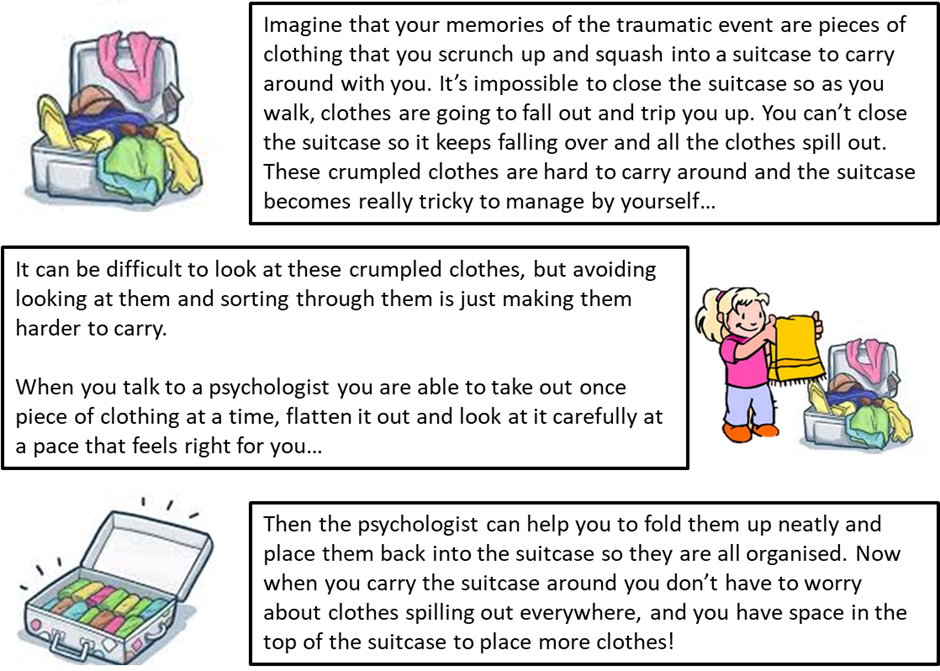
Adapted from ideas by David Trickey - https://
Psychologists understand that everyone’s trauma impacts them differently, so therefore everyone needs different things from therapy. However the most common types of therapy for PTSD are Narrative Exposure Therapy (NET), Eye Movement Desensitization and Reprocessing (EMDR), and Trauma-Focused Cognitive Behaviour Therapy (CBT). Each of these therapies involves either talking about, thinking about or drawing your memories, with support, to help you process them and recover.
There is lots more information about these types of therapy on the NHS website.
Planning Future Goals
- Consider areas that you want to change or improve.
- Try to set goals you are capable of achieving using determination. Do not underestimate your ability!
- Have faith in yourself - your thoughts can affect how you physically feel!
- Write down your goals. It will help you to see what you have achieved.
- Do not panic if you do not achieve your goal. Think about why. Perhaps you need to add in smaller step to achieve the long term goal?
- Reward yourself when you achieve a goal!
Areas To Think About When Planning Future Goals, For Reducing The Impact Of Trauma
| Trauma |
| Sleep |
| Eating |
| Socialising |
| Mood |
| Family |
| School |
|
Write down any other areas of your life that have been impacted by your trauma, and set a goal to work towards:
|
For parents: Supporting Young Children and Teenagers experiencing PTSD
It can be difficult to see a child/teenager struggling. However, as an adult there are ways in which you can help improve their ability to cope with PTSD:
- Set Routine and Record – It is important that the young person establishes a routine to ensure they get enough sleep, but also so they can live a balanced life where their energy is dedicated to family time and hobbies, as well as schoolwork. Keeping a diary can really help with this as it allows you and your child to track their energy levels and understand what activities use up more energy resources.
- Distract and reduce focus on PTSD symptoms - It can be difficult to know how to respond to a child/ young adult who is experiencing symptoms of PTSD. Often, the natural urge is to pay attention to signs that the young person may be struggling. It is important to avoid making the child/ young person worry or become anxious, as they may focus on their symptoms more. Although it is challenging as a parent, it is important to minimise attention on the symptoms, for example, by not asking about something which you know acts as a trigger for them. However, encourage them to set worry time, to think about anything that is distressing them at a planned time (see page 19).
- Encourage normal activities – It is important that the young person continues to participate in activities they enjoy, rather than dedicating all their energy to schoolwork. These activities may need to become less frequent/shorter, but you can still support them to participate despite being fatigued as a consequence of PTSD.
- Provide encouragement – Children and young people will feel more confident in their ability to cope with their PTSD with your support and confidence. Your role is to provide positive encouragement that they can cope with and manage their PTSD.
- Support and communicate – PTSD may affect your child/teenager’s ability to attend school, complete homework, coursework and revision. Offering support with studies may relieve some of the stress, and in turn decrease fatigue/other symptoms. You may like to provide this information booklet to their school/college so they can provide extra support where necessary.
There are plenty additional tips and guides for parents linked on page 24 (Online Support)
Online Support
Trauma resources:
MindEd PTSD education and information for families: https://
Animations explaining PTSD: https://
When it hurts: Dealing with the Pain:
https://
Resources for Teachers, Parents, Carers, and Children: http:/
Free Online Counselling: https:/
Anxiety and Depression: https://
Mindful Breathing: www.
Mindful Activity: www.
Relaxation Techniques: www.
Thought Distancing: www.
Supporting Sleep: www.
Making a Plan: Dealing with things that remind you of what happened: https://www.nctsn.org
What do I say? Talking about what happened with others: https://www.nctsn.org
At the Hospital: Helping my Child Cope: https://www.nctsn.org
At the Hospital: Helping my Teen Cope: https://www.nctsn.org
After the Hospital: Helping my Child Cope: https://www.nctsn.org
After the Hospital: Getting Back to a Schedule: https://www.nctsn.org
When it hurts: Dealing with the Pain: https://www.nctsn.org
The Teen Trauma Journal by Laura Stokes (printed book)
Stress and Anxiety: https://www.moodcafe.co.uk
Emergency Services
If you feel like you may attempt suicide, have injured yourself, taken an overdose, or are worried about immediate safety call 999
Call the NHS on 111 and select option 2.
Contact your GP.
Call HOPELINEUK on 0800 068 4141
Call Samaritans on 116 123.
Text SHOUT to Shout's textline on 85258.
Other Services
Kooth
*For young people aged 11-25*
Free, anonymous online counselling, via a live chat service or messages.
Website link: https://www.kooth.com/
Link to sign up for support: https://
Fleet Phoenix
*young people and families living in Hart district*
Music projects, youth clubs and mentoring projects, anxiety workshops, and community outreach programmes
Website link- www.
Berkshire Youth Support Service
*Youth clubs for those living in Berkshire*
Website link - https:/
Action4Youth
*For young people living in Buckinghamshire*
Youth groups
Website link - https://
The Mix
*Ages 11-25*
Telephone or webchat counselling.
Contact Link:
https://
Self Referral Link:
https://
Childline
Free confidential online service where you can talk about anything. Online resources for young people for a variety of struggles
Website link: www.childline.org.uk
Tel and online chats open 24/7
Tel: 0800 1111
Link to 1-to1 webchats with online counsellors -
https://
Support aimed for children under 12:
www.
Number 22
*must be aged between 12-25 and live in Windsor, Maidenhead or Slough*
27 Church Street, Slough, SL1 1PL
Tel: 01628 636661
Email: info
Self Referral Link: https://
Telephone support line, aged 11+, bookable 25- minute telephone appointment.
Link to book telephone appointment: https://
Time to Talk
*Must be aged 11-25 and live in West Berkshire.*
Up to 12 free counselling sessions. Face-to-face, online or telephone sessions.
Broadway House, 4-8 The Broadway, Newbury, RG14 2BA
Tel: 01635 760 331
Email: office
Self Referral Link: https://
Child and Adolescent Mental Health Service (CAHMS)
*Must be age 0-17 and live in Berkshire*.
For more serious concerns about your child's mental health.
Tel: 0300 365 1234 (for non-urgent enquiries)
For urgent mental health concerns about a young person: Call the mental health access team on 0300 247 0000.
Link to Refer: https://
For lower level mental health concerns, search for the Getting Help Team in Buckinghamshire, which can be accessed via Early Help.
Early Help Bracknell Forest
Website Link - https://
Email: Early.
Referral link: https://
Youthline
*Must be aged 12-25 and live in Bracknell Forest.*
Counselling sessions in person, online and by telephone.
Tel: 01344 311200
Email: ask
Self Referral Link: https:/
ARC Youth Counselling
*must be aged 11+ and live in Wokingham*
Counselling sessions face-to-face or online.
Tel: 0118 977 6710
Email: Office
Self Referral Link: https://arcweb.org.uk/get-in-touch/
Berkshire Talking Therapies
*must be aged 17+ and live in Berkshire*
Talking therapy for anxiety, low mood & stress.
Tel: 0300 365 2000
Email: talkingtherapies
Self Referral Link:
https://
Bucks Mind
*Must be aged 13-21 and live in Buckinghamshire*
Face-to-face and online appointments.
Tel: 01494 463364.
Email: ypcounselling@bucksmind.org.uk
Referral link: https://
Youth Enquiry Service (YES Wycombe)
*Must be aged between 13-35 and live in High Wycombe*
52 Frogmoor, High Wycombe, HP13 5DG
Tel: 01494 437373
Email: info
Referral link: https://yeswycombe.org/how-to-reach-us/
Youth Concern
*must be aged between 13-25 and live in Aylesbury Vale, Buckinghamshire*
Offer 20 free counselling sessions face-to-face, by phone or virtual.
The Uptown Coffee Bar, Whitehill Lane, Aylesbury, HP19 8FL.
Tel: 01296 431183
Text or Whatsapp: 07470 833500
Email: admin
Self Referral:
You can ask for counselling by contacting Margaret: counselling@youthconcern.org.uk
Child and Adolescent Mental Health Service (CAHMS)
*Must be age 0-17 and live in Buckinghamshire*.
For more serious concerns about your child's mental health.
Tel: 01865 901 951
Email: BucksCAMHSSPA
Link to Refer: https://
For lower level mental health concerns, search for the Getting Help Team in Buckinghamshire, which can be accessed via Early Help https://
Buckinghamshire Talking Therapies
*must be aged 17+ and live in Buckinghamshire*
Talking therapy for anxiety and depression.
Tel: 01865 901 600
Text: Text TALK and your name to - 07798 667 169
Self Referral Link:
https://
Mind works Surrey
*Must be age 0-17 and live in Surrey or Northeast Hampshire*.
Emotional wellbeing and mental health service
Early Support
Self-referral and lots of helpful resources at www.mindworks-surrey.org
Tel: 0300 222 5850
Community Mental Health Teams (CAMHS)
These services are for more serious concerns about your child's mental health. Referrals must be made by a professional.
Crisis line (6+ years): 0800 915 4644
Hampshire Child and Adolescent Mental Health Service (CAMHS)
*Must be aged between 8-18 and live in Hampshire, n.b. for Northeast Hampshire see Mindworks Surrey*
Support for a range of emotional and mental health difficulties
Tel: 02382 317 912
Email: hantscamhsspa@southernhealth.nhs.uk
Referral Link: www.portal.hampshirecamhs.nhs.uk
Hampshire Youth Access
*must be aged between 5-17 (or 24 for care leavers and SEND) and live in Hampshire*
Counselling, mental health and emotional wellbeing advice and support.
Tel: 02382 147 755
Text: text 'HANTS' to 85258
Email: enquiries@hampshireyouthaccess.org.uk
Website: www.hampshireyouthaccess.org.uk
Talking Therapies Hampshire
*must be aged 16+ and registered with a GP in Hampshire*
Talking therapy for anxiety and depression.
Tel: 023 8038 3920
Email: info@italk.org.uk
Self Referral Link: www.
Healthy Surrey Talking Therapies
*must be aged 17+ and registered with a GP in Surrey*
Talking therapy for anxiety and depression.
DHC Talking Therapies: www.dhctalkingtherapies.co.uk
IESO digital health: www.
Mind Matters: www.
With you: www.
A wealth of general health and wellbeing resources: www.
Contact us
If you have any queries relating to this information, please contact the Paediatrics service.
About this information
Service:
Paediatrics
Reference:
P/111
Approval date:
1 July 2025
Review date:
1 July 2028
Click ‘show accessibility tools’ at the bottom of the page

Then click ‘select language’

Alternative formats
You can use the accessibility toolbar at the bottom of your screen to:
-
Change the text size
-
Adjust the font
-
Modify the colour contrast
-
Use the translate function
If you would like this information in another format, such as Braille, audio, or easy read, please speak to a member of staff.
You can also print as well as download as PDF using the “Print this page” button at the end of the page.
Staff will print a copy for you on request
Important note
This page provides general information only. It is developed by clinical staff and is reviewed regularly every 3 years for accuracy. For personal advice about your health, or if you have any concerns, please speak to your doctor.