

Advice after your nerve block for surgery
On this page…
What is an osteotomy?
An osteotomy is an operation that changes the alignment or shape of a bone. Around the knee, it helps treat early arthritis that affects only one side of the joint.
The surgeon partially cuts the bone, adjusts its position, and fixes it with a strong metal plate and screws.
This reduces pressure on the worn part of the knee by shifting weight onto the healthier side.
Why do people need osteotomy?
When you stand or walk, your body weight passes from your hip to your ankle in a straight line.
If your legs are:
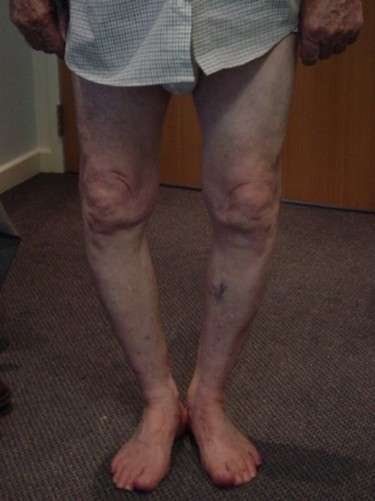
- Bow legged (varus) – more weight goes through the inner (medial) knee.
- Knock knee (valgus) – more weight goes through the outer (lateral) knee.
Over time this uneven load can cause wear and tear (osteoarthritis), especially if you have had a meniscus or ligament injury.
Modern surgical planning allows very accurate correction and quicker rehabilitation.
The pictures and long leg alignment XR’s below show examples of normal and abnormal alignment.
|
|
Bow legs XR |
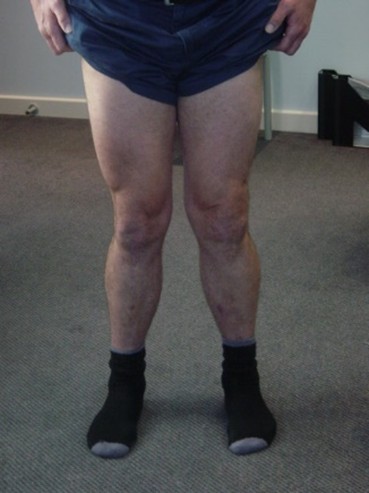 |
Knock Knees |
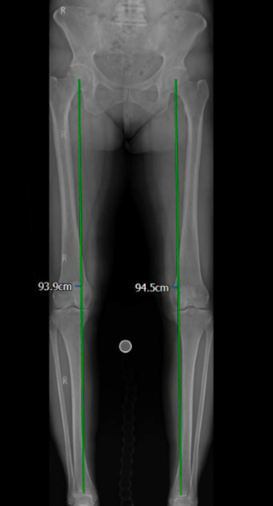 |
Bow legs on X-ray |
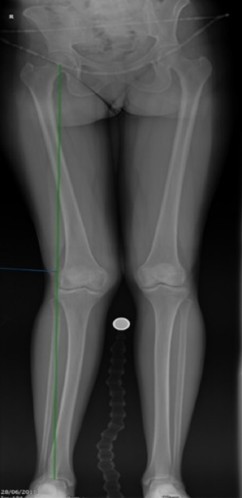 |
Knock knees on X-ray |
Types of osteotomy
High Tibial Osteotomy (HTO) - Used for bow legged alignment.
The upper shin bone (tibia) is realigned and fixed with a plate and screws.
Benefits:
- Off loads the worn inner side of the knee
- Allows full weight bearing earlier due to strong fixation
- Bone usually heals within 3–4 months
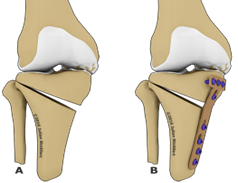 |
High Tibial Osteotomy held with plate and screws |
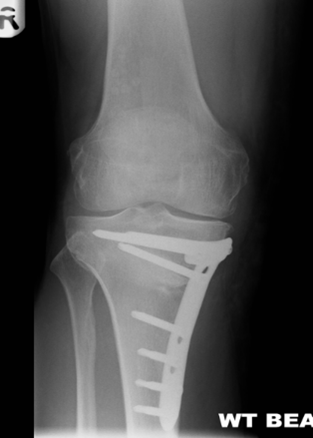 |
XR showing plate in position |
Distal Femoral Osteotomy (DFO) - Used for knock knee alignment.
The lower thigh bone (femur) is adjusted to offload the outer side of the knee.
Before and after Distal Femoral Osteotomy
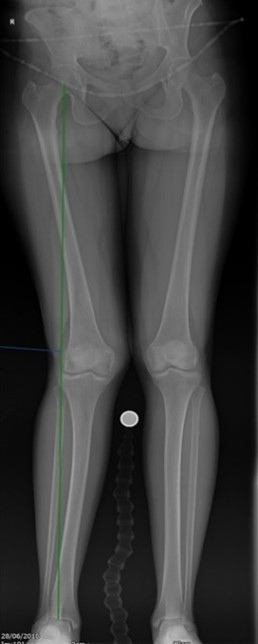
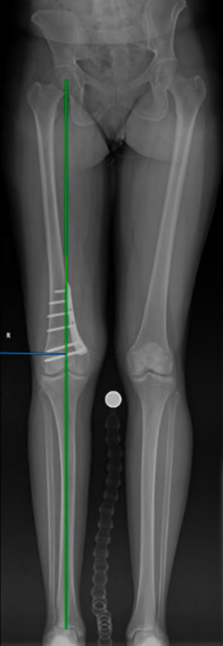
Combined osteotomy
Occasionally, both bones are corrected if alignment is severely off.
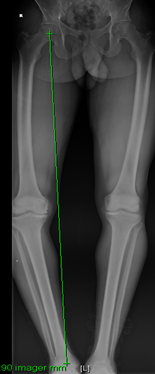 |
Long leg alignment XR showing severe varus (bowlegs) deformity |
 |
Post-op XR showing corrected alignment after combined HTO + DFO |
What happens before surgery?
You will be asked to attend a pre-assessment clinic. This is to ensure you are medically fit for surgery. It is important that you keep yourself as fit and healthy as possible prior to your operation.
What happens after surgery?
After the operation, you will wake up in the recovery room. You will be moved back to the ward once you are awake.
You can put weight on your leg straight away after the operation. You will need to use crutches for about six weeks.
Some patients will need to wear a brace for at least six weeks, and this will be discussed with you when you are admitted to the ward. You will be shown how to take the brace on and off your knee. It is normal to have the movement of your knee restricted for the first six weeks.
Physiotherapy will begin immediately to help you regain movement and strength. Your rehabilitation programme may be slightly different depending on your needs, but the main aim is to slowly build up your activity with guidance from your physiotherapist
Will I have to stay in hospital?
Patients normally stay in hospital for one night after the operation.
Follow-up care
As well as regular physiotherapy, you will also have follow-up appointments with your surgeon. Your first follow up appointment with your surgeons team is usually six weeks after surgery.
General guidance
Pain
- Some pain is expected for up to six weeks, gradually improving.
- Use medication and ice as needed.
Wound care
- Dressings stay on for two weeks, until reviewed by post-op nurses.
- You will have a scar along the tibia or femur.
Leg alignment
Your leg may look different in standing or lying after surgery—this is normal and expected.
When to seek help
Contact the ward you were discharged from if you have:
- Worsening pain
- Increasing redness, swelling or discharge
- Fever above 37.5°C
- A sudden difficulty moving your leg
Driving:
- Usually safe from 6 weeks after your consultant review.
- Do not drive while wearing a brace.
- Automatic car drivers may return sooner.
Work:
- Desk work: around 6 weeks
- Manual/active jobs: at least 3 months
Sport:
Guided by your consultant and physiotherapist.
Rehabilitation programme
Weeks 0-4
The aims are regaining quadriceps control, protected weight bearing and regaining flexion to 90 degrees
- Elevate leg when not walking and use regular ice packs to reduce swelling
- Partial weight bearing with crutches
- Quadriceps and hamstring exercises to maintain muscle bulk including isometric static quadriceps and hamstring exercises, straight leg raises and the use of an exercise bike without resistance once swelling has subsided
- Patella mobilisation exercises
- Range of movement aiming to achieve full extension and 90 degrees of flexion as soon as possible
Weeks 4-8
The aim of this phase of the rehab is to achieve full weight bearing, wean out of the brace, stop using crutches, achieve your full pre-operative knee movement and improve muscle strength
- Progress to full weight bearing as comfort allows and wean off using crutches
- Range of movement: maintain full extension and regain pre-operative amount of flexion
- Increase use of exercise bike to rebuild quadriceps, hamstring and calf strength
- Continued use of elevation and ice after exercises if needed to improve swelling
Months 2-6
The aim of this phase of the rehab is to regain full knee strength and control and return to chosen activities once the bone has fully healed
- Range of motion, maintain full movement
- Continued strengthening exercises as directed by physio, return to sports activities such as gym, golf, tennis, etc
You will be reviewed regularly during your recovery with outpatient follow-up at approximately 6 weeks, 3 months and 6 months. You will need x-rays at 6 weeks and 3-4 months and possibly 6 months to check the osteotomy has healed.
Useful Contacts
Heatherwood Hospital:
- Orthopaedic pre assessment 0300 614 7778 / 0300 614 7147
- Arthroplasty Nurse Heatherwood 07789927177
- Nurses Station Treetops Heatherwood 0300 614 4175
- Physio/OT Office Treetops Heatherwood 0300 614 4178
Frimley Park Hospital:
- Frimley Park Physiotherapy 07570 974390
- S2 Elective Ward Frimley 0300 613 3781 / 0300 613 3783
- Elective Helpline Frimley 0300 613 2556
Wexham Park Hospital:
- Ward 1 Wexham Park 0300 615 3010 / 0300615 3012
- Outpatient Physio Wexham 0300 615 3501 / 0300615 3500
- Wexham Park Physiotherapy 07717 199851
Contact us
If you have any queries relating to this information, please contact the Orthopaedics service.
About this information
Service:
Orthopaedics
Reference:
N/081
Approval date:
13 March 2026
Review date:
1 March 2029
Click ‘show accessibility tools’ at the bottom of the page

Then click ‘select language’

Alternative formats
You can use the accessibility toolbar at the bottom of your screen to:
-
Change the text size
-
Adjust the font
-
Modify the colour contrast
-
Use the translate function
If you would like this information in another format, such as Braille, audio, or easy read, please speak to a member of staff.
You can also print as well as download as PDF using the “Print this page” button at the end of the page.
Staff will print a copy for you on request
Important note
This page provides general information only. It is developed by clinical staff and is reviewed regularly every 3 years for accuracy. For personal advice about your health, or if you have any concerns, please speak to your doctor.