

Advice after your nerve block for surgery
On this page…
Introduction
We have given you this information because you have an appointment for a radiology procedure on the gastrointestinal (GI) tract. Please make sure you read this information and follow the instructions carefully before your procedure. If you have any further questions, please speak to a member of your healthcare team who will be able to advise you.
The oesophagus, or gullet, is the tube that takes food down from the mouth to the stomach. If it becomes narrowed or blocked, there will be a problem with swallowing so a procedure to insert an oesophageal stent has been requested. A stent is a metal mesh tube, which may have a fabric covering, which is inserted by mouth into the oesophagus and positioned across the area that has narrowed using X-ray guidance. The stent gently expands to allow fluid and foods to pass down to the stomach more easily.
The type of stent which may be used will be one of:
- Permanent self-expanding metal mesh stents
- Removable self-expanding metal mesh stents
- Biodegradable stent
Before your appointment
Please let us know if:
- there is any possibility that you may be pregnant. For the purposes of sedation and medication, all patients from 12-55 years of age (regardless of gender) will be asked about the possibility of them being pregnant.
- you have limited mobility and will require assistance to get on and off a couch.
- you will need an interpreter. We are not able to use family members or friends to interpret.
In order to make your appointment run more smoothly, please let us know if any of these apply, in advance, by calling our bookings team (contact details are displayed on the main Radiology page).
On the day of procedure
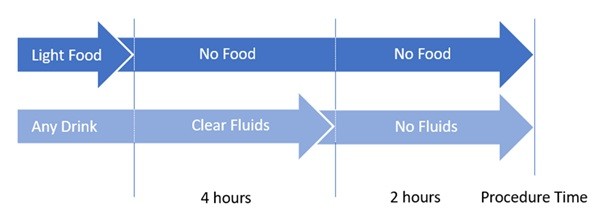
Eating – Do not eat any food for 6 hours prior to the time of your appointment.
Diabetic patients - If you are diabetic you should have received an early morning appointment. If not please contact the department to rearrange your appointment time to the next appropriate and available appointment. Do not take your diabetic tablets or insulin, but bring them with you. You also may want to bring a snack with you to eat after your examination
Eating and Drinking
You should have nothing to eat 6 hours prior to the time of your procedure. You can continue to drink clear fluids (water) up to 2 hours prior to the procedure but then nothing should be consumed.
What to bring with you
You will usually be admitted for the procedure as a day case. Occasionally it is necessary for patients to stay overnight in hospital after the procedure. For this reason we advise that you prepare an overnight bag and bring this with you.
Please bring with you to your appointment any sprays or inhalers that you are taking. Please bring a list of any regular medications you are taking
During the procedure
Referral and consent
You will be asked to sign a consent form confirming that you understand the procedure and are aware of the risks and benefits involved. Where practical this is usually done on the ward, before you come to the Radiology Department or in an outpatient clinic environment before your admission to the hospital.
The procedure is normally done as a planned procedure and you should have plenty of time to discuss the situation with your doctor or the nurse specialist looking after you before you sign the consent form. When you arrive for the procedure you will also discuss the procedure with the radiologist who will be performing the procedure who will again sign the consent form with you.
If after discussion with your hospital doctor or radiologist, you do not want the procedure carried out, then you can decide against it. If the radiologist feels that your condition has changed or that your symptoms do not indicate such a procedure is necessary then they will explain this to you and they will communicate with the referring doctor who will review your situation as soon as possible. At all times the radiologist and referring doctor will be acting in your best interests.
The Examination
Your procedure will be performed by a radiologist who will be working with a radiographer and a team of nurses.
Once called, you may be asked to change into a gown.
You will be required to drink one or more cups of flavoured liquid contrast which is not unpleasant. This enables the Radiologist to see your oesophagus on the television screen to identify the site of narrowing or obstruction.
You will have a local anaesthetic in your throat and be under mild sedation for the procedure. The interventional radiologist will introduce a device containing a wire and a catheter through your mouth and to the blockage in your gullet or small intestine. After the narrowing has been reached with the wire, a tiny balloon will be introduced and will slowly expand to dilate the area around the blockage.
Once the area has expanded enough, the stent will be inserted to bridge the blocked segment and keep it open. Sometimes a second dilation with a balloon is needed to help the stent expand better.
The procedure takes around 30 minutes, but please expect to be with us for an hour or so in total.
After the Examination
You will be taken back to the your ward, where you will need to rest. You will have your pulse, blood pressure and, if necessary your temperature, taken to ensure there have been no complications.
Your throat may feel sore. You may get some pain or discomfort in the gullet for a few days after the procedure as the stent expands.
You will not have anything to eat or drink until the nurse or radiologist are happy with your recovery. If you are comfortable and there are no obvious complications you will be allowed to drink clear fluids.
When you do start to eat it is advisable to begin by eating liquidised meals and progress to soft, moist foods if you feel comfortable. The dietician will advise you about what foods to avoid to prevent food blockage of your stent. It is important that you follow this advice and chew your food well. Try to have small frequent nourishing meals. Frequent drinks may help to keep your stent clear.
Risks
A stent insertion is generally a safe procedure. However, as with any procedure, some risks or complications may occur:
- There is a small risk of a perforation (tear) of your oesophagus (in the region of 1 in 300 cases). This is greater if you are currently having high dose chemotherapy or radiotherapy.
- Small perforations can be managed conservatively and can heal with rest from feeding and antibiotics. Larger holes may require an operation to repair them or another stent inserting.
- A small amount of bleeding may occur, but more significant bleeding is very rare.
- Some people get heartburn and acid reflux after the procedure. The symptoms may be worse when lying flat so sleep with extra pillows to raise your head. You may be prescribed an acid reducing tablet such as Omeprazole or Lansoprazole and antacids to take after each meal and before going to bed.
- Rarely, the stent may slip out of position and the procedure may need repeating.
- X-rays are a type of radiation. We are all exposed to natural background radiation every day from the sun, food we eat, and the ground. Exposure to medical X-rays carries a small additional risk, but your doctor feels that this risk is outweighed by the benefits of having the test and the amount of radiation you will receive is kept to as low as reasonably possible.
Contact us
If you have any queries relating to this information, please contact the Radiology service.
About this information
Service:
Radiology
Reference:
PILS-IR.20
Approval date:
2 October 2024
Review date:
2 October 2027
Click ‘show accessibility tools’ at the bottom of the page

Then click ‘select language’

Alternative formats
You can use the accessibility toolbar at the bottom of your screen to:
-
Change the text size
-
Adjust the font
-
Modify the colour contrast
-
Use the translate function
If you would like this information in another format, such as Braille, audio, or easy read, please speak to a member of staff.
You can also print as well as download as PDF using the “Print this page” button at the end of the page.
Staff will print a copy for you on request
Important note
This page provides general information only. It is developed by clinical staff and is reviewed regularly every 3 years for accuracy. For personal advice about your health, or if you have any concerns, please speak to your doctor.