

Advice after your nerve block for surgery
On this page…
What is a Colonoscopy?
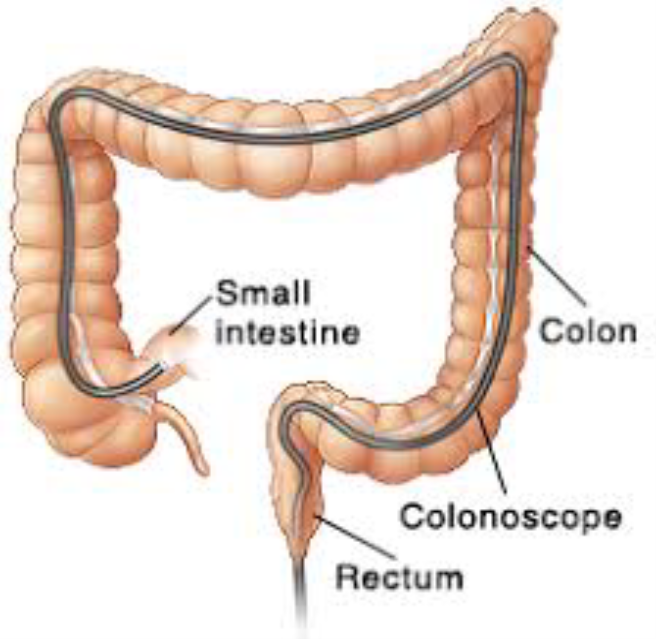
A colonoscopy is an investigation using a flexible, telescopic tube to look at the lining of the large bowel (colon). A long tube, called a colonoscope is inserted at the anus and maneuvered around to the appendix. The whole of the large bowel (colon) is about 1.5 metres in length.
To get good views, you will need to eat a restricted diet for 2 days before your appointment and take a laxative (bowel prep) to clear out the bowel. Some medications may need to be stopped.
Detailed instructions for taking bowel prep will be sent to you with the bowel prep medications after you have had any necessary blood tests.
Why do I need a Colonoscopy?
You have completed a Faecal Immunochemical Test (FIT) sent by the national Bowel Cancer
Screening Programme, this has indicated blood in the stool which requires further investigation
What are the alternatives?
An alternative test called a CT colonography (scan) is available which your doctor can refer you for separately. This is a less invasive test which uses x-ray equipment and a computer to obtain an interior view of the colon. However, it is strictly a diagnostic procedure that still requires bowel prep to be taken but which does not allow tissue to be sampled. We get better pictures from a colonoscopy and can also take biopsies (small samples for testing) or remove polyps (growths on your bowel lining) at the same time, both of which help with your diagnosis. If we find an abnormality during CT colonography, you would then need to have a colonoscopy to examine or treat it.
What are the benefits?
A normal test result can reassure you that all is well. A colonoscopy can also help us to reach a diagnosis (sometimes by taking biopsies) to make sure you are on the best treatment. If you have polyps, we can remove them during the procedure.
What are the risks?
A colonoscopy is an extremely safe procedure and complications are very rare.
Possible complications can include:
- Bleeding: It is common to pass a small amount of blood from your anus if a biopsy or a polyp has been removed. This should only happen up to 12-24 hours after the procedure and is usually no more than a few teaspoons full. So do not worry if you open your bowels after the test and notice some blood. The risk of this is 1 in 100 if you have a polyp removed. The risk of bleeding requiring a blood transfusion following polypectomy is approximately 1 in 2,400
- Perforation: We take every care to avoid perforation; but if it happens your abdomen may become painful and bloated. You may need to stay in the hospital, have more tests such as a CT scan or, in extremely rare cases, you may need surgery to repair the hole. The risk of making a perforation (hole) during this test is less than 1 in 1,700
It is also possible to miss small abnormalities. The chance of missing cancer or a polyp is approximately 3 in 100 colonoscopies
- Reactions to the sedative: We give you the smallest possible dose of sedative to prevent you from having any side effects. If you do have a reaction, we will give you medication to reverse the effects of the sedative.
- Failure to complete: Occasionally, the procedure may need to be abandoned or may be incomplete; for example, if the bowel preparation did not empty your bowel completely, if there is a narrowing or sharp angulation of the bowel or if you find the procedure too uncomfortable. In this case, the procedure may need to be repeated, or we may suggest an alternative procedure.
Will I need sedation?
The majority of colonoscopies are done under sedation. The type of sedation used is called conscious sedation and is not a full general anaesthetic. This means that although you will feel sleepy, relaxed and may not remember the examination, you will still be able to respond to verbal instructions, i.e., you are awake, but drowsy. Sedation is given through an intravenous cannula, which is a small tube that is put into a vein in the back of your hand.
Will I have to stay in hospital?
You will usually have the colonoscopy as a day patient, involving a stay of 3 - 5 hours.
Will I get the results straight away?
When you have recovered, a healthcare professional will explain the results. If a biopsy has been taken or a polyp removed, you will be told when and where you can get these results.
Are there any after effects?
After effects are rare, but you may notice some bleeding if a biopsy has been taken or a polyp removed. You may also experience abdominal pain within the first 24 hours after the colonoscopy.
What preparation do I need for the examination?
Please refer to the Bowel prep information leaflet. If you don’t have this, please contact the telephone numbers at the back of this leaflet. Also, please see instructions below.
Four days before your examination
Stop taking any constipating agents, e.g., co-phenotrope, codeine phosphate etc but continue with other medication and any laxatives. Avoid fibre supplements such as Fybogel.
Two days before your examination
Eat only the following foods: white fish, chicken, cheese, white bread, eggs, butter or margarine, plain yoghurt, honey (but not jam or marmalade), rich tea biscuits, potato (without the skin), yellow jelly (not red), ice cream, sorbets (not red). Have plenty to drink. Do not eat high fibre foods, red meat, pink fish, fruit, vegetables, mushrooms, salad, wholemeal bread, cereals or pulses in any form.
Special Precautions for Bowel Preparation
- If you are taking any regular medication for stomach, bowel, heart, lung, kidney or other medical conditions, please continue these as normal, you may take your medications with a glass of water on the day of your examination.
- If you normally take any iron tablets, stop taking them 7 days prior to your procedure.
- For patients on oral anticoagulants (warfarin, apixaban, daligatran, rivaroxaban) OR the antiplatelet drugs clopidogrel or tricagralor, we will advise how these medications should be managed around your procedure. Please contact us on 0300 615 4154 if you have not been contacted regarding the above medication.
- For patients on warfarin, please have your INR checked 7 days before your procedure and call us at 0300 6154154 with the result. Your INR will be checked again on the day of the procedure by our nursing team. 75 mg daily of aspirin may be continued.
- If you have had a heart attack, have acute heart failure or have had a coronary stent inserted recently, it is advisable to wait until your condition has stabilised before having your colonoscopy, usually 6 weeks. Check with us by telephoning 0300 615 4154 Please also check with your cardiologist.
- If you are asthmatic, please bring your inhalers with you. If you have a CPAP machine at home, please bring this with you.
- If you are taking any regular medication for diabetes, please read the Diabetes advice leaflet or please telephone 0300 615 4154 if you have not received this. The advice leaflet will explain how to control your blood sugar around the time of your procedure and bring your diabetic pills or insulin with you. It is important to maintain a blood sugar above 5 mmol/l leading up to your procedure. Check your blood sugar level and if necessary, take some glucose tablets ahead of your procedure to achieve this.
- If you have a colostomy (external stool bag on a stoma from previous bowel surgery), the bowel preparation medicine will work in the same way. You are advised to put on a drainable appliance before taking the medicine until after the examination. If you do not have any drainable appliances (pouches), please contact your stoma care nurse at Wexham Park Hospital on 0300 615 3734 or Frimley Park on 0300 613 6301 bleep via the hospital switchboard on 0300 614 5000. Please bring some spare stoma bags with you.
- Please let us know by telephoning 0300 615 4154 if you are pregnant or trying to conceive.
- If you are taking the oral contraceptive pill, you should take alternative precautions during the week after taking bowel prep as rapid bowel transit may make the pill ineffective.
What happens when I arrive for my test?
Please note that your appointment time is the time that you should arrive in the department. It is not the time of your actual procedure. We recommend that you plan to be with us for the whole morning or afternoon, depending on your time slot.
When you arrive, a nurse will complete your assessment with you and will ask about your arrangements for getting home. If you have sedation, someone must come to the endoscopy unit; collect you and stay with you overnight. You will not be allowed to go home on your own in a taxi.
The nurse will check your temperature, blood pressure, pulse, respiration rate and your oxygen levels. If applicable, the nurse will check your INR and blood sugar levels. If you choose to have sedation, a nurse or a doctor will put a cannula (small plastic tube) into a vein, usually on the back of your hand, through which the Endoscopist will administer the sedation. You will be asked to change into a hospital gown and remove your underwear. We will offer a pair of dignity shorts for you to wear. There are single changing cubicles available in the unit.
Informed Consent
Prior to the procedure, you will be required to sign a consent form. Before signing it, the healthcare professional will discuss with you what the procedure is likely to involve; the intended benefits; alternative investigations; significant, unavoidable or frequently occurring risks; and any extra procedures which may become necessary. All of the information which will be discussed with you is included in this leaflet. We want to involve you in decisions about your care and treatment. If you are unsure about any aspect of the treatment proposed, please do not hesitate to speak with a member of staff.
What happens before the test?
A nurse will take you into the endoscopy room and make you comfortable on an examination couch. The nurse will monitor your blood pressure, pulse, respiration rate and your oxygen levels during the test. The nurse will ask you to lie down on your left side. The nurse or endoscopist will give your choice of pain relief (sedation and pain killer or gas and air) now. If you are having a sedative, we will give you supplementary oxygen.
What happens during the test?
A nurse will be with you at all times during your procedure to reassure you and talk you through what is happening. The endoscopist will gently put the colonoscope into your anus and move it along the length of your colon. They may ask you to change position to:
- make you more comfortable.
- make it easier to pass the colonoscope around your bowel.
- and/or make sure they can see as much of the inside lining of your bowel as possible.
We will put gas into your bowel so that we can see better. You may feel ‘wind’ or cramps during the procedure and perhaps the occasional ‘twinge’ as the colonoscope is pushed around bends.
It should not be painful. If it is, please tell the endoscopist. They can give you medication to ease the pain or change what they are doing. The endoscopist can take biopsies or remove polyps during the test, by passing thin instruments through the colonoscope. This does not hurt, and you may not feel it happening at all. During the test medical photographs are taken for the report.
How long does the test take?
It usually takes 20 – 30 minutes. It may take longer depending on what needs to be done. How long it takes you to recover depends on whether you have had a sedative. Patients with morning appointments should be ready to be discharged from the unit between 11.00am and 1.00pm. Patients with afternoon appointments should be ready for discharge between 4.00pm and 6.00pm.
What happens after the test?
You must rest in the unit for at least 30 minutes to an hour after your procedure or until the effect of the sedative has worn off. You may feel a little bloated with wind pains, but these usually disappear quickly. You may resume eating as normal. A nurse will give you any necessary paperwork before you leave the department. We will also send a copy of the report to your GP or the hospital specialist
If you have had sedation, your mental ability to think clearly and make decisions may be affected for up to 24 hours after the procedure even though you feel wide-awake. For this reason, you must have someone who can collect you from the Unit, take you home and look after you for the rest of the day.
If have had sedation, for 24 hours after your procedure you must not:
- Drive
- Operate potentially dangerous machinery
For 8 hours after sedation, you should not:
- Use potentially dangerous appliances, such as cooker or kettle
- Have a bath unsupervised
- Look after dependants on your own
- Go to work
- Sign any legal documents
- Drink any alcohol, take sleeping tablets or recreational drugs
Sedation and analgesia (pain killer) or Entonox® (gas and air)?
Intravenous sedation and pain killer or Entonox® for pain relief can improve your comfort during the procedure so that the endoscopist can perform the procedures successfully. You can have a sedation or Entonox depending on your choice during colonoscopy procedure. The nurse will discuss this with you on admission and during the consent process.
Intravenous sedation and pain killers
The sedative and the pain killer will make you feel slightly drowsy and relaxed. Sedation is not an anesthetic therefore you will be conscious.
You will be in a state called co-operative sedation. This means that, although drowsy, you will still hear what is said to you and therefore will be able to follow simple instructions such as a request to change your position during the procedure. You should still be able to talk to
You will be in a state called co-operative sedation. This means that, although drowsy, you will still hear what is said to you and therefore will be able to follow simple instructions such as a request to change your position during the procedure. You should still be able to talk to the staff during the procedure and tell them how you are feeling and see the video screen if you wish.
If you have a sedative, someone must come to the endoscopy unit; collect you and stay with you overnight. If not, we would have to cancel your colonoscopy. You will not be allowed to go home on your own in a taxi.
Entonox® (gas and air)
Entonox® is a powerful pain killer. It provides rapid, safe and effective short-term pain relief. You may already know that Entonox® is used to relieve pain during childbirth. You are able to drive a car after 30 minutes of its use.
What happens when I go home?
You may feel a little bloated and have some mild cramps due to the gas that was put into your bowel during the procedure. This usually settles within 24 hours. We encourage you to pass wind to ease these symptoms. If you keep getting wind pain, we advise you to lie on your right side; or walk around if you are stable on your feet.
You may notice a little blood with your next bowel movement, on your underwear or toilet tissue.
As you had bowel prep, it may take up to three days before your colon fills up and you have a bowel movement. You can eat and drink as normal and continue to take your regular medication unless advised otherwise. We recommend you drink plenty of fluids to keep hydrated.
Care provided by trainees
Our department supports clinical training and so there may be a trainee nurse assigned to the procedure list. We will make the investigation as comfortable as possible for you. If you do not wish to have your care or procedure undertaken by a trainee, please advise the staff. Neither your treatment nor timings will be affected by your decision.
What should I bring with me to hospital?
- the name and contact number of the person collecting you
- a list of medications including herbal and over the counter medications
- a list of allergies to medication, food or substances
- please bring your essential medications such as insulin, Parkinsons medication, epilepsy medications, etc.
- Please do not bring any valuables with you. The hospital cannot accept responsibility for the loss or damage to personal property during your stay in endoscopy. However, please make sure that you bring your hearing aids and eyeglasses and make sure to inform the nurse during your admission.
- Please bring a bag to place all your belongings whilst in the unit
Contact us
If you have any queries relating to this information, please contact the Endoscopy service.
About this information
Service:
Endoscopy
Reference:
H/084
Approval date:
1 July 2025
Review date:
1 July 2028
Click ‘show accessibility tools’ at the bottom of the page

Then click ‘select language’

Alternative formats
You can use the accessibility toolbar at the bottom of your screen to:
-
Change the text size
-
Adjust the font
-
Modify the colour contrast
-
Use the translate function
If you would like this information in another format, such as Braille, audio, or easy read, please speak to a member of staff.
You can also print as well as download as PDF using the “Print this page” button at the end of the page.
Staff will print a copy for you on request
Important note
This page provides general information only. It is developed by clinical staff and is reviewed regularly every 3 years for accuracy. For personal advice about your health, or if you have any concerns, please speak to your doctor.