

Advice after your nerve block for surgery
On this page…
You have been advised to have a bronchoscopy to help find the cause of your symptoms, or to assess the progress of your condition. The examination will be carried out in the Endoscopy Unit, which is situated on the first floor of the hospital. Please do not bring valuables with you as the hospital cannot accept
responsibility for the loss or damage to personal property during your time on these premises.
Bronchoscopy & EBUS takes about 45 minutes to complete, but this varies with the individual findings.
Patients should be ready for discharge by approximately 1300hrs.
If you have sedation, it is essential that someone is available to drive you home as you will not be able to drive for 24 hours afterwards. It is also recommended that if you have had sedation, you do not operate machinery or make important decisions for the remainder of the day, as sedation impairs your reflexes and judgement. Someone will need to be with you for the remainder of the day and overnight if you have had sedation. If there is a problem with this please discuss this with the admitting team.
What is a Bronchoscopy & EBUS?
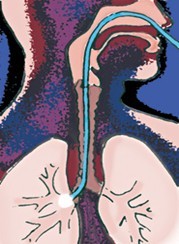
A bronchoscopy is an investigation which allows the doctor to look directly at the trachea (windpipe) and the bronchi (branches of the airway). A bronchoscope is passed through your mouth, past the larynx (voice box) and into your trachea and airway. A small plastic mouth guard will be placed into your mouth to prevent you accidentally biting the instrument. Having inspected the airways, the doctor will use the ultrasound probe on the end of the bronchoscope to look through the walls of the airway to examine the lymph nodes (glands) and other structures in the centre of your chest. This allows the doctor to take a biopsy by passing a fine needle into these structures which can be analysed by the laboratory.
A diagram of this procedure showing bronchoscope passing down the airway with the bright light on the end
Risks
All endoscopic procedures carry a small risk of bleeding or pneumothorax (collapsed lung) less than 1:100 risk.
Other rare complications include allergic reactions to local anaesthetic or sedative.
Preparation
You must not eat or drink for at least 6 hours before examination. The examination can be performed using local anaesthetic spray and with an injection of a sedative. If you prefer to try without sedation this is sometimes possible. You will be able to discuss these options in detail on the day of your procedure.
Your Usual Medications
It is important to take your regular prescribed medications on the day of your bronchoscopy. You may take these with a small sip of water only. Some medications cause you to bleed excessively including:
• Aspirin
• Dipyridamole
• Clopidogrel
• Ticagrelor
• Warfarin & Sinthrome
• Dalteparin & other heparin injections
• DOACs (Rivaroxaban, Apixaban, Dabigatran, Edoxaban, Argatroban)
These may need to be stopped for several days before your procedure. If you are taking any of these medicines, please inform the doctor performing your bronchoscopy so that we can advise you on this:
Please contact the Respiratory Secretaries - Tel: 0300 613 4122 or 0300 613 6203
What to expect before the procedure:
The doctor or nurse will explain the procedure to you and will be happy to answer questions. You will have your pulse and blood pressure taken and will be asked about previous medical history. Bring details of any medication you are currently taking. We will require the telephone number of a relative or friend who will be able to collect you.
You will be asked to sign a consent form giving permission for the examination.
What to expect during the examination
In the treatment room you will be asked to lie on a trolley. A cannula will be inserted into a vein in your arm. A local anaesthetic will be sprayed in your nose and mouth. An intravenous sedative will be inserted into a vein. As the bronchoscope is passed you may cough, but as the anaesthetic takes effect your throat will relax. You will be monitored throughout the whole procedure with supplementary oxygen in your nose.
What to expect after the examination
You will rest in the recovery area for about one hour, or until the main effects of the sedation have worn off. Because your throat will be numb, you will not be able to eat or drink for about one hour.
The doctor may wish to see you before you go home, and you will be given a letter giving you details of follow-up arrangements. If any biopsies have been taken, the letter will also give you details of when results will be available.
After the examination you may cough up small amounts of blood over the following 24 hours, this will soon pass and is nothing to worry about. Any soreness in the throat or hoarseness will also ease in a day or so. A low grade fever can occur in the 12 hours following this
procedure. A simple pain killer such as paracetamol can help.
If you require further information, please contact:
Endoscopy Unit
Tel: 0300 613 4509
During the hours of 8am to 6pm
Any Questions?
The team/staff involved in your care have written this page to make your admission and care as smooth as possible. However, it does not cover every aspect of your care, and the staff will be happy to answer any questions or points of concern.
Contact us
If you have any queries relating to this information, please contact the Respiratory medicine service.
About this information
Service:
Respiratory medicine
Reference:
W/051
Approval date:
6 December 2024
Review date:
1 April 2026
Click ‘show accessibility tools’ at the bottom of the page

Then click ‘select language’

Alternative formats
You can use the accessibility toolbar at the bottom of your screen to:
-
Change the text size
-
Adjust the font
-
Modify the colour contrast
-
Use the translate function
If you would like this information in another format, such as Braille, audio, or easy read, please speak to a member of staff.
You can also print as well as download as PDF using the “Print this page” button at the end of the page.
Staff will print a copy for you on request
Important note
This page provides general information only. It is developed by clinical staff and is reviewed regularly every 3 years for accuracy. For personal advice about your health, or if you have any concerns, please speak to your doctor.