

Advice after your nerve block for surgery
On this page…
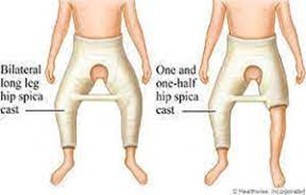
Caring for a child in a Hip Spica Cast can be hard work. There is no doubt that these casts can be awkward for both the parent and the child. We hope this advice leaflet will help you deal with the every day issues you may face caring for a child in a Hip Spica.
What is a Hip Spica Cast?
The Hip Spica cast can vary: your child may have one or both legs in the cast, and the position and type will be dependant on your child’s medical condition. In all cases, your child’s tummy and lower back will be encased in the cast. Whatever position your child’s leg/s are in, the care principles will remain the same. Your child will adapt to life in the cast very quickly.
What is it made of?
At Frimley Health, we use a combination of casting materials. There may be a layer of Plaster of Paris applied first, as this contours and moulds to your child’s body. Then a layer of Synthetic material such as Fibre Glass will be applied to give the cast strength. The Orthopaedic Casting Practitioners applying the cast will select the material used. The cast will normally take approximately 24 - 48 hours to dry completely, depending on the combination of materials used. If the cast is made from Synthetic material only, it will be at maximum strength within 2 –3 hours. Every effort will be made to ensure the cast is comfortable before you leave the hospital. The outside of the cast can be quite rough to touch, so now is not the time to be wearing those ‘best’ clothes!
What about clothing?
Clothing can sometimes prove troublesome. Girls are slightly easier to dress than boys, as little dresses will usually fit nicely over the cast. Trousers or shorts can be bought a size or two larger and then cut down the seams, Velcro can then be sewn in to make them easy to put on and take off. This can also be done to underwear. Socks and bootees can be worn as normal if feet are not encased in the cast.
What size nappies will I need to buy?
If your child is NOT potty trained, you will need to buy two sizes of nappy. You will need Newborn nappies, which should be pushed up inside the cast in the nappy area. Then you will need a larger size nappy to go around the inside nappy and the cast to secure it all in place. The nappies will need to be checked more frequently than usual, as this will help to lower the chances of leakage. Although some leakage is inevitable. If your child is potty trained you will probably need to support them on the potty or toilet.
Can I bath my child in the Hip Spica cast?
You will NOT be able to bath your child, as the cast cannot be immersed in water. Washing with a damp flannel or baby wipes should suffice. Do not use talcum powder as this can irritate your child’s skin if it gets inside the cast. Hair washing may require two adults, one to support/hold the child and the other to wash the hair.
What about bedtime?
When putting your child to bed, make sure there are plenty of pillows and cushions to support their body and legs. It may take a couple of nights to work out a comfortable position for your child.
Can my child go out in a pushchair?
Transporting your child comes with issues of its own. In most cases the Hip Spica will be applied in a way so that your child will ‘fit’ into most car seats and pushchairs. Car seats that have flatter seat sides are probably better at the moment. A wheelchair with leg supports is best for the older child. Cushions will help you make them more comfortable.
Are there special food requirements?
Meals should be little and often, as there won’t be much room in the cast for a full tummy. Plenty of fruit, vegetables, whole meal bread and cereals will reduce the possibility of constipation. If your baby is breastfed, you may still continue but you might have to experiment with finding a comfortable position for you both. Small babies are naturally prone to wind and colic. The cast will prevent them from drawing their legs up to allow the wind to travel through their systems; therefore, more time and care should be taken over winding your baby after a feed.
Finally….
Don’t allow your child to push anything (e.g., toys, pencils, etc) inside their cast. Your child will adapt very well and very quickly to life in their Hip Spica. They will find ways to move about the house and should be treated as normally as possible. Ensure you change your child’s position frequently to prevent pressure sores.
Their heels and the skin near the edges of the cast will be most at risk from pressure sores when in a Hip Spica, so check their skin regularly. Cushions, beanbags, duvets and blankets will all help to give your child support and comfort.
Cast Removal
The cast will be removed in the Plaster Room on a date decided by the Consultant in charge of your child’s care. The cast will be removed using our oscillating cast saw. It will not hurt your child but some children can be frightened of the loud noise it makes and the ‘tickling’, vibrating feeling of it as it cuts through their cast.
Videos explaining how the Oscillating saw works can be found on YouTube™.
For more tips and advice contact:
STEPS - a charity who offer support and information about lower limb conditions.
STEPS
The White House,
Wilderspool,
Business Park, Greenalls Avenue,
Warrington
WA4 6HL
Telephone: 01925 750271
Website: www.
Hip spica care – babies and toddlers toileting www.
Hip spica care – older children toileting www.
In Car Safety Centre, can provide advise and potentially loan car seats to enable a child in a Hip Spica to travel safely within a car.
Email: essex@
Telephone: 01702 808313
Website: www.
If you have any worries or concerns with the cast, you can contact the Plaster Room and speak to one of the Orthopaedic Casting Practitioners, who will be only too pleased to help and reassure you.
The contact number for the Plaster Room at Frimley Park is: 0300 6134339
Opening hours: Monday – Friday, 9am – 5pm
The contact number for the Plaster Room at Wexham Park is: 0300 6154058
Opening hours: Monday, Tuesday, Thursday, Friday, 9am – 5pm
Wednesday 9am – 1pm (closed in the afternoon)
Contact us
If you have any queries relating to this information, please contact the Plaster room service.
About this information
Service:
Plaster room
Reference:
N/048
Approval date:
1 November 2025
Review date:
1 November 2028
Click ‘show accessibility tools’ at the bottom of the page

Then click ‘select language’

Alternative formats
You can use the accessibility toolbar at the bottom of your screen to:
-
Change the text size
-
Adjust the font
-
Modify the colour contrast
-
Use the translate function
If you would like this information in another format, such as Braille, audio, or easy read, please speak to a member of staff.
You can also print as well as download as PDF using the “Print this page” button at the end of the page.
Staff will print a copy for you on request
Important note
This page provides general information only. It is developed by clinical staff and is reviewed regularly every 3 years for accuracy. For personal advice about your health, or if you have any concerns, please speak to your doctor.