

Advice after your nerve block for surgery
On this page…
Introduction
This page has been given to you to help answer some of the questions you might have about having lithotripsy to treat your kidney stones.
If you have any questions or concerns, please do not hesitate to speak with your doctor, sonographer or nurse.
What is lithotripsy?
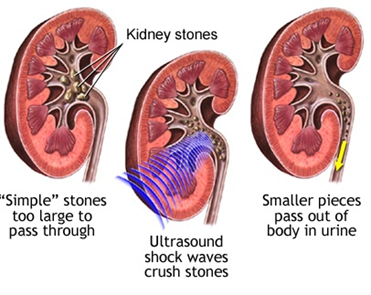
Lithotripsy comes from the Greek words ‘lithos’ and ‘tripsis’ and literally means ‘stone breaking’. The procedure uses shock waves to break your kidney stones into small sand-like particles that can then pass out of your body through your urine.
Why do I need this procedure?
Your doctor has found that you have a stone or several stones in your kidney or ureter (tube that links the kidney with the bladder). Kidney stones can be painful and can cause infection or blood in your urine. If nothing is done to remove them, they may continue to grow and could eventually damage your kidney or block your ureter.
What are the benefits?
Lithotripsy is performed at Heatherwood Hospital in the dedicated Lithotripsy Centre in the Day Surgery Unit as an out-patient procedure. This means that you can come to the hospital, have the procedure and then return home all within 2 hours. Please note that during the 2 hours you will be required to wait up to 30 minutes for the drugs to take effect so please bring a book or a tablet to pass the time. Lithotripsy avoids the need for surgery and anaesthetic, reducing your hospital stay and the amount of time you will need to recover.
What are the risks?
As with any procedure, there are risks when having lithotripsy. The majority of patients do not have serious problems but it is important to be aware of them. The sonographer will discuss the risks and benefits and ask you to sign a consent form.
There are several risks that you should be aware of:
- It is common for patients to have blood in their urine after lithotripsy. Like blackcurrant cordial, a few drops of blood will make the urine pink/red. This is likely to settle within a few days of the treatment.
- Between 1 in 50 and 1 in 250 patients experience more severe bleeding. Should this occur, you may require a blood transfusion and, very rarely (1 in 500), a metal coil may be placed into the bleeding blood vessel via a small puncture in the groin to stop the bleeding.
If you are concerned about the amount of bleeding that you are having, call the Lithotripsy Centre on 0300 614 4130 / 0300 614 4131, contact your GP or attend your closest A & E department.
- As the small fragments pass down your urinary tract you may get some discomfort or pain. This occurs in 1 in 2 people. It is advisable to have some pain killers available for when you get home, such as paracetamol and ibuprofen. Please check with a Doctor or Pharmacist to ensure it is safe for you to take these medications. If the pieces are too big to pass you may need a repeat session of lithotripsy or a small operation to remove the stone via a telescope placed through the water pipe.
- You may develop a urine infection. Symptoms of this can include:
- Cloudy and offensive smelling urine
- Feeling shivery
- A raised temperature.
If you have any of these symptoms and think that you may have a urine infection, call the Lithotripsy Centre on 0300 614 4130 / 0300 614 4131, contact your GP or attend your closest A & E department.
- You may need more than one session of lithotripsy, so a further appointment may be made for you after your treatment. Once you have had a stone you are at increased risk of forming more stones in the future, so re-treatment may be required months or years later. The most important thing for you to do to prevent them reforming is to ensure you drink plenty of water which is 2-3 litres daily.
Are there any alternatives?
Kidney stones in the ureter can be removed with a fibre-optic telescope, in a procedure called a ureteroscopy. Larger stones can be removed through a small hole made in your side, although this involves a longer stay in hospital with associated longer recovery time. Please talk to your Consultant or the sonographer if you would like more information on these alternative treatments.
Before the procedure
The sonographer (the person who delivers the treatment) will check the consent form with you and remind you of the risks and benefits. Please do not hesitate to ask any questions. If there is a possibility that you could be pregnant, you must inform staff as soon as possible, as the x-rays could have harmful effects on an unborn baby.
You must eat and drink normally before the procedure it is particularly important to have a full stomach so make sure you have breakfast or lunch depending on your treatment time.
The machine makes a loud clicking noise and you are welcome to bring a music player and headphones to listen to your music.
For the procedure you may need extra painkillers on top of the standard tablets/ suppository; if you do, you will not be able to drive home and will need a responsible adult to collect and take you home.
If you have been invited to sign up to the MyFrimleyHealth Record App please do, as this will speed up your discharge on the day.
IMPORTANT NOTICE
Please contact the Lithotripsy Centre at least two weeks before your procedure for advice on how long you need to stop taking blood thinners for:
this includes warfarin, clopidogrel, apixaban, rivaroxaban, Edoxaban, dipyridamole.
If you do not stop your blood thinner in time, the treatment will be cancelled and rebooked.
Arriving at the Lithotripsy Centre
The department is located in the Day Surgery Unit on Level 2 of Heatherwood Hospital which is located at Brook Avenue, Ascot, SL5 7SG. DO NOT GO TO RADIOLOGY.
Please Note: Only the patient is allowed through from Day Surgery Reception into their Day Surgery Pod. This is due to limited space in Day Surgery and is an attempt to minimise the volume of people in the department. Family members and friends are welcome to wait in Day Surgery Reception or in the Cafe. A family member or friend will be allowed through to be with the patient in exceptional circumstances but this will need to be approved by the Nurse in charge of Lithotripsy.
Please do not wear any jewellery, as we cannot be responsible for any valuables that are lost while you are in the department.
A nurse will ask you some questions about your medical history and take your blood pressure so that you are properly prepared for the treatment. The nurse will also ask you to give a urine sample.
The nurses will give you some painkillers. These are usually in the form of tablets and/ or a small suppository.
During the procedure
The sonographer will ask you to lie on your back or front on the machine depending on the location of your stone. X-rays and/or ultrasound are used to locate and target the stone(s). Then a water cushion will come up against the side of your skin.
When the lithotripsy begins, you will be aware of shock waves entering your body. Some people describe it like having a finger flicking your skin or small static shocks. While some people find this painful, others are pain free during the treatment. If you experience pain, please tell the sonographer (who will be present throughout), and they will be able to reduce the power of the machine.
During the procedure, shocks are delivered to the stone at the rate of two per second. The treatment lasts for about 25 minutes and delivers around 3,000 shock waves, which pass through your body to break the stone into fragments. These fragments then have to pass out of your body in your urine.
After the procedure
If you were not given additional painkillers, you will be able to go home as soon as you feel able. If you have additional/stronger painkillers, it may be necessary to spend a little longer in the unit to recover and you must have someone to escort you home. He/she should come with you for the appointment or be contactable by phone when you are ready to leave.
You should rest at home following your procedure and should be able to carry out your normal activities 24 hours after the procedure. To flush out stone fragments, make sure you drink plenty of fluids – mainly water. Try to drink 2-3 litres of fluid per day. You should continue drinking this amount in the long term, as this can help to prevent the development of new stones.
What to look out for when you are home
You may see blood in your urine for one or two days after the procedure. This is normal and will fade and clear. You may feel a bit sore after the procedure. You can take simple painkillers such as paracetamol to help with this.
If the pain becomes severe or if you develop a temperature (above 38◦C or 100.4 F), call the Lithotripsy Centre or your GP.
Alternatively, go to your nearest Accident & Emergency Department; please take your lithotripsy treatment report with you.
Your follow up appointment
If your kidney stones are large, you may need more than one session to break them up entirely. You will have a follow-up appointment a few weeks after your completed course of lithotripsy to check the success of the treatment. If you do not receive your appointment before you go home or if you need to change the date, please call the Lithotripsy Centre on 0300 614 4130 / 0300 614 4131 between 9.00 am and 5.00 pm Monday - Friday.
Contact us
If you have any queries relating to this information, please contact the Urology service.
About this information
Service:
Urology
Reference:
Z/050
Approval date:
28 October 2024
Review date:
30 June 2027
Click ‘show accessibility tools’ at the bottom of the page

Then click ‘select language’

Alternative formats
You can use the accessibility toolbar at the bottom of your screen to:
-
Change the text size
-
Adjust the font
-
Modify the colour contrast
-
Use the translate function
If you would like this information in another format, such as Braille, audio, or easy read, please speak to a member of staff.
You can also print as well as download as PDF using the “Print this page” button at the end of the page.
Staff will print a copy for you on request
Important note
This page provides general information only. It is developed by clinical staff and is reviewed regularly every 3 years for accuracy. For personal advice about your health, or if you have any concerns, please speak to your doctor.