

Advice after your nerve block for surgery
On this page…
What is the temporomandibular joint?
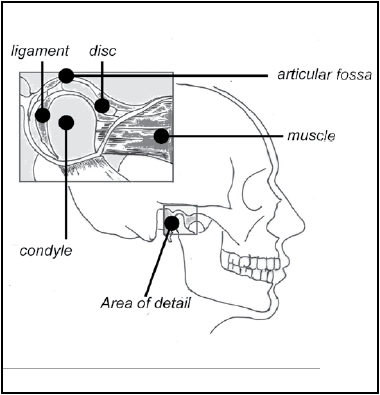
The temporomandibular joint (TMJ) is located in front of each of your ears, where your skull and lower jaw meet. It allows your lower jaw (mandible) to move.
The TMJ is a hinge and gliding joint and is the most constantly used joint in the body. The round upper end of the lower jaw, or the movable portion of the joint, is called the condyle; the socket is called the articular fossa. Between the condyle and the fossa is a disk made of cartilage that acts as a cushion to absorb stress and allow the condyle to move easily when the mouth opens and closes.
If this joint doesn’t work effectively, it is called TMJ dysfunction.
What are the symptoms and causes of TMJ dysfunction?
TMJ dysfunction is quite common and has a variety of symptoms, such as earaches, headaches or difficulty opening your mouth.
You may also find you have clicking or grating sounds in the joint and might feel pain when opening and closing your mouth.
The causes of TMJ dysfunction are varied. Arthritis is one cause of TMJ dysfunction symptoms. Sometimes it is the result of an injury or from grinding your teeth at night. Another common cause involves displacement or dislocation of the disk between the jawbone and the socket. A displaced or dislocated disk may produce clicking or popping sounds, limit your jaw movement and cause pain when you open and close your mouth.
The disk can also develop a hole (perforation), which can produce a grating sound when the joint moves. There are also conditions such as trauma (a broken bone or jaw injury) or rheumatoid arthritis that can cause the parts of the TMJ to fuse, preventing jaw movement altogether.
What can I do to help improve the dysfunction and ease the pain?
There are a number of things you can do to improve the function of your TMJ and ease the pain:
- massaging your muscles
- avoiding foods that are hard to chew
- doing exercises to relax your jaw and face
- practicing good posture using hot or cold packs on your face.
Some doctors will prescribe anti-inflammatory medication (such as ibuprofen) that can bring down the swelling and help your jaw to relax. In some instances TMJ treatment can involve wearing a mouth guard or splint, which helps if you clench your jaw or grind your teeth, particularly at night.
Exercises to improve jaw function
The purpose of these exercises is to prevent clicking of your jaw joint and to strengthen the muscles which pull your jaw backwards. This will relax the muscles which close your mouth, as well as the muscles which pull your jaw forward and from side to side. Your jaw will act more like a hinge and this will take the strain off it.
Exercises
Set aside two five minute periods each day at a time when you are relaxed, e.g., just before you get up or go to bed. Sit upright to perform all of the following exercises:
- Close your mouth and make sure your teeth are touching. Do not ‘clench’ your teeth. Rest the tip of your tongue on your palate, just behind your upper front teeth.
- Run the tip of your tongue backwards towards your soft palate at the back of your mouth as far back as it will go. Keep your teeth gently together.
- Hold your tongue back in this position to keep contact with the soft part of your palate and slowly open your mouth until you feel your tongue being pulled away. Do not open your mouth any further. Stay in this position for five seconds then close your mouth and relax.
- Repeat this whole procedure slowly but firmly for the next 5 minutes.
As you open your mouth you should feel the tension in the back of your neck and under your chin. The first few times you perform the exercise do it while looking in a mirror, to check that your lower teeth move vertically downwards and do not go off to one side.
If you are performing the exercise correctly, there will be no clicks or noise from your joints.
If there is, restart the exercise and continue practising, adjusting your position until it is click-free.
Do not do this exercise more than recommended for the first week – five minutes, twice a day, for a week. After this first week, do the exercises as often as you can. This will help to strengthen the ligaments around your jaw and relax the muscles which close your mouth.
You may find your pain is worse for a while at first; this is because you are not used to the movement. Over time this will subside.
After 2-3 weeks of doing the exercises you will find that your muscles will be retrained and your jaw will open and close smoothly without any clicking.
Remember
• Never bite your fingernails.
• Never bite your lower lip.
• Avoid biting on your front teeth.
• Keep your upper and lower teeth apart when at rest.
These activities will make your TMJ dysfunction worse and could increase your pain.
If you have any queries at all please call us on 0300 614 0240 – Monday to Friday 9:00 am to 5:00 pm.
Contact us
If you have any queries relating to this information, please contact the Oral and maxilofacial surgery service.
About this information
Service:
Oral and maxilofacial surgery
Reference:
M/014
Approval date:
13 January 2025
Review date:
1 January 2028
Click ‘show accessibility tools’ at the bottom of the page

Then click ‘select language’

Alternative formats
You can use the accessibility toolbar at the bottom of your screen to:
-
Change the text size
-
Adjust the font
-
Modify the colour contrast
-
Use the translate function
If you would like this information in another format, such as Braille, audio, or easy read, please speak to a member of staff.
You can also print as well as download as PDF using the “Print this page” button at the end of the page.
Staff will print a copy for you on request
Important note
This page provides general information only. It is developed by clinical staff and is reviewed regularly every 3 years for accuracy. For personal advice about your health, or if you have any concerns, please speak to your doctor.