

Advice after your nerve block for surgery
On this page…
Introduction
Dysphagia, the medical term for swallowing difficulties, can become more common as dementia progresses. However, the presentation of dysphagia will vary from person to person. Characteristics of dysphagia in individuals with dementia may include continuous chewing, holding food in the mouth for a long time, struggling to chew food down properly and/or taking longer to swallow. Dysphagia in individuals with dementia can result in weight loss, malnutrition, and dehydration.
Safe feeding practices
To aid safe eating and drinking, ensure the individual is fully awake, sat upright, and is wearing dentures / hearing aids / glasses if they have them. Monitor impulsivity when eating and drinking – small mouthfuls and a slow pace may help. Mouthcare is also highly important, so ensure the individual has a clean and moist mouth before offering food/drink.
What to look out for…
Sometimes, despite use of safe feeding practices, an individual with dementia may still have difficulties when eating and drinking. The signs listed below may suggest food/drink is going down the wrong way, which puts the chest at risk of infection and can be fatal. Individuals that show these signs should have their swallow assessed by a Speech & Language Therapist (SLT).
- Coughing, throat clearing, or choking
- ‘Gurgly’ or wet sounding voice
- Increased shortness of breath
- Face noted to change colour
- Eyes watering
- Food left in the mouth after swallowing
It may also be appropriate for the individual to see an SLT if they get recurrent chest infections, even if they do not show any of the signs above. Speak to your GP for an SLT referral.
Diet & Fluid Modification
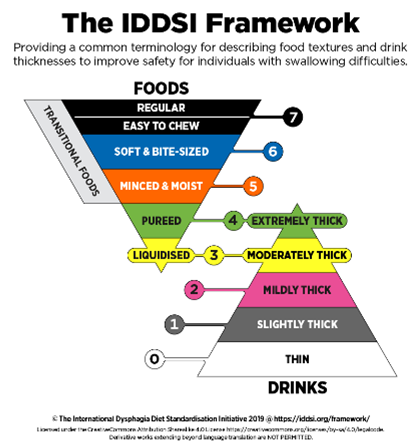
Following a swallow assessment, your SLT may make diet and fluid recommendations. For example, softer or pureed food and/or thicker fluids may be recommended. Typically, these recommendations are to reduce the risk of chest infection/choking. See picture (below) for the various diet and fluid recommendations that may be suggested by your SLT.
Non-oral Feeding versus Eating and Drinking with Acknowledged Risks
If all consistencies of food and drink are considered to increase the individual’s risk of chest infection and/or choking, it may be appropriate to consider non-oral feeding for a limited time (in hospital, this is usually via a nasogastric tube, which goes up the nose and into the stomach).
This is appropriate if the individual’s swallow has suddenly deteriorated and is expected to get better; for example, if the individual is currently unwell with an infection and receiving active treatment.
If the individual is medically fit, their swallow has deteriorated gradually over time, or their swallow is not anticipated to improve, it is typically not appropriate to provide nasogastric feeding as this is not a long-term option and can be distressing for individuals with dementia.
In this case, the doctor & SLT team may suggest Eating & Drinking with Acknowledged Risks. This means the individual would eat and drink (modified or normal consistencies) orally, whilst they or their family/carers acknowledge that this may increase the risk of chest infection or choking. Eating & Drinking with Acknowledged Risks may better support the individual’s wellbeing and quality of life.
Contact us
If you have any queries relating to this information, please contact the Speech and language therapy service.
About this information
Service:
Speech and language therapy
Reference:
VV/052
Approval date:
1 July 2024
Review date:
1 July 2027
Click ‘show accessibility tools’ at the bottom of the page

Then click ‘select language’

Alternative formats
You can use the accessibility toolbar at the bottom of your screen to:
-
Change the text size
-
Adjust the font
-
Modify the colour contrast
-
Use the translate function
If you would like this information in another format, such as Braille, audio, or easy read, please speak to a member of staff.
You can also print as well as download as PDF using the “Print this page” button at the end of the page.
Staff will print a copy for you on request
Important note
This page provides general information only. It is developed by clinical staff and is reviewed regularly every 3 years for accuracy. For personal advice about your health, or if you have any concerns, please speak to your doctor.