

Advice after your nerve block for surgery
On this page…
Introduction
The inside of your nose consists of a cavity which is separated by a partition called the nasal septum. The side walls of the nasal cavities contain fleshy-folds called turbinates, which warm and moisten the air we breathe. Thus, the nose is an air-conditioner and filter the lungs providing moist, warm and clean air.
Problems with your nose:
There are two common problems with the nose:
- The deflection of the nasal septum, causing narrowing of one of the passages of the nose.
- Inflammation or allergies affecting the lining of the nose, which causes stuffiness of the nose.
The treatment is an operation to straighten the nasal septum. This operation is called Septoplasty. The stuffiness of the nose can be reduced by electric cautery to the lining of the nose which shrinks the lining.
This is the only treatment to straighten the septum, but it is usually only performed after any swelling of the lining of the nose has been treated with steroid nasal sprays and sometimes antihistamines.
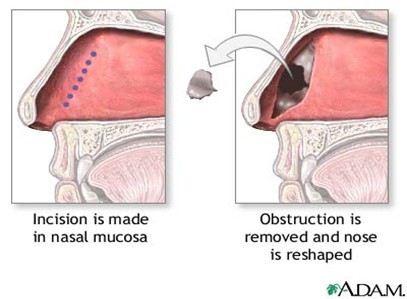
About the operation
You will attend a pre-admission clinic 1—2 weeks before the surgery. If you have a cold or other nasal infection your surgery may have to be postponed.
You will normally be admitted to hospital on the morning of the operation. The operation itself takes about one hour. It is carried out through the nostrils. There are no cuts on the outside and little swelling or bruising of the nose. There is very little pain after the operation. Some headaches may be experienced for a few days.
After the operation, your nose will have a small sponge inserted into it to stop bleeding.
This is usually left in the nose for a few hours. Your stay in hospital will usually be for one night and you will be allowed home the next day. You may be discharge by an experienced nurse if there have been no complications. You will need two weeks off work.
After the Operation—What to Expect:
Your nose is likely to be more stuffy than before the operation. There will be some bloodstained discharge from the nose for up to 10 days which is quite normal. After the first two weeks, the stuffiness will start to become less and at 4 weeks the nose should be better than before the operation.
However it can take four to six weeks before the nose is completely settled. Your first post-operative visit to the ENT Clinic will be after 6 weeks. Depending on the state of your nose, you may or may not require a further follow up.
Risks
- Mild oozing of fresh blood from the nose is common
- Bleeding—more severe bleeding after the operation may occur anytime up until the 10th post-operative day and may require insertion of packs in the nose. Occasionally a further operation is required to stop the bleeding.
- Infection—as with all forms of surgery, infection can occur and requires treatment with antibiotics. Nasal infection often presents with bleeding. Occasionally bleeding can occur within the nasal septum itself. This is called a septal haematoma. If the haematoma becomes infected, a septal abscess may occur.
- Both septal haematoma and abscess may require surgical drainage at a further operation, together with intravenous antibiotics. Unfortunately, these problems can affect the cartilage of the septum, compromising the result of the surgery. This is very rare.
- Perforation—if the septum does not heal as predicted, a hole can develop in the septum. This is rare. This may be permanent and result in a lot of crusting of the nose.
- Recurrence of septal division—during the procedure, as little cartilage as possible is removed in order to straighten the nasal septum. Occasionally after the surgery, the septum moves back to its original position and the operation if therefore not successful. Sometimes it is necessary to repeat the procedure.
- Change in the shape of the nose—modern septoplasty surgery involves re-positioning the cartilage and bone of the nasal septum with limited removal. Past experience has shown that removal of too much cartilage in particular, can result in a change in shape of the nose. The chances of this occurring are very small indeed.
If any of these problems arise after you have gone home please contact the wards: Frimley Park Hospital: Short Stay Surgery ward Direct No: 0300 613 3216 F1 (children’s ward) 0300 613 4252
Sources of Additional Information:
British Association of Otorhinolaryngologists: www.
National Institute for Health and Clinical Excellence (NICE) www.
Contact us
If you have any queries relating to this information, please contact the Ear or nose and throat (ENT) service.
About this information
Service:
Ear, nose and throat (ENT)
Reference:
G/033
Approval date:
23 February 2026
Review date:
1 February 2029
Click ‘show accessibility tools’ at the bottom of the page

Then click ‘select language’

Alternative formats
You can use the accessibility toolbar at the bottom of your screen to:
-
Change the text size
-
Adjust the font
-
Modify the colour contrast
-
Use the translate function
If you would like this information in another format, such as Braille, audio, or easy read, please speak to a member of staff.
You can also print as well as download as PDF using the “Print this page” button at the end of the page.
Staff will print a copy for you on request
Important note
This page provides general information only. It is developed by clinical staff and is reviewed regularly every 3 years for accuracy. For personal advice about your health, or if you have any concerns, please speak to your doctor.