

Advice after your nerve block for surgery
On this page…
Introduction
Approximately 1—2 per cent of the population in the United Kingdom consider their ears to be too prominent. Usually the shape and the position of the ears are inherited. Prominent ears often lack a normal fold. People with prominent ears are sometimes teased particularly during their school years and this can lead to loss of self-confidence.
Pinnaplasty or otoplasty is an operation which adjusts the shape of the cartilage within the ear to create the missing folds and to allow the ear to lie closer to the side of the head. The operation is usually carried out under general anaesthetic (fast asleep) however it can be done under local anaesthesia in suitable adults.
This is the only treatment for prominent ears.
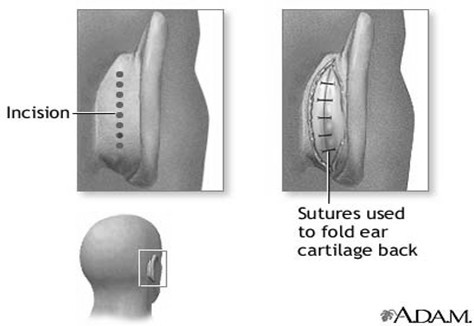
About the operation:
- You will attend the hospital about 1 – 2 weeks before the operation for a pre-operative assessment.
- You should not have suffered from a common cold for at least two weeks before the operation. If you have had an infection please ring the Consultant's secretary.
- You will be admitted to hospital on the morning of the surgery.
- Surgery begins with an incision just behind the ear, in the natural fold where the ear is joined to the head. The surgeon will then remove the necessary amount of cartilage and skin to achieve the right effect. In some cases the surgeon will trim the cartilage shaping it into a more desirable form and then pin the cartilage back with permanent sutures to secure the cartilage. In other in stances the surgeon will not remove any cartilage at all, using stitches to hold the cartilage permanently in place, or do multiple cuts into the cartilage to weaken it in certain parts, in order to get it into a desired shape.
- Soft dressings and headbands are applied to the ears to hold the ear in the desired position. These are usually removed after about one week.
After the operation:
- You will be able to go home the day after the operation. Sometimes it may be carried out as a day case procedure
- The headband should be kept dry and not be disturbed until it is removed in the clinic. If it is dislodged please phone the ward.
- There will be some discomfort after the operation which is usually controlled by taking paracetamol.
- For about 6 weeks following removal of the dressings you need to wear a protective head band or bandage when sleeping to avoid the ears being bent forward against the pillow.
If any of these problems arise after you have gone home please contact the wards:
Frimley Park Hospital: Short Stay Surgery ward Direct No: 0300 6133216 or 0300 6133950
F1 (children’s ward) 0300 613 4252
Risks
In a small number of patients the scars can become prominent and may require further treatment.
An unsatisfactory result requiring further surgery occurs rarely.
- Infection is not common but should this occur it would require treatment with antibiotics and regular dressing changes.
- Pressure sore sometimes the pressure of the dressing can produce a break in the skin, which can take some time to heal.
- Haematoma As the skin has been lifted during the operation some collection of fluid or blood (haematoma) may occur. Haematoma is suspected when there is an immediate pain from increasing pressure of blood within the ear. This is guarded against by the special padded dressing that is applied following the operation. This dressing should not be disturbed in any way. If haematoma is to occur the collected blood may be required to be surgically removed.
- Numbness The ears are often a little numb after the procedure and this often takes several weeks to settle.
Recurrence of the prominent ear may occur many months later.
Sources of Additional Information:
British Association of Otorhinolaryngologists: www.
National Institute for Health and Clinical Excellence (NICE) www.
Contact us
If you have any queries relating to this information, please contact the Ear or nose and throat (ENT) service.
About this information
Service:
Ear, nose and throat (ENT)
Reference:
G/025
Approval date:
23 February 2026
Review date:
1 February 2029
Click ‘show accessibility tools’ at the bottom of the page

Then click ‘select language’

Alternative formats
You can use the accessibility toolbar at the bottom of your screen to:
-
Change the text size
-
Adjust the font
-
Modify the colour contrast
-
Use the translate function
If you would like this information in another format, such as Braille, audio, or easy read, please speak to a member of staff.
You can also print as well as download as PDF using the “Print this page” button at the end of the page.
Staff will print a copy for you on request
Important note
This page provides general information only. It is developed by clinical staff and is reviewed regularly every 3 years for accuracy. For personal advice about your health, or if you have any concerns, please speak to your doctor.