

Advice after your nerve block for surgery
On this page…
Introduction:
Your body contains dozens of lymph glands. They are found in clusters in the neck, in the armpits and in the groin. They are part of the body’s immune system and can be thought of like little factories producing white blood cells and antibodies in response to infection, inflammation and other processes, or disease conditions.
Problems with the Lymph Gland that require Surgery:
As humans so frequently get upper respiratory tract infections, swollen glands in the neck are also very common. Normally though, these swollen glands will shrink down once the infection has passed.
Sometimes, swollen lymph glands may persist. There are very many seasons for this and most of them are quite simple and harmless. However, persistent swollen glands, can suggest more serious problems somewhere in the body.
Normally, your own doctor will have watched these swollen glands for a period of time. If they do not settle down, then you may be referred to a Specialist. Some times the Specialist will arrange an ultrasound scan and/or a needle test to take a small biopsy from the lymph gland.
Sometimes the results of the needle test are not helpful. Sometimes the nature of the gland, or the problem, is such that a needle test will not help to give the right answer. In these situations, a formal lymph node biopsy may be suggested.
About the operation:
Lymph node biopsy can be done under a local or a general anaesthetic. This decision will normally be made between you and the doctor whilst in the clinic. It is more common to have this done under a local anaesthetic, rather than a general (fast asleep).
The operation may involve removal of the whole of the lymph gland if it is not too large. If it is very large, then a small portion (a bit like a slice of cake) will be removed.
This specimen is then sent to the Pathologists so that a formal diagnosis can be made.
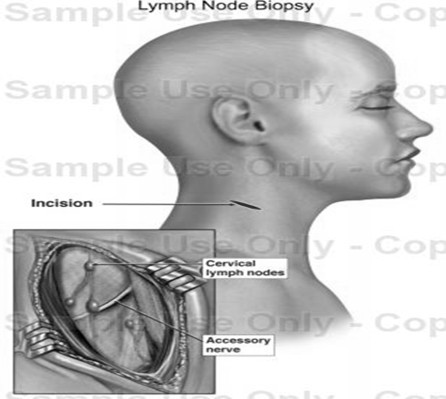
The operation itself normally takes between 20 and 40 minutes. A small incision is normally made over the lymph gland and the lymph gland removed in whole or in part.
There are many important blood vessels and nerves within the neck and therefore the Surgeon will take great care to try and avoid damage to any of these structures.
At the end of the operation the incision (wound) is normally sewn up with stitches).
What to expect afterwards:
Normally, after the operation, if it has been done with local anaesthetic, you should feel fairly normal with only an area of numbness where the local anaesthetic has been injected. As this wears off, you may feel some
discomfort, which should respond to simple painkillers (Paracetamol or simple anti-inflammatories).
Over the next few days, there may be a little bruising and swelling around the wound. The stitches that have been used to close the incision should be removed about one week after surgery. This can normally be arranged with your doctor’s surgery.
Sometimes dissolving stitches are used so removal is not required. Normally, only a day or two off work is required. This is something that can be discussed with your Surgeon at the time of the operation.
Recognised complications:
As with all operations, there is a risk of bleeding or infection, although these are uncommon in this operation.
The main specific risks in this operation relate to damage to nerves passing through the neck close to the lymph gland that is biopsied.
If a sensory nerve is damaged, this may lead to an area of numbness in the skin in the region of the incision.
If one of the motor nerves (movement nerves) is damaged, this may lead to some weakness in the area supplied by this nerve. Nerves that may be affected by this are as follows:
- A branch of the facial nerve, causing some weakness at the corner of the mouth
- The accessory nerve, causing some weakness and stiffness of the shoulder on that side.
- Damage or injury to other motor nerves is extremely uncommon.
Concerns about these risks should always be discussed with your Surgeon prior to the operation.
If any of these problems arise after you have gone home please contact the wards:
Frimley Park Hospital: Short Stay Surgery ward Direct No: 0300 613 3216
Sources of additional information:
British Association of Otorhinolaryngologists: www.
National Institute for Health and Clinical Excellence (NICE): www.
Contact us
If you have any queries relating to this information, please contact the Ear or nose and throat (ENT) service.
About this information
Service:
Ear, nose and throat (ENT)
Reference:
G/019
Approval date:
23 February 2026
Review date:
1 February 2029
Click ‘show accessibility tools’ at the bottom of the page

Then click ‘select language’

Alternative formats
You can use the accessibility toolbar at the bottom of your screen to:
-
Change the text size
-
Adjust the font
-
Modify the colour contrast
-
Use the translate function
If you would like this information in another format, such as Braille, audio, or easy read, please speak to a member of staff.
You can also print as well as download as PDF using the “Print this page” button at the end of the page.
Staff will print a copy for you on request
Important note
This page provides general information only. It is developed by clinical staff and is reviewed regularly every 3 years for accuracy. For personal advice about your health, or if you have any concerns, please speak to your doctor.