

Advice after your nerve block for surgery
On this page…
Introduction
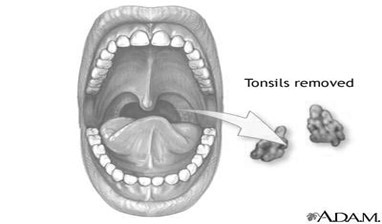
Tonsillectomy is a commonly performed operation to remove the tonsils. Adenoidectomy is an operation to remove the adenoids.
What are the tonsils / adenoids ?
The tonsils and adenoids are small areas of tissue, the purpose of which is to fight infection as part of the immune system. The tonsils are in the back of the throat, the adenoids are higher up in the back of the nose. If Infections of the tonsils (tonsillitis) occur frequently, it may be advised that you have them removed. Removal of the tonsils does not cause any reduction in the body’s ability to fight infections.
Tonsillectomy may also be required if the tonsils are enlarged and cause problems with breathing at night. Occasionally, it is necessary to remove a tonsil for a biopsy. The tonsils may be removed on their own or with the adenoids.
About the operation
You will attend the hospital about 1 – 2 weeks before the operation for a pre-operative assessment. You should not have suffered from tonsillitis or a common cold for at least two weeks before the operation. If you have had an infection please ring the consultant's secretary. Please tell the surgeon about all medication you are taking, especially warfarin, aspirin and/or the oral contraceptive pill.
You will be admitted to hospital on the morning of the surgery. The operation requires a general anaesthetic (you will be fast asleep) and takes about 30 minutes.
Afterwards you will return to the ward. You will usually stay for one night. You will be given some medicines Including painkillers to take home with you when you are discharged.
After the Operation – what to expect
- Your throat will be very sore after the operation. This lasts for 10-14 days and often gets worse before it gets better
- Earache can be a particular problem
- Where the tonsils have been removed you will see white or yellow patches at the back of the throat which is a normal part of the healing process
- It usually takes about 2 weeks to heal. We would advise you to take these 2 weeks as leave from work/school.
- To try and help with these problems, you will be encouraged to eat and drink regularly and take regular painkillers.
If any of these problems arise after you have gone home please contact the wards:
Frimley Park Hospital: Short Stay Surgery ward Direct No: 0300 613 3216
F1 (children’s ward) 0300 613 4252
What are the risks?
- Bleeding—after the operation, you are observed in case bleeding occurs from the area where the tonsils and adenoids were removed. If the bleeding continues or is copious (more than a tablespoon), please contact the ward immediately. Sometimes this problem may be serious enough to require readmission to hospital and very occasionally a return to the operating theatre will be required to stop the bleeding.
- Taste—Some people may notice a change to their sense of taste after this operation. Usually this recovers but very rarely it may persist.
- Voice—if your tonsils/adenoids were very large, there may be a change in the quality of your voice following the operation.
- Pain—post-operative pain is to be expected. Occasionally this is severe and requires readmission to hospital to control it effectively.
Sources of Additional Information:
British Association of Otorhinolaryngologists: www.
www.
National Institute for Health and Clinical Excellence (NICE) www.
Contact us
If you have any queries relating to this information, please contact the Ear or nose and throat (ENT) service.
About this information
Service:
Ear, nose and throat (ENT)
Reference:
G/038
Approval date:
23 February 2026
Review date:
1 February 2029
Click ‘show accessibility tools’ at the bottom of the page

Then click ‘select language’

Alternative formats
You can use the accessibility toolbar at the bottom of your screen to:
-
Change the text size
-
Adjust the font
-
Modify the colour contrast
-
Use the translate function
If you would like this information in another format, such as Braille, audio, or easy read, please speak to a member of staff.
You can also print as well as download as PDF using the “Print this page” button at the end of the page.
Staff will print a copy for you on request
Important note
This page provides general information only. It is developed by clinical staff and is reviewed regularly every 3 years for accuracy. For personal advice about your health, or if you have any concerns, please speak to your doctor.