

Advice after your nerve block for surgery
On this page…
Hello and Welcome!
Did you know?
There are exercise guidelines for cancer patients.
The evidence for exercise in cancer
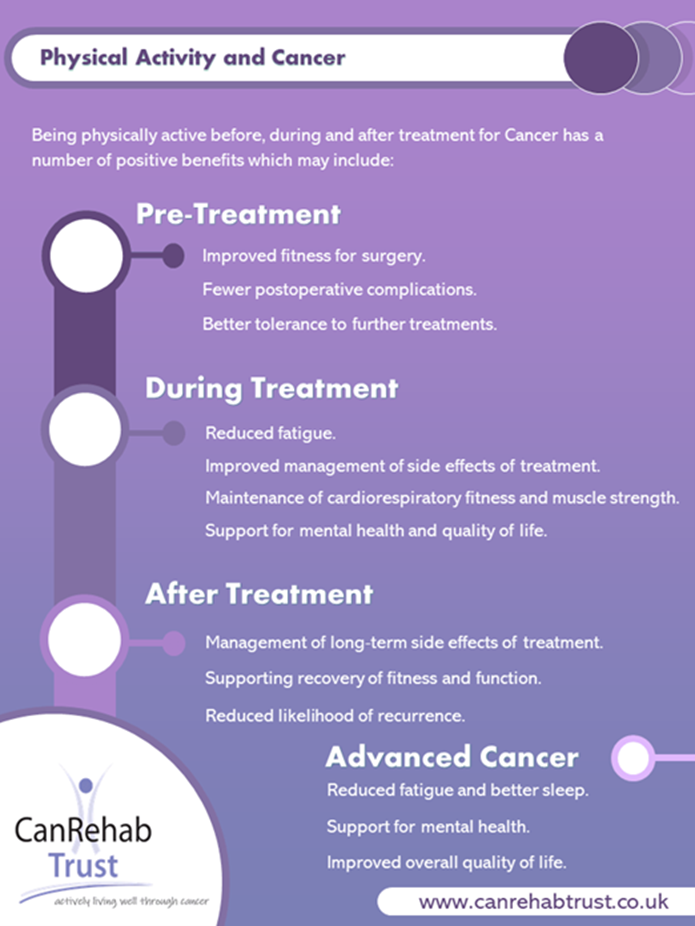
Research has shown that exercise is safe, possible and helpful for many people with cancer.
Guidelines say that it is safe to be active during cancer treatment and after. Also, people with cancer should try to be active and get back to their normal activities as soon as possible.
The UK government and the World Cancer Research Fund (WCRF) have suggestions to help prevent cancer and other conditions. They say that all adults should try to follow the nationally recommended guidelines for physical activity.
The UK government and the World Cancer Research Fund (WCRF) have suggestions to help prevent cancer and other conditions. They say that all adults should try to do at least one of the following ways of exercising:
150 minutes of moderate exercise per week
or
75 minutes of vigorous exercise per week
plus
strength training twice a week
Remember that everyone is different and exercise needs to be tailored to you. Take into account your fitness, diagnosis, and other factors that could affect safety.
This guide is designed to support you with becoming more active.
Research suggests that, along with having a healthy diet, being physically active can help reduce the risk of some cancer types coming back. It can also help reduce the risk of developing other health problems, such as heart disease, stroke and diabetes.
Planning
At any stage of your cancer journey, it is important to build up to your previous level of exercise gradually, especially if you are experiencing fatigue.
If you are experiencing cancer treatment related fatigue, please speak with your cancer nurse or therapist for support with this.
It is also important to start with light to moderate intensity exercise and avoid vigorous exercise until recommended.
When you first return to exercise you will need to find the correct level to work at.
To start with, we advise that you reduce your usual time, resistance and intensity of exercise. You can then gradually increase as able.
Intensity
The talk test is a simple and helpful guide to measure how hard you are working.
If you can talk but not sing, then it is likely you are doing moderate-intensity activity.
If you’re doing vigorous-intensity activity, you will not be able to say more than a few words without pausing for a breath.
If being active for at least 150 minutes every week sounds like a lot, it’s important to remember that making any increase in your daily activity levels can make a difference. Even small bite-sized chunks of physical activity for five minutes spread throughout the day count.
As well as moving more, it’s important to limit the time spent being sedentary. This means not sitting or lying down more than necessary, when not sleeping. If you are sedentary, try to break up periods of inactivity with light physical activity.
Monitoring yourself during exercise
It is important to monitor your body’s response to exercise so that you know when you have reached the recommended level of activity.
Moderate activity is different for everyone dependent on personal fitness levels.
The talk test below helps you monitor how you feel during exercise and whether you have achieved light, moderate or vigorous level of exercise.
BORG rating of perceived exertion
|
Rating of perceived exertion |
Perceived Exertion |
|
1 |
Very Light Activity Hardly any exertion, but more than sleeping, watching TV, etc |
|
2-3 |
Light activity Feels like you can maintain for hours. Easy to breathe and carry a conversation. |
|
4-6 |
Moderate Activity Breathing heavily, can hold a short conversation. Still somewhat comfortable, but becoming noticeably more challenging. |
|
7-8 |
Vigorous Activity Borderline uncomfortable. Short of breath, can speak a sentence. |
|
9 |
Very Hard Activity Very difficult to maintain exercise intensity. Can barely breathe and speak only a few words. |
|
10 |
Max Effort Activity Feels almost impossible to keep going. Completely out of breath, unable to talk. Cannot maintain for more than a very short time. |
Safety Advice for Exercise
WHEN TO STOP EXERCISE & INFORM A MEDICAL PROFESSIONAL:
- onset of Chest, arm or jaw pain

- unexplained pains in limbs
- sudden shortness of breath
- bruising, redness or swelling in one limb
- onset of fever
- feeling cold or clammy
- new pain
WHEN TO DELAY EXERCISE:
- nausea and /or vomiting.
- recent bone, back or neck pain
- new /increased joint pain
- persistent headaches
- fever
WHEN TO REFER TO A MEDICAL PROFESSIONAL BEFORE RESUMING EXERCISE:
- any changes to medical status
- not given chemotherapy due to low blood count
- not given biological therapy due to low ejection fraction
- irregular heartbeat
- extreme fatigue (symptom of anaemia)
- unusual sudden one-sided muscular weakness
- bleeding from any source
Cardiovascular Exercise Suggestions
*REMEMBER: Exercise should help your body feel energised, NOT wiped out.*
Appropriate physical activity balanced with rest can help preserve fitness during treatment to prevent persistent fatigue.
Different forms of cardiovascular exercise:
- walking
- stairs
- gardening
- static bike/pedals
- online exercise videos (weareundefeatable.co.uk)
Progression/Regression: How to grade your activity.
If managing MODERATE intensity: Increase time by 5-10mins every 1-2weeks for initial 4-6weeks.
If starting at LIGHT intensity: Increase time as above until managing 60mins x 3/week and then increase intensity to MODERATE, starting at 10mins.
Grading Cardiovascular Activity
|
Activity e.g., static cycling |
Length of time |
Number of times per week |
Resistance/ Intensity |
|
|
Week 1 |
10 mins |
3 |
Level 2 |
|
|
Week 2 |
15 mins |
3 |
Level 2 |
|
|
Week 3 |
20mins |
3 |
Level 2 |
|
|
Week 4 |
30 mins |
4 |
Level 2 |
|
|
Week 5 |
30 mins |
5 |
Level 2 |
|
|
Week 6 |
30 mins |
5 |
Level 3 |
|
Muscle Strengthening/Resistance Exercises
You may have experienced a loss of muscle mass during cancer and its treatment, but in rebuilding this lost muscle it will also help with balance, fatigue and quality of life.
Plus, muscle-strengthening activities can help make daily activities feel easier.
Doing muscle-strengthening activities doesn’t automatically mean having to go to a gym or lifting weights.
They can be done at home without the need for weights.
For example:
- use your body weight in exercises like squats,
- work with resistance bands,
- use items such as water bottles for added resistance,
- do heavy gardening like digging,
- carry heavy shopping.
It all counts!
As a guide
- Perform 1–3 sets of the exercise of your choice for 8-12 repetitions (the last repetition should make you work a bit harder).
- Lift and lower the weight in a controlled manner (2 seconds up and 2 seconds down).
- You can make your exercise harder by doing each repetition slower and/or increasing the number of repetitions you do.
- Aim to do muscle-strengthening activities at least twice a week.
Muscle Strengthening/Resistance Exercises suggestions
Seated, lying, or standing exercises with weights, band and or bodyweight.
Aim to perform each exercise:
8-12 repetitions, 1-3 sets, with 1-2minutes’ rest between sets.
Moderate pace (2 seconds up, 2 seconds down for each exercise).
|
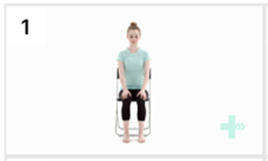
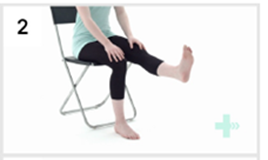
1. Seated leg extensions Sit upright on a chair. Slowly straighten your affected knee, pointing your toes towards the ceiling. Control the movement as you slowly lower the leg back down. |
|
|
|
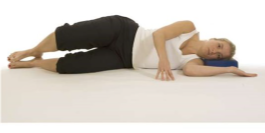
2. Clam Lying on your side with 1 foot on top of the other and knees slightly bent. Slowly lift your top knee away from the bottom knee, opening you knee up like a clam shell. Slowly return the leg back down to rest on the other. |
|
|
|
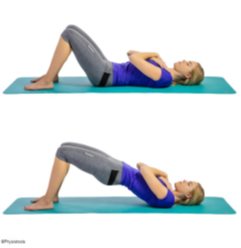
3. Bridging Lying on your back with knees bent up. Have hands by your side to help if needed, otherwise have them across your chest. Squeeze your buttocks and slowly your bottom up off the floor/bed. |
|
|
|
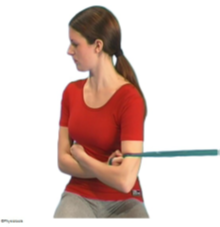
4. Torso rotation Sit up tall. Hold a resistance band tied to something behind you in 1 hand. Slowly twist your head and back away from the band.Slowly return to the start then repeat on the other side. |
|
|
|
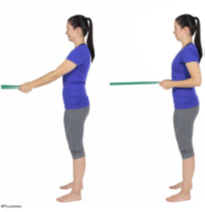
5. Band row Standing or sitting with a resistance band tied in front of you. With your arm outstretched, grasp the band and pull it in towards you by bending the elbow. Slowly return the arm outstretched in front of you again. |
|
|
|
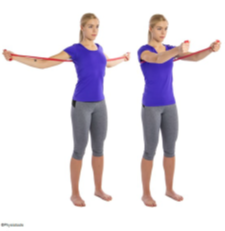
6.Chest press Standing or sitting. Have a resistance band behind your shoulder blades and in each hand with arms out to side and elbows slightly bent. Slowly bring your hands straight in front of you. Slowly return to the start position. |
|
|
|
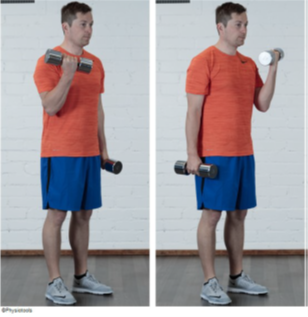
7. Biceps curl Standing or sitting. Hold a weight in each hand. Slowly bend up your elbow. |
|
|
Contact us
If you have any queries relating to this information, please contact the Physiotherapy service.
About this information
Service:
Physiotherapy
Reference:
BB/097
Approval date:
31 January 2025
Review date:
1 January 2028
Click ‘show accessibility tools’ at the bottom of the page

Then click ‘select language’

Alternative formats
You can use the accessibility toolbar at the bottom of your screen to:
-
Change the text size
-
Adjust the font
-
Modify the colour contrast
-
Use the translate function
If you would like this information in another format, such as Braille, audio, or easy read, please speak to a member of staff.
You can also print as well as download as PDF using the “Print this page” button at the end of the page.
Staff will print a copy for you on request
Important note
This page provides general information only. It is developed by clinical staff and is reviewed regularly every 3 years for accuracy. For personal advice about your health, or if you have any concerns, please speak to your doctor.