

Advice after your nerve block for surgery
On this page…
What is the medial patellofemoral ligament (MPFL)?
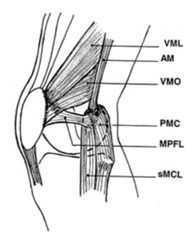
The medial patellofemoral ligament (MPFL) is a thin band of tissue that helps keep your kneecap (patella) in the correct position. As you bend and straighten your knee, the patella normally slides within a groove in the thigh bone (the trochlear groove).
If the kneecap slips out of place (partially or fully), it can cause:
- Feelings of instability
- Pain
- Repeated dislocations
- Wear and tear under the kneecap over time
The MPFL acts as an anchor to stop the kneecap drifting sideways.
If your knee still feels unstable or keeps dislocating, MPFL reconstruction can help improve stability.
What is MPFL reconstruction?
The operation is usually done under general anaesthetic. During surgery:
- Small cuts are made around the knee.
- A camera (arthroscope) is used to check the joint.
- A small hamstring tendon is taken to create a new MPFL (you won’t notice the tendon loss).
- The new ligament is fixed to the kneecap and thigh bone using X ray guidance.
- Sometimes the outer side of the knee is loosened (a lateral release) to help the kneecap stay centred.
- The knee is cleaned, stitched and bandaged before you wake up.
What are the benefits and outcomes of the surgery?
The aim is to stop the kneecap from dislocating or feeling unstable. Around 90–95% of patients are happy with the results.
What are the risks of surgery?
All surgery carries small risks. Your surgeon will discuss these fully.
Common risks (still rare):
- Slow wound healing or oozing (<2%)
- Infection needing antibiotics (<2%)
- Stiffness requiring extra physiotherapy (<5%)
- Blood clots (<1%)
- Small risks from general anaesthetic
Specific risks for this surgery:
- Temporary (sometimes permanent) numbness near the scars
- Swelling and stiffness
- Ongoing front of knee pain in a small number of people
- Very small risk of kneecap fracture during drilling
- Metalwork sometimes needs removing later
- Less than 1% have repeat instability
- The surgery cannot reverse existing arthritis
What are the alternatives to an MPFL reconstruction?
- Physiotherapy
- Strengthening muscles around the knee
- Managing symptoms without surgery
- Other surgical options (used in selected cases):
- Lateral release: loosens tissues on the outer knee (rarely successful alone)
- Tibial tubercle osteotomy: repositions where the tendon attaches to the shin (bigger operation)
- Trochleoplasty: reshapes the groove in the thigh bone (major surgery, only for severe cases)
MPFL reconstruction is usually preferred because it has fewer complications and quicker recovery.
What happens before surgery?
You will be asked to attend a pre-assessment clinic. This is to ensure you are medically fit for surgery. It is important that you keep yourself as fit and healthy as possible prior to your operation.
What happens after surgery?
After the operation, you will wake up in the recovery room. You will be moved back to the ward once you are awake.
You will be allowed to fully weight bear (FWB) on the operated leg straight away. You will use crutches for the first few weeks after surgery.
Physiotherapy will begin immediately to help you regain movement and strength. Your rehab programme may be slightly different depending on your needs, but the main aim is to slowly build up your activity with guidance from your physiotherapist
Typical time frames:
• 2–4 weeks off work
• Driving at 4–6 weeks, when walking safely without crutches
• Return to sport from 4-6 months
Return to activity and sport is dependent upon individual recovery and you will be guided by both your Physiotherapist and Consultant.
Will I have to stay in hospital?
Most patients go home the same day. A small number may stay overnight.
Follow-up care?
As well as regular physiotherapy you will also have follow-up appointments with your surgeon. Your first follow up appointment with your surgeon’s team is usually six weeks after surgery.
If you are concerned about post-operative complications please contact the ward you were discharged from
Useful Contacts
Heatherwood Hospital:
- Orthopaedic pre assessment 0300 614 7778 / 0300 614 7147
- Arthroplasty Nurse Heatherwood 07789927177
- Nurses Station Treetops Heatherwood 0300 614 4175
- Physio/OT Office Treetops Heatherwood 0300 614 4178
Frimley Park Hospital:
- Frimley Park Physiotherapy 07570 974390
- S2 Elective Ward Frimley 0300 613 3781 / 0300 613 3783
- Elective Helpline Frimley 0300 613 2556
Wexham Park Hospital:
- Ward 1 Wexham Park 0300 615 3010 / 0300615 3012
- Outpatient Physio Wexham 0300 615 3501 / 0300615 3500
- Wexham Park Physiotherapy 07717 199851
Contact us
If you have any queries relating to this information, please contact the Orthopaedics service.
About this information
Service:
Orthopaedics
Reference:
N/084
Approval date:
13 March 2026
Review date:
1 March 2029
Click ‘show accessibility tools’ at the bottom of the page

Then click ‘select language’

Alternative formats
You can use the accessibility toolbar at the bottom of your screen to:
-
Change the text size
-
Adjust the font
-
Modify the colour contrast
-
Use the translate function
If you would like this information in another format, such as Braille, audio, or easy read, please speak to a member of staff.
You can also print as well as download as PDF using the “Print this page” button at the end of the page.
Staff will print a copy for you on request
Important note
This page provides general information only. It is developed by clinical staff and is reviewed regularly every 3 years for accuracy. For personal advice about your health, or if you have any concerns, please speak to your doctor.