

Advice after your nerve block for surgery
On this page…
Four weeks after your surgery your tendon is still very weak and has a high risk of rupture, especially if too much strain is placed on the surgical repair.
It will take at least 8 weeks before your tendon is strong enough to perform certain activities and at least 12 weeks before you can return to heavy activities.
Scar
Continue with firm massage over your scar with cream.
Duration: 3-4 times a day for 5 mins
Splint Wear
Must be worn overnight and for protection when hand may be at risk. E.g. public transport, school playground and at work.
Exercises
Complete all exercises 10 reps every 4 hours, unless stated on your sheet. Only remove the minimal number of straps to complete each exercise.
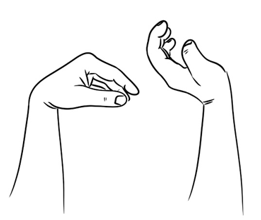 |
1. Active wrist flexion and extension. Bend your wrist slowly forward and backwards. |
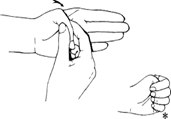 |
2. Passive thumb flexion Push your thumb across to the base of the little finger using your other hand, hold for 5 seconds then release. |
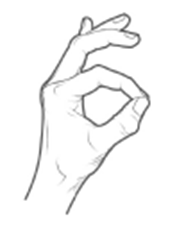 |
3. Thumb opposition Touch the top of each finger, in turn. |
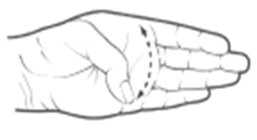 |
4. Active thumb flexion Touch the tip of your little finger and trace it down to base of little finger and then extend thumb away from little finger. |
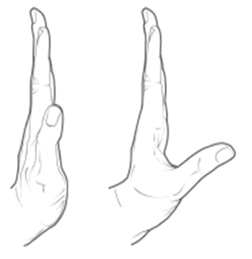 |
5. Active thumb adduction and abduction Slide your thumb away from your fingers and then bring it back to rest against your index finger. |
Precautions
To help you recover from injury or surgery on your hand, your therapist will advise about what activities you can and cannot do. As you recover and your injury heals, you will be able to gradually increase the amount of activities you can do.
For the next four weeks after your splint is off:
DO NOT use your hand for anything other than very light activities.
DO NOT lift anything with your hand.
DO NOT push anything with your hand.
DO NOT push your thumb back.
Do NOT lean on your hand.
Activities
You can now start to use your thumb for light activities. Do not do any activity that causes resistance to the thumb such as a large cup of coffee or a pint glass, because this is too heavy for this stage.
Examples of daily activities and their classification (light, medium or heavy) are listed below and when it is safe to perform these activities following your surgery. Your therapist will help guide you.
4-8 Weeks LIGHT activities:
|
using a knife/fork/spoon, but not cutting meat |
writing, typing, using the telephone |
|
putting on loose clothes |
using a remote control |
|
fastening zips and buttons |
reading a newspaper/book |
|
showering, shaving |
handling money |
|
brushing teeth and hair |
drinking from a small cup |
8-10 Weeks MEDIUM activities:
|
opening/closing door handles |
sweeping up |
|
using a key to open door |
hanging out washing |
|
holding a pint of liquid |
Light gardening |
|
Driving - On discussion with your therapist |
|
10-12 Weeks HEAVY activities:
|
Cycling |
Ironing, hoovering |
|
Lifting light saucepans/kettle |
unscrewing jars/lids |
|
Cutting meat/vegetables |
Using a tin opener |
12 weeks RETURN TO NORMAL USE:
Gradually progress your activities to improve your strength and return to full function. E.g. Contact sports, weight lifting
Please note this is only a guide. Please discuss specific activities with your therapist as every injury and person is individual.
Contact Details
If you have any concerns, or need to change your Hand Therapy appointment, please contact the Therapy Department on: (Lines open 8.30-15.30, Monday – Friday). In an emergency, seek medical advice from a GP or local accident or minor injuries unit.
Frimley Park Hospital: 0300 613 3396
Heatherwood Hospital: 0300 614 0540 Option 3
Wexham Park Hospital: 0300 614 0540 Option 2
Contact us
If you have any queries relating to this information, please contact the Hand therapy service.
About this information
Service:
Hand therapy
Reference:
UU/108
Approval date:
23 February 2026
Review date:
1 February 2029
Click ‘show accessibility tools’ at the bottom of the page

Then click ‘select language’

Alternative formats
You can use the accessibility toolbar at the bottom of your screen to:
-
Change the text size
-
Adjust the font
-
Modify the colour contrast
-
Use the translate function
If you would like this information in another format, such as Braille, audio, or easy read, please speak to a member of staff.
You can also print as well as download as PDF using the “Print this page” button at the end of the page.
Staff will print a copy for you on request
Important note
This page provides general information only. It is developed by clinical staff and is reviewed regularly every 3 years for accuracy. For personal advice about your health, or if you have any concerns, please speak to your doctor.