

Advice after your nerve block for surgery
On this page…
This page has been designed for you by health professionals to provide you and your relatives with information that may help guide you through your hospital stay.
Our aim is for you to regain an appropriate level of function and return to your home environment with a suitable level of assistance.
What is a Greater Trochanter fracture?
A fracture of the greater trochanter is a break to the top of the thigh bone, outside of the hip joint.
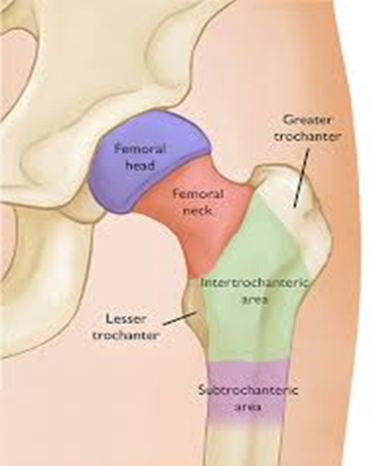
Isolated fractures of the greater trochanter usually occur from a low energy fall and while they are often painful, they usually heal without surgery – this is referred to as conservative management. These fractures are stable and can be treated with analgesia and physiotherapy.
Weight-Bearing status
The consultant looking after you will make a decision around how much weight you can put through your injured leg. Your Physiotherapist will assist in teaching you how to maintain these weight-bearing statuses. Below are all the weight-bearing statuses:
- Non Weight Bearing - This means you cannot put any weight through your injured leg. You should keep the foot of your injured leg off the floor.
- Limited Weight Bearing - This means you can put some weight, but not all of it, through your injured leg. The amount of weight will be determined by your consultant. Using a walking aid such as a wheeled zimmer frame or two crutches will assist you to maintain partial weightbearing.
- Unrestricted Weight Bearing - This means there is no restriction in how much weight you can put onto your injured leg.
Your Ward Team
You will be looked after on the ward by a variety of health professionals. All members should be wearing an identification badge to help you recognise them.
Here is a brief reference guide to their roles:
Doctors
- Doctors either wear their own clothes or scrubs.
- You will be admitted under the care of an Orthopaedic Consultant and their team. You will be seen by them following your operation.
- If you’re 65 and over, you will be seen by our Consultant Orthogeratrician and their team, who specialise in the management of fragility fractures and medical issues in the older person alongside the orthopaedic team.
Nursing Staff
- The role of a nurse is to administer medication, assist with personal care and monitor your well-being.
- Nurses wear tops in a hospital blue with a navy trim.
- Nursing students wear tops in a cloud blue with a navy trim.
- Nursing Practitioners wear tops in a royal blue with a navy trim.
Physiotherapists
- The physiotherapist on your ward will get you out of bed the day after your surgery and work with you regularly with the aim to get you on your feet as soon as possible.
- They will provide you with any walking aids you may require.
- They wear navy blue trousers/shorts and a white polo top or white top with a navy trim.
Occupational Therapists (OT)
- If required, the OT will see you after your surgery and assess your needs to go home.
- If they feel you require support at home, they will provide you with or recommend any equipment and help you may need to assist you with this.
- They wear green trousers and a white polo top or white top with a green trim.
Other ward staff
- Healthcare assistants wear tops in a lilac with a navy trim.
- Pharmacy wear bottle green tops with a navy trim they ensure you have been prescribed appropriate medication and prepare any medication needed to go home.
- Porters (navy blue top) ensure you get to any areas of the hospital outside of the ward for medical reasons.
- Dietitians wear ruby tops with a hospital blue trim they will assess your nutritional needs if needed. They are able to advise you on what food and drink you should be consuming, and can provide additional nutritional support if required.
- Podiatrists wear ruby tops with a royal blue trim they will assess your feet if needed.
During Your Hospital Stay
- You will receive regular pain relief, but additional pain relief may be prescribed for you if your pain is severe or to allow you to walk more easily. You will need to request this extra pain relief.
- You will be assessed by a physiotherapist, taught exercises and mobilised out of bed. Once you have been taught the exercises, it is your responsibility to carry these out independently if you are able. These will be provided on a separate sheet if required.
- We encourage patients to be in their own clothes, so ask your visitors to bring items such as supportive footwear and comfortable clothing to help promote your recovery. You should be getting dressed daily; please ask for help from health care assistants or nursing staff if needed.
- You should be sitting out of bed daily, ready for physiotherapy sessions.
- You will be reviewed by the physiotherapist regularly, with the aim to walk further every day.
- If you need to climb stairs at home you will practise this in hospital.
- If required, the OT will assess how you will manage day to day tasks and whether you may need any aids at home.
- Your risk of further falls will be assessed and acted upon (medication review, strength and balance exercises, occupational therapist assessment)
- Your risk of osteoporosis will also be assessed and you may be started on bone protection (vitamin D, calcium, bisphosphonates), sent for a special scan of your bones or referred to the outpatient rheumatology clinic for follow up.
Leaving The Hospital
- We aim to discharge you home from hospital as soon as you are medically stable and safe to continue your recovery at home.
- The doctors will need to declare you as medically stable for discharge prior to going home and provide you with discharge letters. This may happen at a different time to when the physiotherapy and occupational therapy team deem you safe to return home.
- Depending on your mobility, you will need to discuss transport to get home, if you need assistance the nurses can help arrange this
- Pharmacy will arrange your medication for going home.
- Any outpatient or community referrals will be made upon your discharge.
- If help is required at home for personal and domestic care, this will be put in place prior to your discharge from hospital. However, some patients may need a period of time in a step-down hospital in their local area prior to going home to progress with their independence.
- Your discharge plans may change as you improve whilst you are on the ward. These plans are made by the professionals that work alongside you and have assessed your needs, however this will be discussed with you and your family at the time.
Contact us
If you have any queries relating to this information, please contact the Orthopaedics service.
About this information
Service:
Orthopaedics
Reference:
N/065
Approval date:
20 March 2026
Review date:
20 March 2029
Click ‘show accessibility tools’ at the bottom of the page

Then click ‘select language’

Alternative formats
You can use the accessibility toolbar at the bottom of your screen to:
-
Change the text size
-
Adjust the font
-
Modify the colour contrast
-
Use the translate function
If you would like this information in another format, such as Braille, audio, or easy read, please speak to a member of staff.
You can also print as well as download as PDF using the “Print this page” button at the end of the page.
Staff will print a copy for you on request
Important note
This page provides general information only. It is developed by clinical staff and is reviewed regularly every 3 years for accuracy. For personal advice about your health, or if you have any concerns, please speak to your doctor.