

Advice after your nerve block for surgery
On this page…
Introduction
Type 1 Diabetes is a condition where the cells in the pancreas which produce insulin are no longer functioning, so unable to make insulin to meet the body’s needs.
The treatment is insulin administered via injections or insulin pump alongside a healthy diet and lifestyle.
What is insulin for?
Carbohydrate foods are digested and broken down into glucose, this is absorbed into the blood stream, causing the blood glucose level to rise.
Insulin helps the glucose to enter the cells where it is used for energy and growth or stored as fuel, in the form of glycogen in the liver and muscles.
Insulin therefore plays a vital role in regulating the level of glucose in our blood and preventing the blood glucose level from rising too high.
Where does glucose in the blood come from?
When we eat a food, it is broken down into its simplest form in the stomach and the intestines by the process of digestion. Glucose comes from the carbohydrates that we eat.
All types of carbohydrates - starches, foods with naturally occurring sugars and foods with added sugars - end up as glucose in the blood. The liver can also release glucose from its glycogen stores during exercise or due to stress.
Managing blood glucose levels
Type 1 diabetes is managed by replacing naturally produced insulin using insulin via pen injections or an insulin pump.
To mimic what the pancreas should be doing, two types of insulin are required if using insulin pen injections. A fast-acting insulin (bolus) needs to be taken with all carbohydrate containing meals and snacks, along with a longer lasting background (basal) insulin once per day.
If having insulin administered via an insulin pump only fast acting insulin is used (Novorapid). The insulin pump will slowly release insulin through each 24hour period based on individual settings and insulin boluses will need to be done for all carb containing meals and snacks.
There are some essential steps to help manage blood glucose levels:
- Eat a healthy balanced diet
- Have a good meal routine, 3 regular meals and only small snacks if needed
- Always give an insulin bolus 10-15mins before consuming any food and drinks that contain carbohydrate
- Check blood glucose levels regularly at least 6 or more times a day. This can be via finger prick or a continuous blood glucose sensor
- Keep active, exercise helps the body use insulin more effectively
- Learn how food and activity affect your glucose levels, so you can adjust your insulin doses.
Does the child or young person have to follow a special diet?
Children and young people with diabetes can eat the same healthy foods that all the family can enjoy. They need the same amount of energy and nutrients as all other children of their age for growth and development.
Having a healthy balanced diet including fruit, vegetables and wholegrain foods which provide the energy and nutrients needed; reducing intake of fat, added sugars and salt; and drinking water is important for long term heath.
The foods we eat can be divided into five food groups. If you eat a variety of foods from across the groups you will have a well-balanced diet.
Carbohydrate is found in foods from all the food groups. It is important to know which foods contain carbohydrate to match insulin doses with these foods. This is referred to as Carbohydrate Counting.
’The Eatwell Guide’ shows the types and proportions of foods you need to eat to achieve a well-balanced diet. Choose a good variety of foods to provide your body with the nutrients it needs. Foods outside of the plate are not essential to health and should only be eaten in small amounts.
It is very important to drink sufficient water to stay hydrated, especially if blood glucose levels are above target range, whilst doing exercise and in hot weather.
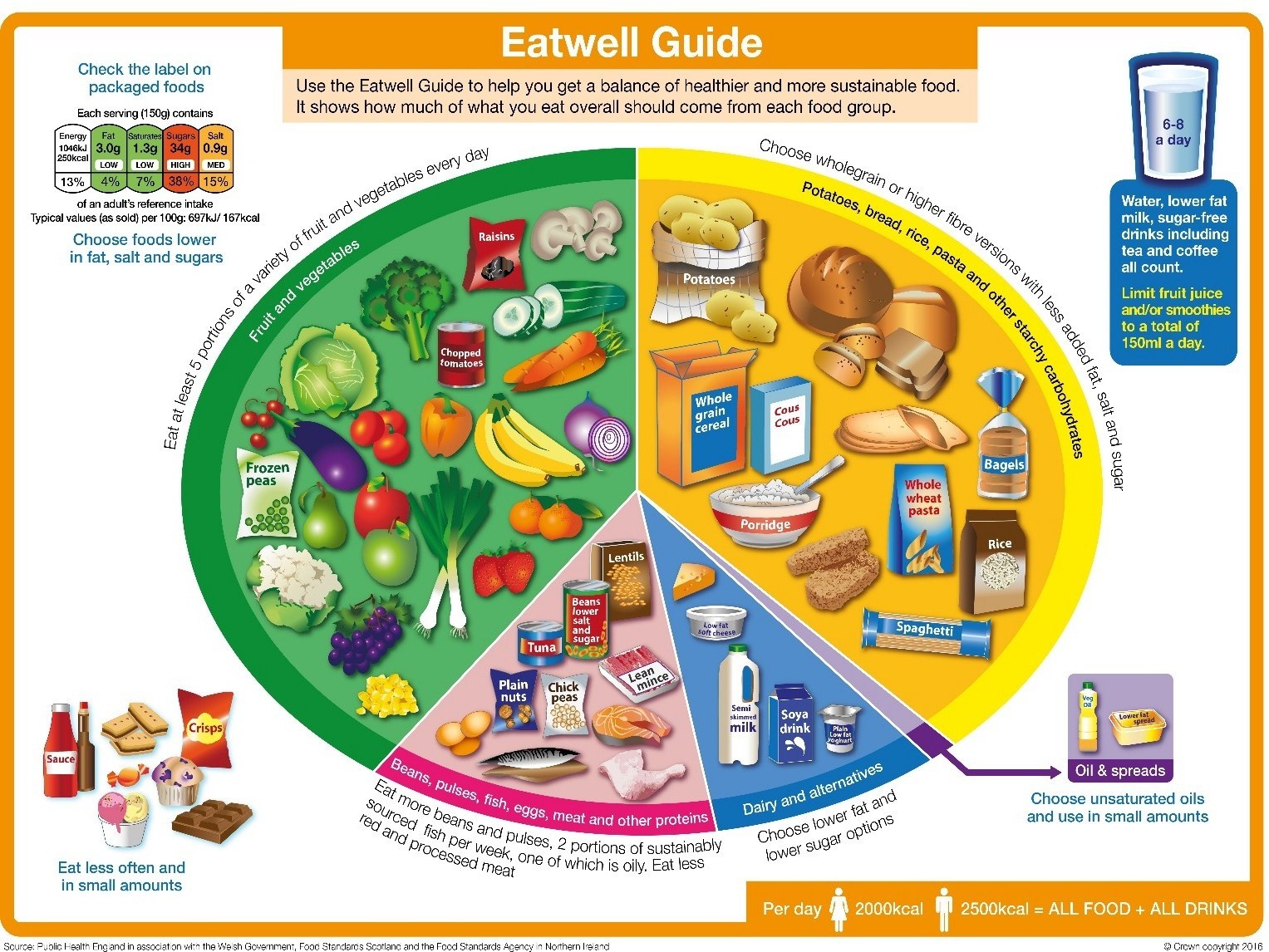
Eating a Balanced Diet
The foods you eat should provide all the nutrients you need to grow and develop, be a healthy weight and keep your heart healthy. Choosing healthy foods helps to manage blood glucose levels. There are no foods that need to be avoided completely, just try to make healthy choices most of the time.
It is important to ensure that portion sizes are appropriate for age and that there is not excessive snacking between meals to help maintain a healthy body weight and growth.
Bread, Rice, Potatoes and Pasta (starchy carbs)
These foods increase the blood glucose as they act as fuel for the body to provide energy. They also provide fibre, some calcium, vitamins and iron. It is important not to restrict the portion size of these and ideally include these foods in every meal.
Higher fibre versions e.g. wholemeal or multigrain breads, wholegrain cereals and brown rice are more filling, keep the bowels healthy and prevent constipation. Children under 5 years should have both white and wholegrain versions.
Fruits and Vegetables
Includes all fresh, frozen and tinned fruit (in own juice) and vegetables, cooked or salad vegetables, pure fruit or vegetable juice and dried fruits. They contain essential vitamins, minerals and fibre which help with blood glucose control.
To keep healthy aim to eat a minimum of five portions from a mixture of fruit and vegetables each day. Spread fruit portions throughout the day and limit fruit juice or smoothies to one small glass (100ml) a day with a meal, as the naturally occurring sugars (fructose) can cause a rise in blood glucose levels.
Milk and Dairy Foods
Milk contains carbohydrate in the form of lactose, which will influence blood glucose and so requires insulin. Dairy foods are a good source of protein and calcium. Full fat versions should be used if your child is under 2 years, otherwise you can choose lower fat products for the whole family.
Aim for three portions of milk and dairy foods every day.
- One portion is the equivalent of a ⅓ pint of milk, a pot of yoghurt or 30g cheese.
- Choose ’no added sugar’ yoghurts.
- Full fat Greek yoghurt is high in protein and should be used as an alternative to flavoured yoghurts.
- Low fat natural yoghurt or crème fraiche can be used as an alternative to cream.
Meat, Fish, Beans, Eggs, Nuts and meat alternatives
These are known as protein rich foods and are important sources of iron, B vitamins, magnesium, and zinc, which are essential for growth. Protein is important to help the body grow and repair tissues.
Lentils, pulses, tofu and Quorn are also in this group. Protein rich foods should be included in two meals a day.
When eating proteins, be aware of breadcrumbs, batter, or sauces as these contain carbohydrates which can increase blood glucose.
Oily fish e.g. salmon, sardines, and mackerel contain omega–3 oils which can help to prevent heart disease. Aim to have 1-2 portions per week.
Processed Foods High in Fats and/or Added Sugars
These foods generally provide lots of calories but contain very little nutrients.
Everyone, whether they have diabetes or not, should aim to eat less of these foods as they can lead to tooth decay, excess fat storage and increased body weight.
Foods high in fat e.g. crisps, biscuits, cakes, butter, margarine, oil, pies and pastry should be eaten less often. Use lower fat alternatives, where available, as these are a healthier choice.
Foods and drinks that contain a lot of sugar are generally poor sources of nutrients and will raise blood glucose levels quickly. Reduce intake of high sugar foods, however, do not ‘ban’ them completely. it is important for children to learn how to include sugary foods as part of a healthy balanced diet as occasional treats, not too often and always with insulin.
Salt
Avoid adding salt at the table and reduce the amount you use in cooking. Use herbs and spices to flavour foods instead.
Processed foods and savoury snacks are high in salt. Reduce intake and always check food labels to help choose products with lower salt content.
Diabetic Foods
Special ‘diabetic foods’ are not recommended for children or adults with diabetes.
They are often expensive and higher in energy content than similar ‘normal’ foods.
Diabetic foods often contain sweeteners, sugar alcohols e.g. sorbitol, which can have a laxative effect, and may produce side effects such as tummy pain and diarrhoea. It is much better to learn how to manage normal treats with diabetes.
Here are some other tips:
- At breakfast choose more slowly absorbed carbohydrate foods (Low Glycaemic Index - Low GI) to help manage blood glucose and include some protein e.g. egg or Greek yoghurt.
- Eat 3 meals a day which include starchy carbohydrates, use wholegrains as much as possible.
- Try to have at least 2hours between meals and snacks. Only snack if hungry and keep snacks small (<15g carbs). Remember all carb containing snacks need insulin.
- Have a good variety of fruit and vegetables.
- Eating more wholegrain and low-fat foods can help with diabetes management.
- Avoid drinking milk and fruit juice between meals as these will increase blood glucose levels. Do not give younger children drinks just before meals as it will reduce appetite.
- Limit sweets and treats to after meals and not every day.
- Limit eating time at meals to 30-40mins.
- Avoid distractions at mealtimes and if possible, eat as a family.
- Try not to reward good eating habits with food-based treats.
Carbohydrate-free/Low Carbohydrate Snacks
Some foods contain little or no carbohydrate and can be useful as snacks between meals if insulin dosing is not possible.
The list below provides examples that will have minimal effect on your blood glucose level and so do not require insulin dosing:
- Vegetables e.g. carrot, celery, tomatoes, cucumber sticks, peppers or salad leaves
- Sliced cold meats (ham/chicken/turkey/beef/pepperoni)
- Canned/smoked/fresh fish e.g. tuna/salmon
- Cheese (30g is a snack portion)
- Eggs
- Olives
- Pickled vegetables e.g. onions/gherkins
- Seeds or unsalted nuts (25g is a snack portion)
- Sugar-free jelly or sugar-free ice-pops
Remember:
- All carbohydrate containing snacks should be counted and need to be entered into MyLife App or insulin pump for insulin dose calculation.
- Some snacks are high in salt, and fat so limit portion and frequency.
How does food affect blood glucose levels?
Most of the glucose in the blood comes from the digestion of carbohydrate foods (both starches and sugars). The amount of carbohydrate food eaten in a meal or snack influences how much blood glucose levels rise after eating.
It is important to have a good understanding of how much and what type of carbohydrate is in the foods you eat, what else you eat as part of the meal can have an impact as well. To best match insulin to food at meal and snack times you need to learn about:
- Amount of carbohydrate (Carbohydrate Counting)
- How to use an insulin to carbohydrate ratio
- Type of carbohydrate (Glycaemic Index)
- How mixed meals affect glucose levels
Carbohydrate Counting
Carbohydrate counting enables better control of diabetes; by helping you adjust pre-meal insulin doses to match the carbohydrate content of each meal.
There are 3 key steps to carbohydrate counting
- Identify carbohydrate containing foods
- Know the portion/serving size
- Calculate or estimate the amount of carbohydrate in the portion
Which foods contain carbohydrate and must be Carb Counted?
|
Carbohydrates |
||
|
Starches |
Sugars |
|
|
Bread - all types Crackers and breadsticks |
Natural |
Added |
|
Potatoes, Sweet Potato, yam, plantain, squashes Peas Sweetcorn beetroot |
Fruit all - fresh, tinned and dried |
Cakes - all types |
|
Rice, Pasta, Noodles |
Fruit Juices and smoothies |
Biscuits - all types |
|
Breakfast Cereals |
Milk |
Puddings/desserts |
|
Couscous, Quinoa, Bulgar wheat |
Yoghurt and Fromage frais |
Sweets/Chocolate |
|
Beans and pulses e.g. baked beans, lentils |
Custard/ice-cream |
Fizzy Drinks/squashes |
|
All items made with flour e.g. pizza, pastry, breaded fish |
Milk puddings |
Jams/Marmalade/ Honey/ Syrups/ Treacle |
What is my portion size?
For each carbohydrate containing food you eat you need to be able to work out your portion size. There are several ways to do this.
1. Using pre-portioned/suggested serving information.
Servings or portions are often described differently depending on the type of food, how it is prepared and served.
- Packaged food is often described by quantity or several pieces, such as a slice of bread, a tub of yoghurt, 3 fish fingers, 5 crackers, 8 potato wedges.
- Foods we cook then share, are often described as fractions, for example ½ pizza, ¼ quiche, ⅛ cake.
- Weight is used for foods that we eat in varying amounts such as 40g of cereal, 140g of rice, 160g of pasta.
If you want to eat a different number of pieces of food than in a suggested serving or portion:
1. Work out how much carbohydrate is in one piece/unit.
2. Multiply this amount by the number of pieces you are going to eat.
Look through the following examples and then try with some of your own food choices and labels
|
Typical Values |
Per slice |
Per 100g of product |
|
Energy |
102kcal |
218kcal |
|
Carbohydrate |
19.8g |
42.0g |
|
of which sugars |
1.3g |
2.8g |
|
Fat |
1.1g |
2.4g |
If you ate 2 slices of bread, you would need to multiply the amount of carbohydrate in one slice of bread by 2.
19.8 x 2 = 39.6g of carbohydrate in 2 slices
Victoria Sponge Cake
We often share foods like pizza, pasta bake, puddings or cakes.
The examples below show you how to calculate how much carbohydrate is in your serving.
The label below shows the nutritional values for 100g and for 1/6 of a cake.
You are going to have a 1/8 of the cake. You can work out how much is in your slice by following the steps below:
|
Typical values |
Per portion (1/6 cake) |
Per 100g |
|
Energy |
230kcal |
405kcal |
|
Carbohydrate |
31.6g |
55.5g |
|
of which sugars |
18.6g |
32.6g |
|
Fat |
10.0g |
17.6g |
1. Work out how much carbohydrate is in the whole cake. Multiply the carbohydrate in the 1/6 cake portion by 6 to work out the carbohydrate in the whole cake.
31.6 x 6 = 189.6g carbohydrate in whole cake
2. Work out how much carbohydrate is in your slice (1/8 cake). Divide the total carbohydrate in the whole cake by 8 to work out the carbohydrate in 1/8 cake.
189.6 ÷ 8 = 23.7g carbohydrate in your portion
2. Weighing food portions and calculating carbs
For loose foods such as breakfast cereal, rice, pasta, potato and fruit, the most accurate way to count carbohydrate is to weigh your portion, then calculate its carbohydrate using the ‘per 100g’ value on nutritional labels or reference tables.
What you need:
- Digital kitchen scales that weigh to the nearest 1g
- Calculator
- Notebook and pen
To calculate the carbohydrate in your portion:
- Weigh your portion.
- Look at the label and check the amount of carbohydrate per 100g of product
Remember: Use the total carbohydrate per 100g figure on the food label. NOT the ‘of which sugars’
3. Divide the carbohydrate ‘per 100g’ figure by 100 to tell you how much carbohydrate is in 1g.
4. Multiply this amount by the weight of your portion to calculate how much carbohydrate is in your portion.
(Carbohydrate per 100g ÷ 100) x weight of your portion = carbohydrate in your portion.
Use a calculator to help you complete calculations accurately and easily.
For foods you eat regularly it is useful to use measuring cups or handy measures to make replicating your portion easier, if you do not want to weigh each time.
NOTE:
Although cooking does not change the carb content of food, cooking method will change the weight of some foods e.g. pasta, rice, couscous, potatoes. Ensure you use the uncooked carb content as reference if weighing prior to cooking or the cooked carb content if weighing portion post cooking. Both Carbs and Cals and Digibete give the carb values for cooked portions.
Example calculation for weighed portion using Carbs per 100g: 100g baked beans contains 14g of total carbohydrate.
- If the portion weighs 80g then carbohydrate content = (14 ÷ 100) x 80 = 11g
- If the portion weighs 220g then carbohydrate content = (14 ÷ 100) x 220 = 31g
Now work out each of the individual foods in a meal and add them up to get the carb content of the whole meal. This would be the same process if carb counting a recipe.
3. Estimating Using Carbohydrate Calculator Books/Apps
You will be provided with a copy of the Carbs and Cals Book at diagnosis and advised to download either the Carbs and Cals App or The Digibete App Carb Calculator (free)
- Contains food photos with carbohydrate contents for a variety of portion sizes
- Useful when eating out or for foods without labelling
- Also useful for carb content of cooked food portions, such as, pasta, rice or noodles.
4. Estimating/replicating using Handy measures
Useful for foods you eat regularly to replicate portions accurately, if you do not want to weigh each time. Also useful for foods without labelling
For example:
1 tablespoon pasta/rice =10g carbs
1 medium egg sized potato = 10g carbs
2 tablespoons baked beans = 10g carbs
1 scoop mashed potato = 10g carbs
A fist is approx. 1 cup (ice-cream/cereal) = 30grams carbs
Adult hand sized pizza slice = 30g carbs
5. Information from restaurants or food outlets websites
When eating out some food outlets and restaurants now provide the carb content of their meals. Use this when available, otherwise use your Carbs and Cals or Digibete Carb Calculator App to estimate carb content.
Calculating Insulin dose using Insulin to carb ratio (ICR) and Insulin Sensitivity Factor (ISF)
An insulin to carbohydrate ratio tells you how much carbohydrate 1 unit of insulin will match.
For example: 1 unit to cover 15g carbohydrate (1:15g).
This means that every 15g of carbohydrate needs 1 unit of Novorapid to keep your blood glucose between 4-9mmol/l.
Once you have worked out how much carbs are in your meal, you need to calculate the insulin dose using your insulin to carb ratio as advised by the diabetes team. The amount of insulin needed at different times of the day can vary so you may have different ratios for different mealtimes.
Calculating your insulin dose. For example:
• Insulin to carb ratio = 1 unit of Novorapid for every 10g carbs (1:10g)
• Total carbohydrate calculated for meal = 50g
Carbohydrate bolus = 50g ÷ 10g = 5 units Novorapid
If blood glucose levels are above range at pre-meal blood glucose test you may also need to include a correction dose. The diabetes team will advise you on when to do this.
For example:
- Pre-meal blood glucose level = 14mmol/l
- Target blood glucose level = 6mmol/l
- Correction factor/ISF (1:2) = 1unit:2mmol/l
Correction bolus = (current blood glucose – target blood glucose) ÷ correction factor = (14 - 6) ÷ 2 = 4units Novorapid
To calculate total Novorapid injection to be administered pre-meal = 5units(for food/carbs) + 4units(to correct high blood glucose)
Total pre-meal dose = 9units Novorapid
Your ICR’s will be programmed into the settings of your MyLife App if on pen injections or into your insulin pump by the Diabetes Team.
These settings will be reviewed and adjusted regularly.
Glycaemic Index
- The Glycaemic Index (GI) is a system of ranking carbohydrate foods according to how quickly or slowly they effect blood glucose levels.
- Eating carbohydrate foods with a low GI (‘slow-release foods) causes a slow, steady rise in blood glucose levels, while those with a high GI cause levels to rise more quickly and can be difficult to match with insulin.
- Mixing foods with different GI values creates a new GI for a meal. For example, when a high GI food like a jacket potato is mixed with a low GI food like baked beans, they become a medium GI meal.
- Introducing more low GI foods into meals can help to control the rise in blood glucose levels after meals and may improve overall control of diabetes.
- Not all low GI foods are healthy foods. Try not to eat more of the high fat low GI foods like pizza, crisps and chocolate.
- For a healthy balanced diet, try to include a variety of lower GI value foods as part of meals and snacks.
How do I use GI?
- Try eating whole oat porridge for breakfast or add fruit to your breakfast cereal in the morning.
- Swap your snacks to fruit and low Greek yoghurt from biscuits, crisps and cereal bars
- Swap “old” potato for sweet potato or new potato
- Eat more rice, pasta, or noodle-based meals. Try wholegrain versions
- Have wholegrain, rye or Pitta bread for sandwiches
- Add beans and pulses to stews & casseroles
The GI value of a food only gives an indication of how that food may affect your blood glucose levels if it is eaten on its own. The total amount of carbohydrate, cooking method, fat and protein content and physical activity all affect your blood glucose levels. Keeping a diary of your blood glucose results, dietary intake and physical activity can help you to understand your results and make appropriate changes if required.
Ask the Diabetes Team Dietitian for more information on GI.
Mixed meals
Some foods do not produce glucose when they are digested so we do not count them, but they impact blood glucose levels when eaten in large quantities. These are foods containing protein or fats.
Eaten in small/normal portion sizes your insulin to carbohydrate ratio will cover any effect they have on blood glucose. Larger portions may increase the amount of insulin needed with the meal.
- If a meal is more than 20g fat and 25g protein extra insulin may be needed.
- If the meal is more than 40g fat and 30g protein, then extra insulin will probably be needed.
Food labelling along with the Carbs and Cals Book/App can be used to help identify these meals. Extra insulin can be given if you notice these meals effect your blood glucose level. These foods usually cause the glucose level to rise 2-5 hours after eating and can be more of an issue if eaten in the evening.
It is often required to split the insulin dose for these meals. You can start with a 50%-50% split giving the second part of the dose 1-1.5hours after the pre-bolus.
Contact the Diabetes Team for more advice if you are having problems with blood glucose profile post meals.
Contact Information
Please contact the Diabetes Team - Email: fhft.
or the Specialist Paediatric Diabetes Dietitian - Email: stella.
Additional information:
Digibete – www.
Diabetes UK – www.
Breakthrough T1D (formerly JDRF) – www.
Contact us
If you have any queries relating to this information, please contact the Dietetics service.
Click ‘show accessibility tools’ at the bottom of the page

Then click ‘select language’

Alternative formats
You can use the accessibility toolbar at the bottom of your screen to:
-
Change the text size
-
Adjust the font
-
Modify the colour contrast
-
Use the translate function
If you would like this information in another format, such as Braille, audio, or easy read, please speak to a member of staff.
You can also print as well as download as PDF using the “Print this page” button at the end of the page.
Staff will print a copy for you on request
Important note
This page provides general information only. It is developed by clinical staff and is reviewed regularly every 3 years for accuracy. For personal advice about your health, or if you have any concerns, please speak to your doctor.