

Advice after your nerve block for surgery
On this page…
What is a Central Slip Injury?
The Central Slip is the tendon which straightens the middle joint of your finger. A central Slip injury is usually caused by a sudden forceful bend of the middle joint of the finger which tears this tendon. You will be unable to fully straighten your finger and the finger maybe swollen and painful.
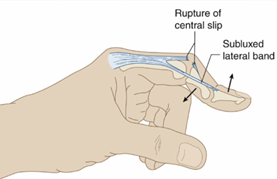
How is it treated?
Your tendon(s) have been repaired with complex microsurgery and will need strict care to limit the possibility of re-injury of your repaired tendon (rupture).
You will not be able to use your finger for any activity until four weeks after surgery. At four weeks you will be advised on appropriate light activities which will aid your recovery but not harm your tendon repair. Your tendon will take up to 12 weeks to completely heal and it is important to follow all advice to avoid rupturing your tendon during this time.
You will be advised on exercises to complete during the first four weeks to enable safe mobilisation of your repaired tendon.
Splint Instructions
- Your resting splint, on the back of your finger, should be worn 24 hours a day. To complete your exercises in the appropriate exercise splint, you will need to remove 2 straps on your resting splint, as demonstrated by your therapist. See photo instructions on the next page.
- Avoid direct contact with heat, (e.g. radiators, hairdryers and hot water from a shower/bath) as this may alter its shape.
- When bathing/showering, cover you splint in a plastic bag taped to your arm. Keep your arm away from the hot water as this may alter the splint shape.
- Your therapist will only remove your splint during the first four weeks to change the dressing and adjust the splint, if required.
- Your exercise splint will be altered weekly to increase the bend on the finger, only if you can fully straighten your finger on your own. If you are unable to straighten your finger on your own, then we will not alter the exercise splint and we will review the following week.
Skin Care
- Avoid wetting unhealed areas.
- Wash all areas not covered by the splint.
- Use moisturiser if your exposed skin becomes dry.
- If at any time you feel the splint is causing pressure or impairing your circulation, you must contact your therapist immediately.
Problems you may encounter
Swelling: the injured joint may be swollen which may increase or decrease and affect the fit of your splint, please arrange an appointment with your hand therapist for a splint adjustment.
Skin irritation: water and sweat may lead to the skin becoming sore. Keep the skin dry and contact the hand therapist if skin problems persist. If at any time you feel the splint is causing pressure or impairing your circulation, you must contact your therapist immediately.
If you are unable to move your finger/s, or experience any stiffness or pain, you must contact your therapist.
Hand Use
- While your finger is in the splint, it is important to avoid gripping or lifting heavy objects as this can put strain on your healing tendon.
- We advise you check with your insurance before driving.
- Do not participate in any contact sports.
- Maintain the movement of your unaffected fingers to avoid stiffness.
Exercises
Whilst wearing your splint it is important to keep the other finger joints mobile and to move the joints as advised by your therapist. The following exercises should be completed with the affected finger every 1-2 hours during the day, repeat 5 times.
First 4 weeks:
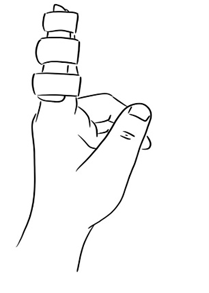
A: With your splint on, bend the knuckle joints as far as possible and then straighten.
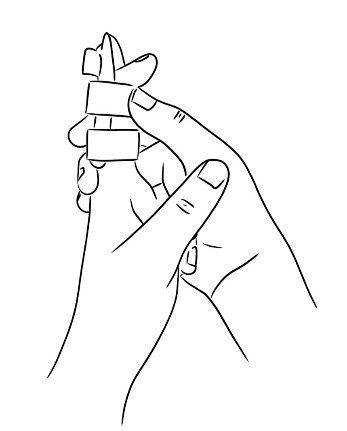
B: Undo the top strap, bend and straighten the top joint in isolation.
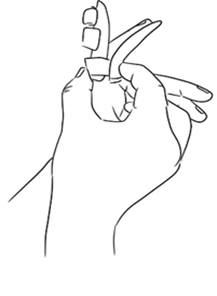
C: Bend your wrist forwards and keep your knuckle in neutral when performing these exercises. Remove the top two straps, place your exercises splint on as shown and lift the finger up straight to your resting splint and allow it to rest down to your exercise splint. Your therapist will slowly increase the movement allowed in the splint each week.
Four to six weeks:
Your therapist will assess the tendon in therapy. If they are happy, then you will begin weaning from the splint. This means that you will only be required to wear the resting splint at night and during vulnerable situations. Your therapist will advise of exercises, as appropriate, to help regain maximum range of movement of the finger and prevent any deformity from developing.
Contact Details
Hand therapy departments: (Lines open 8.30-15.30, Monday – Friday). In an emergency, seek medical advice from a GP or local accident or minor injuries unit.
0300 6133396 for Frimley
0300 6140540 then Option 2 Wexham or Option 3 for Heatherwood
Contact us
If you have any queries relating to this information, please contact the Hand therapy service.
About this information
Service:
Hand therapy
Reference:
UU/112
Approval date:
23 February 2026
Review date:
1 February 2029
Click ‘show accessibility tools’ at the bottom of the page

Then click ‘select language’

Alternative formats
You can use the accessibility toolbar at the bottom of your screen to:
-
Change the text size
-
Adjust the font
-
Modify the colour contrast
-
Use the translate function
If you would like this information in another format, such as Braille, audio, or easy read, please speak to a member of staff.
You can also print as well as download as PDF using the “Print this page” button at the end of the page.
Staff will print a copy for you on request
Important note
This page provides general information only. It is developed by clinical staff and is reviewed regularly every 3 years for accuracy. For personal advice about your health, or if you have any concerns, please speak to your doctor.