

Advice after your nerve block for surgery
On this page…
Introduction
Adenoidectomy is a common operation to remove the adenoids from the space behind the nose. It can be performed as a single procedure, with a tonsillectomy, grommet insertion or cautery to the nasal lining.
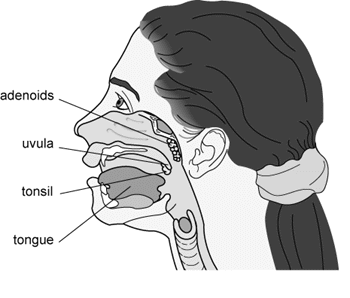
The adenoids are part of the immune system and are of similar tissue to the tonsils. They may increase in size causing blockage of the nose or the tube to the ear, or become infected. Removing the adenoids does not affect the body’s ability to fight infections.
| Diagram showing the location of the adenoids: |
|
Procedure
The operation is performed under general anaesthetic (fast asleep). The adenoids are usually removed through the mouth by either a sharp curette or by use of cautery, which is an electric current. Occasionally, small amounts of adenoidal tissue are removed through the nose, particularly in adults.
Suction Diathermy Adenoidectomy is a new procedure where electric current is used to vaporise the adenoids.
Alternatives
Your doctor will have discussed the alternatives to surgery, which include a period of observation or treatment with medication such as nasal sprays, drops or antibiotics.
Pre-operative assessment and care
There will be a pre-operative check about two weeks before the operation. If you or your child has a cold in the week before the operation, please contact your consultant’s secretary as the operation may have to be postponed. The admission is on the morning of the surgery. After the surgery you will return to the ward and will normally be discharged that day.
After the operation – what to expect
There is a little pain after an adenoidectomy. You, or your child, will be observed on the ward for bleeding for a minimum of four hours.
After discharge home
You may notice blood stained discharge from the nose after going home. This usually takes several days to clear. You, or your child, will be tired and should rest for a few days. We recommend one week off work or school.
If suction diathermy has been used, it is common to notice a bad smell from the nose around the end of one week. Antibiotics may be given to take home if suction diathermy has been used.
Risks
Bleeding is a rare complication of adenoidectomy that may occur up to two weeks after surgery. If there is more than a tablespoon of bright red blood from the nose or mouth, please contact the ward immediately.
Usually the bleeding will settle and needs only a period of observation. A small number of patients need a return to the operating theatre to stop the bleeding.
If any of these problems arise after you have gone home please contact the wards:
Frimley Park Hospital:
Short Stay Surgery ward Direct No: 0300 613 3216
ENT outpatient department, ground floor, the first left after entering the main entrance. Telephone: 0300 613 4635
F1 (children’s ward) 0300 613 4252
Sources of Additional Information:
British Association of Otorhinolaryngologists: www.
National Institute for Health and Clinical Excellence (NICE) : www.
Contact us
If you have any queries relating to this information, please contact the Ear or nose and throat (ENT) service.
About this information
Service:
Ear, nose and throat (ENT)
Reference:
G/001
Approval date:
23 February 2026
Review date:
1 February 2029
Click ‘show accessibility tools’ at the bottom of the page

Then click ‘select language’

Alternative formats
You can use the accessibility toolbar at the bottom of your screen to:
-
Change the text size
-
Adjust the font
-
Modify the colour contrast
-
Use the translate function
If you would like this information in another format, such as Braille, audio, or easy read, please speak to a member of staff.
You can also print as well as download as PDF using the “Print this page” button at the end of the page.
Staff will print a copy for you on request
Important note
This page provides general information only. It is developed by clinical staff and is reviewed regularly every 3 years for accuracy. For personal advice about your health, or if you have any concerns, please speak to your doctor.