Fragmin (Dalteparin) is a type of blood-thinning medicine (anticoagulant).
You may be prescribed Fragmin:
To help prevent blood clots after being in hospital or after surgery
To treat a blood clot
During pregnancy
If you have certain medical conditions that increase clot risk
Take your medication exactly as advised by your healthcare team. If you miss doses you may be at increased risk of clots.
How is Fragmin given?
You should read the Patient Information Leaflet included in the Fragmin pack before administering the medicine.
Fragmin is given by a small injection under the skin. You should take the dose of Fragmin at the time recommended by your doctor. This leaflet explains how you should go about injecting Fragmin yourself.
Please follow the steps explained below.
Firstly, remove the single dose Fragmin syringe from the box.
Then wash and dry your hands. The injection site should be cleaned. (Please note that if a carer is doing the injecting then it is recommended that they wear gloves to perform the injection)
Step 1
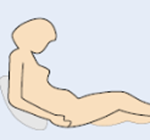
Get yourself in a comfortable position sitting down where you can see your tummy.
Step 2
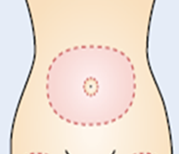
Your tummy (see shaded area) is usually best as the injection site.
For comfort and to reduce the risks of complications (eg, injection lumps; scarring) it is important that you change the injection site each time.
This can be done by rotating around the belly button.
Step 3
Pick up the syringe and take off the grey rubber cover by pulling it straight off. You will notice an air bubble in the syringe, which is supposed to be there and you can just ignore it.
It is important not to press the plunger yet as some medicine may be lost.
Step 4
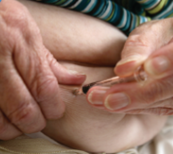
Hold the syringe in one hand and with the other hand, gently pinch a fold of skin with its fatty tissue between your thumb and index finger (as demonstrated in the picture). This will be the injection site.
Step 5
Hold the syringe like a dart, keeping the needle at a right angle.
Insert the needle into the skin until the needle is fully inserted.
Step 6
Keep pinching the fold of skin whilst pressing the plunger and inject the Fragmin slowly until all of the medicine has been injected.
Then release the fold of skin and pull the needle out.
If there is any oozing of blood at the injection site, apply gentle pressure, however, do not rub the injection site as this may encourage bruising.
Immediately dispose of the syringe in the safe container, ideally a yellow sharps bin which can be purchased from most pharmacies. The container must be stored safely and away from children at all times. After you have finished the course of Fragmin injections, contact your local Council to arrange for collection of your used sharps.
Side-effects
People who take Fragmin may experience side effects. This is a short description of the more common side effects you could have. Contact your Consultant or GP if you have any worries or concerns, or if you notice anything unusual. The most common side effect of Fragmin is bleeding, therefore it is more likely that you would bleed or bruise easily should you injure yourself whilst on the course of injections. Some bleeding events can be serious.
You may get a bruise ranging from the size of a pinprick to the size of a two pound coin at the injection site. If you notice a lump at the injection site, don't worry as it is just fluid which will soon be absorbed into your body.
Allergic reactions with Fragmin are not common. Fragmin prefilled syringes may contain latex and alternative heparins should be considered if you have a history of latex allergy. You should tell your doctor before you start treatment if you have had a reaction to medicines in the past.
Some less common side effects that you may notice when taking Fragmin are:
Bleeding of gums
Coughing up blood
Difficulty in breathing or swallowing
Dizziness
Headache
Increased menstrual flow or vaginal bleeding
Nosebleeds
Paralysis
Prolonged bleeding from cuts
Red or dark brown urine
Red or black, tarry stools
Shortness of breath
Unexplained pain, swelling, or discomfort, especially in the chest, abdomen, joints, or muscles
Unusual bruising
Vomiting of blood or coffee ground-like material
Weakness
If you notice any of these side effects, contact your GP immediately.
Contact us
If you have any queries relating to this information, please contact the Haematology (blood) service.
You can use the accessibility toolbar at the bottom of your screen to:
Change the text size
Adjust the font
Modify the colour contrast
Use the translate function
If you would like this information in another format, such as Braille, audio, or easy read, please speak to a member of staff.
You can also print as well as download as PDF using the “Print this page” button at the end of the page.
Staff will print a copy for you on request
Important note
This page provides general information only. It is developed by clinical staff and is reviewed regularly every 3 years for accuracy. For personal advice about your health, or if you have any concerns, please speak to your doctor.