

Advice after your nerve block for surgery
On this page…
Introduction
Orthoptic exercises are for your eyes that can help to improve the symptoms of convergence insufficiency and other related orthoptic problems. They come in 2 main forms. A dot card may be given, which is a narrow strip of card with dots along it connected by a line. The other exercise are stereograms, which consists of 2 incomplete images which can be joined into 1 complete image and vice versa. Your orthoptist will explain and demonstrate this exercise for you.
Dot Card
- Hold one end of the card to your nose and look along the line at the furthest dot from you.
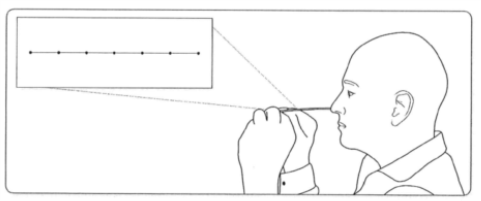
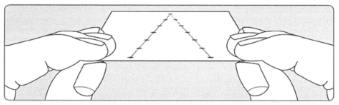
- Concentrate on this dot and try to pull your eyes in to make the dot one. The two lines should join at the dot and make an upside down V. Try next to focus on the next dot closer to you. The lines will meet at the dot, but will now look like an X.
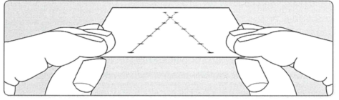
- Continue to focus on the closer dots until you can complete the exercise to your nose. This will be difficult at first, but continued practice will make it easier.
Stereograms
The stereogram which will usually be given to you, is that of two cats. As mentioned before this card will have two incomplete images. Both images have whiskers but on different sides of the face, as well as one having a tail and the other with ears. Together these will form one complete cat.
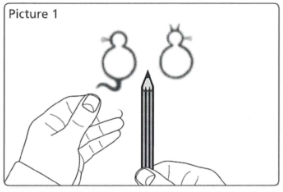
This exercise can be done at either near or distance. Your Orthoptist will tell you which one to do.
Near Stereogram
- Hold the cat card at arm’s length at the same level as your eyes and hold a pen half way between the card and your face.
- Look at the top of the pen and concentrate on it. It should appear as a single image.
-
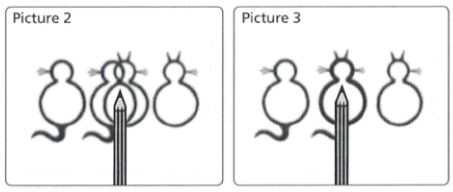
The cats behind the pen will then look like they are moving apart (picture 2). The aim is for you to be able to see 3 cats behind the pen while still looking at the pen. The 3 cats should look like picture 3.
Distance Stereogram
- Hold the cat card at arm’s length at the same level as your eyes. Look over the top of the of the card at a point in the distance. Your orthoptist will have shown you appropriate points to choose.
- Look at the point you have chosen and concentrate on it. It should appear as a single image.
- The cats will now look like they are moving together. The aim is for you to be able to see 3 cats while still looking at your chosen point.
With both near and distance stereograms the middle cat should be complete. When you first start doing this exercise the middle cat might appear blurred, but if you keep doing the exercises the cat should become clear.
How often should I exercise?
These exercises should only be done for a few minutes at a time, but frequently throughout the day. The orthoptist will tell you how many weeks you should perform the exercises for as this can vary.
Other stereograms you might be given
- Bucket - You do this in the same way as the cat stereogram, but the aim is for you to see the middle bucket as a 3D image, as if you are looking into a bucket.
- ABC ring - This is another stereogram card, with a different image. Your orthoptist will demonstrate how to do this.
Risks and benefits
There are few risks associated with these exercises. In rare cases you can provoke convergence spasm, where eyes become crossed and cannot easily be relaxed. To reduce this risk it is important that you relax your eyes after exercising them. You can do this either by looking into the distance or by closing your eyes for a minute or so.
When you start this exercise you may feel increased eye strain and even a worsening of symptoms such as headaches, this is normal. By completing the full course of exercises you will be able to read and focus much more comfortably.
If you have any questions or concerns about the use of stereograms, please do not hesitate to contact the orthoptic department on 0300 613 4253.
Contact us
If you have any queries relating to this information, please contact the Ophthalmology service.
About this information
Service:
Ophthalmology
Reference:
QQ/061
Approval date:
1 July 2024
Review date:
1 July 2027
Click ‘show accessibility tools’ at the bottom of the page

Then click ‘select language’

Alternative formats
You can use the accessibility toolbar at the bottom of your screen to:
-
Change the text size
-
Adjust the font
-
Modify the colour contrast
-
Use the translate function
If you would like this information in another format, such as Braille, audio, or easy read, please speak to a member of staff.
You can also print as well as download as PDF using the “Print this page” button at the end of the page.
Staff will print a copy for you on request
Important note
This page provides general information only. It is developed by clinical staff and is reviewed regularly every 3 years for accuracy. For personal advice about your health, or if you have any concerns, please speak to your doctor.