

Advice after your nerve block for surgery
On this page…
This page provides information about a treatment called intravascular lithotripsy (IVL), used for patients with peripheral arterial disease (PAD). The treatment may be provided in the Radiology department or in the operating theatre as part of a procedure to improve your blood flow to your legs.
What is Peripheral Arterial Disease?
- Peripheral arterial disease (PAD) is a condition affecting the arteries, primarily those supplying blood to the legs.
- Arteries are blood vessels that carry oxygen-rich blood from the heart to the rest of the body.
- In PAD, these arteries can become narrowed or blocked, often due to the buildup of a hard substance called calcium within the artery walls.
- This calcification restricts blood flow, leading to symptoms such as leg pain during walking (intermittent claudication) and, in severe cases, non-healing foot wounds.
What is Intravascular Lithoptripsy?
- Intravascular lithotripsy (IVL) is a medical procedure designed to open narrowed or blocked arteries in patients with PAD.
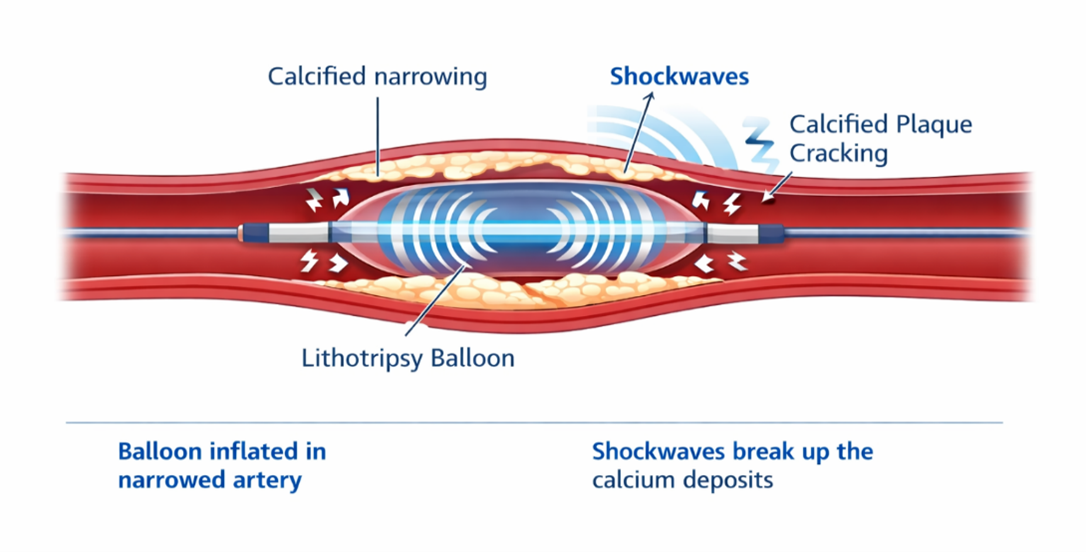
- The procedure involves the use of a catheter, which is a long, thin, flexible tube. There is a balloon at its tip.
- The balloon delivers acoustic (sound) pressure waves, which are used to disrupt the calcified plaque within the artery wall.
- This process facilitates the widening of the artery, thereby improving blood flow.
- In some cases, a small metal scaffold called a stent may be inserted following IVL to maintain arterial patency.
What will happen during the procedure?
Before the treatment:
- Your doctor will discuss the rationale for this treatment with you in detail. They will explain the potential benefits and risks associated with the procedure.
- You will have the opportunity to ask questions, and it is important to ensure you fully understand the information provided.
- You will be asked to provide your informed consent prior to the procedure.
During treatment
- The procedure will be performed in a hospital setting under the care of a team of doctors and nurses.
- The catheter will be inserted into an artery in your leg and the balloon guided to the site of the narrowing.
- Acoustic pressure waves will be delivered to crack the calcium deposits, making the vessel more elastic and flexible. The catheter and balloon will then be removed.
- A stent may be inserted, if necessary, to keep the artery open.
After treatment
- A period of rest will be required following the procedure and you will be closely monitored by medical staff.
- Follow-up appointments will be scheduled to assess your progress.
What are the potential benefits?
- IVL can lead to improved blood flow in the treated leg. This improvement can alleviate leg pain experienced during walking.
- It can also promote the healing of non-healing foot ulcers.
What are the potential risks?
- The risks will be discussed with you by your doctor in detail at the time of the procedure. However, there is a small risk of bleeding, infection, vessel thrombosis (blockage) and embolization (blockage passing down the leg). Very rarely a blockage may lead to major amputation.
- You will have the opportunity to discuss the risks and any concerns that you may have when you meet your doctor before the procedure.
Additional Information
- It is important to note that Intravascular Lithotripsy is a relatively new technique.
- Clinical studies have demonstrated favourable outcomes with IVL, showing high procedural success rates and a low risk of major complications. The long-term success rates of IVL in improving blood flow and relieving symptoms are also being studied.
Contact us
If you have any queries relating to this information, please contact the Vascular surgery service.
About this information
Service:
Vascular surgery
Reference:
Y/064
Approval date:
27 February 2026
Review date:
1 February 2029
Click ‘show accessibility tools’ at the bottom of the page

Then click ‘select language’

Alternative formats
You can use the accessibility toolbar at the bottom of your screen to:
-
Change the text size
-
Adjust the font
-
Modify the colour contrast
-
Use the translate function
If you would like this information in another format, such as Braille, audio, or easy read, please speak to a member of staff.
You can also print as well as download as PDF using the “Print this page” button at the end of the page.
Staff will print a copy for you on request
Important note
This page provides general information only. It is developed by clinical staff and is reviewed regularly every 3 years for accuracy. For personal advice about your health, or if you have any concerns, please speak to your doctor.