

Advice after your nerve block for surgery
On this page…
What is a volar plate injury?
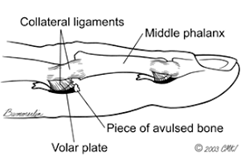
The volar plate is a thick ligament located on the palm side of the finger joints, it stops the finger joint from bending backwards (hyperextending or dislocating).
An injury to the volar plate occurs when the finger is forcefully bent backwards, sometimes the volar plate pulls off a piece of bone from where the volar plate attaches to; this is called an avulsion fracture.
This injury may also involve the collateral ligaments. Collateral ligaments stop excessive side to side movements of the joint.
What are the signs and symptoms of a volar plate injury?
- Swelling and enlargement around the joint.
- Pain when the hand is resting and on moving the joint.
- Inability to move the joint fully.
Treatment
Treatment usually involves supporting your injured finger to the next finger with a compressive sleeve called a Bedford splint. They also help reduce swelling to the finger.
How can I regain movement?
- It is important to reduce the swelling as this limits the joints ability to move. Keep the finger compressed with the Bedford splint and elevate the hand.
- Use the hand and finger for normal activities as discomfort allows.
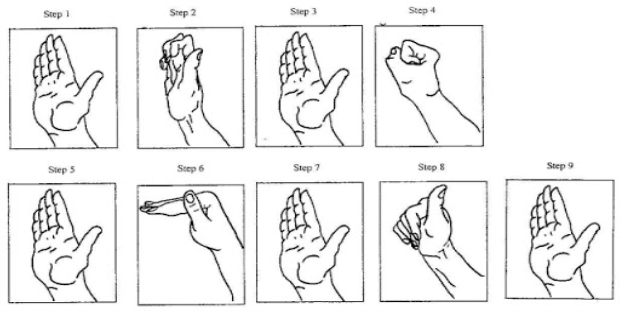
- Carry out the following exercises to gradually increase the movement of the joints.
- Start by gently pushing the finger into as much bend as the finger can tolerate before completing the following:
What can I expect during my recovery?
- Volar plate injuries take a surprisingly long time to heal.
- The joint can be painful at rest and during movement for many weeks.
- Swelling can take months to resolve and can limit the ability for the joint to bend and straighten fully. There maybe permanent enlargement to the joint.
Contact us
If you have any queries relating to this information, please contact the Hand therapy service.
About this information
Service:
Hand therapy
Reference:
UU/054
Approval date:
19 February 2026
Review date:
1 February 2029
Click ‘show accessibility tools’ at the bottom of the page

Then click ‘select language’

Alternative formats
You can use the accessibility toolbar at the bottom of your screen to:
-
Change the text size
-
Adjust the font
-
Modify the colour contrast
-
Use the translate function
If you would like this information in another format, such as Braille, audio, or easy read, please speak to a member of staff.
You can also print as well as download as PDF using the “Print this page” button at the end of the page.
Staff will print a copy for you on request
Important note
This page provides general information only. It is developed by clinical staff and is reviewed regularly every 3 years for accuracy. For personal advice about your health, or if you have any concerns, please speak to your doctor.