

Advice after your nerve block for surgery
On this page…
Airway clearance techniques (ACTs) loosen thick, sticky sputum so it can be cleared from your lungs by coughing or huffing. Clearing the airways may help decrease lung infections and improve lung function.
Important factors in chest clearance:
- Hydration - To get the most out of your Airway Clearance Technique you must drink fluids (not alcohol) and stay well hydrated. When you are dehydrated, your natural lung clearance methods don’t work as well. A good rough guide is about 8 glasses (or between 1 and 2 litres) daily.
- Physical activity - Physical activity can be one of the best ways to help clear sputum out of your lungs. Physical activity that makes you breathe more deeply and quickly will loosen the sputum and move it through your lungs, towards your mouth.
- Positioning – Your airways are like a tree – they have many branches. You need to use the best position to drain particular branches. Spending at least 10 minutes in the chosen position can help to drain sputum naturally.
Many people do not have sputum on a daily basis and therefore do not need to clear their chests regularly. However, these techniques may be useful during exacerbations when sputum load does increase.
If you do have trouble with sputum load, the part of the day you feel most congested is the best time to use some of these techniques, e.g., first thing in the morning or before going to bed. If you do this at night make sure you leave about 30 minutes between finishing your clearance and going to bed.
Active Cycle of Breathing Technique
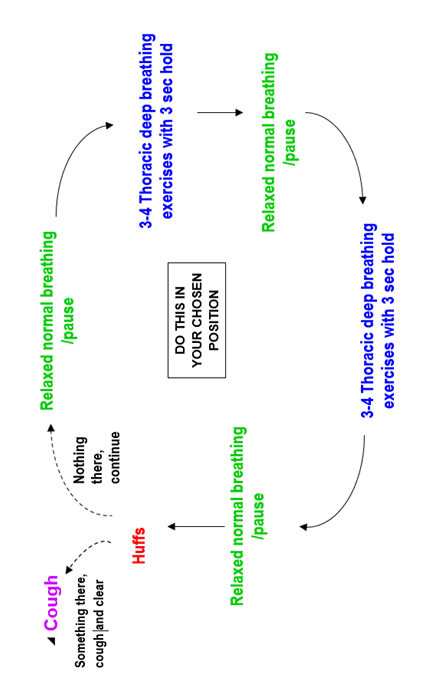
The Active Cycle of Breathing Technique (ACBT) is designed to clear secretions with minimal effort. You don’t need any equipment or assistance so you can do it anywhere at any time. ACBT consists of:
Relaxed normal breathing / pause
Relaxed gentle breathing involves using as little effort as possible. Breathe in and out gently through your nose or through your mouth using ‘pursed lips breathing’. Aim to encourage your breathing rate to slow down and let go of any tension in your body with each breath out, closing your eyes may help with this. Completing this relaxed gentle breathing between the other exercises in ACBT prevents you from becoming dizzy and relaxes your respiratory muscles. This relaxed gentle breathing technique also helps when you are short of breath or experiencing moments of stress and anxiety.
Thoracic deep breathing exercises
3 or 4 deep breaths making sure your lower ribs expand. Hold each breath for three seconds and then breathe out gently. Breathe in through your nose and out through your mouth. This may make you feel light headed if you do too many. Please return to relaxed normal breathing if this occurs.
Huff
Complete 1-2 huff cycles at the end of the ACBT cycle. Huffs are forceful breaths out, using your stomach muscles. It is like steaming up a mirror with your mouth open and helps to clear your sputum without coughing. Rest in-between each huff. There are two types of huff in the huff cycle: The “small-long huff” followed by the “big-short huff”.
The Small-long huff moves sputum from the bottom your chest to the top of your chest. Take a small to medium breath in and then huff with an open mouth, squeezing the air out until your lungs feel empty.
The Big-short huff moves sputum from the top of your chest to the back of your throat, so use this huff when it feels ready to come out, but not before. Take a deep breath in and then huff the air out quickly and sharply.
The visual diagram for this Active Cycle of Breathing Technique is seen over the page. The main thing to remember is to resist the temptation to cough. Coughing continually may make you very wheezy and is very tiring. Only cough when you can feel the sputum at the back of your throat. If you don’t have sputum ready to cough out at the back of your throat, go back to the beginning of the cycle.
Positioning
Positioning may be used to enhance ventilation to specific lung regions where secretions are located, such as in bronchiectasis patients. The increased ventilation to those lung regions can then be used effectively to mobilise secretions. Gravity helps to drain different parts of the lungs, depending upon the position you are in.
You can do the Active Cycle of Breathing Technique in the positions described below, as advised by your physiotherapist. When you need to cough, return to a sitting position. Follow this with a brief rest before lying down again to continue the process until the airways feel clear of sputum.
Sitting: sit in a comfortable upright position.
Side Lying: Lie comfortably on your side with your head supported.
Tipped Side Lying: Lie comfortably on your side with a pillow or two under your hips so that they are higher than your shoulders
The regime should take about 10 minutes per side depending on how much sputum you are producing. Continue until you feel your chest is clear.
If you are having a bad day with your chest, you may want to do more than one position and repeat more than once a day, particularly if you are also unable to exercise due to feeling unwell.
Handheld devices
These devices should be used as an addition to other chest clearance techniques, especially if patients are struggling with clearing sputum effectively. For this reason you may also hear these devices being referred to as ‘adjuncts’. You need to have been assessed by a physiotherapist for your suitability to use these devices.
These devices work by
- creating positive pressure in the airways, which prevents airway collapse and can reduce air trapping, and
- creating vibration, which helps to loosen sputum, making it easier to clear using your breathing exercises such as Active Cycle of Breathing Technique.
Contact us
If you have any queries relating to this information, please contact the Respiratory medicine service.
About this information
Service:
Respiratory medicine
Reference:
W/021
Approval date:
9 December 2024
Review date:
1 December 2027
Click ‘show accessibility tools’ at the bottom of the page

Then click ‘select language’

Alternative formats
You can use the accessibility toolbar at the bottom of your screen to:
-
Change the text size
-
Adjust the font
-
Modify the colour contrast
-
Use the translate function
If you would like this information in another format, such as Braille, audio, or easy read, please speak to a member of staff.
You can also print as well as download as PDF using the “Print this page” button at the end of the page.
Staff will print a copy for you on request
Important note
This page provides general information only. It is developed by clinical staff and is reviewed regularly every 3 years for accuracy. For personal advice about your health, or if you have any concerns, please speak to your doctor.