

Advice after your nerve block for surgery
On this page…
IDDSI Level 4 Purée Diet
What is a puréed diet?
You may be advised to have a Level 4 puréed diet if you have problems with your swallowing or oesophagus (‘food-pipe’). Food of this texture is smooth and cohesive which requires no biting or chewing. It is recommended when muscles of the tongue, cheeks, throat or oesophagus aren’t working enough to manage solid food.
A Pureed Diet
- Is usually eaten with a spoon
- Does not require chewing
- Has a smooth texture with no lumps
- Holds its shape on a spoon
- Falls off a spoon in a single spoonful when tilted
- Is not sticky
- Does not have liquids separate from solids (uniform consistency)
How to prepare a purée diet
- Most everyday foods can be easily made into a purée with a blender.
- Ensure foods are well cooked and cut into small chunks before processing.
- Remove tough skins and large seeds before blending.
- Use a liquidiser, food processor or hand-held blender.
- Some foods may need to be sieved after puréeing to remove skins or ‘bits’ e.g. peas and beans.
- Some liquid may separate on standing - drain excess liquid off before serving.
- Make sure all foods are well cooked.
- Add sauces/stock/cream* etc. to keep food moist. Foods blended with milk, cream or stock tend to taste better than those blended with water.
- Prepare and serve foods separately to maintain colour and taste, e.g. blend peas and remove before blending meat in gravy.
- Not everything needs to be prepared from scratch - many different convenience foods can be used.
Do not use commercial baby foods, these do not provide adequate nourishment for adults. You can purchase ready-made pureed meals from suitable companies, e.g. Wiltshire Farm Foods www.
Maximum Nutrition, Minimum Bulk to Help Maintain Weight
- Use high energy liquids* when extra fluid is required to give the correct consistency. Full fat milk, creamy sauces, thickened gravy, custard or juice will add extra calories to the meal. Do not use water.
- Add high energy foods* whenever possible: butter/spread, milk powder, grated cheese, evaporated milk, cream, sugar, seedless jam or honey are all useful additions.
- Use full fat foods* (not diet variety) - ordinary fromage frais, thick and creamy yoghurts, full fat spreads/butter, full cream milk.
- Try to avoid: skimmed or semi-skimmed milk (use whole milk), any product labelled fat free/low fat/light (lite)/reduced sugar/sugar free/low calorie slimming endorsed foods
- Add plenty of sugar to your food. Always drink ordinary squash rather than the diet variety.
- Fortified milk doubles the goodness of milk without doubling the amount of milk you need to drink. This can be used to make mashed potato, porridge, packet or condensed soups and milk puddings. It can be used whenever you would normally use milk. Fortified milk is made by adding 4 tablespoons of milk powder to 1 pint of full cream milk.
- Fortified drinks such as Complan and Build Up can be bought from a chemist or supermarket. They are useful in between your meals, particularly if you are not managing a great deal to eat.
If you need thickened fluids, make sure your drinks / sauces are the correct consistency advised by your Speech and Language therapist. Avoid foods that turn to liquid in the mouth, e.g. ice cream/jelly
* If you’ve had a stroke, heart attack or have diabetes, these foods may not be suitable as part of your everyday diet. Please contact a Dietitian for more advice.
Tips
- Adopt a pattern of small, frequent meals to maximise your intake across the day.
- Presentation - purée and serve the meat, vegetables and starchy foods all separately on the plate to make meals look more appetising. A plate with dividers may be helpful to prevent food from mixing.
- Try to use different colours to enhance the visual appeal of a meal, e.g. a bright coloured vegetable with a paler protein.
- Vary the flavours in a meal. Use spices, herbs and a variety of sauces, e.g. soy, Worcester, tomato, barbeque.
- Do not puree stringy foods (e.g. green beans), crumbly foods (e.g. bread), crunchy foods (e.g. nuts), chewy foods (e.g. tough meat or toffees), or foods with skins or husks (e.g. sausages or sweetcorn).
- Portioning and freezing food
- If you have a freezer, you may find it convenient to make up a full recipe of some dishes (4-6 servings), then divide into portions to be frozen. Cool the food quickly after cooking and freeze immediately. Do not forget to label and date the pots.
- Defrost the portions thoroughly in the fridge or in the microwave, and then reheat. Food should not be reheated more than once because of the risk of food poisoning - and defrosted food should never be re-frozen.
- Ready-to-eat meals, tinned, packet, frozen or boil-in-the-bag foods can be reheated according to the instructions on the packet, then liquidised. If necessary, thicken with mashed potato or serve with sauce/gravy.
If you are concerned about your food / fluid intake, are experiencing symptoms such as constipation or require more information on appropriate meal ideas / recipes please speak to your Dietitian
Meal Suggestions
Breakfast
- ReadyBrek or smooth porridge made with milk and sugar/honey*
- Weetabix with sufficient milk mixed to a moist paste – all milk must be fully absorbed.
- Smooth and creamy scrambled egg
- Puréed fruit with skins and pith removed
- Smooth full-fat yoghurt* or fromage frais with puréed fruit
- Greek yoghurt mixed with honey or maple syrup*
Main Meals
- Smooth Soups - most soups will need to be liquidised and strained to remove any bits. Soups may need to be thickened using powdered potato, corn flour or prescribed thickener if you are advised to have thickened fluids
- Boneless fresh, frozen or tinned fish can be cooked by steaming, baking, poaching or microwaving, and then pureed with a smooth sauce
- Puréed meat, poultry or egg with sauces
- Puréed meals, e.g. shepherds/cottage pie, stews, casserole, chilli, bolognaise, lasagne, moussaka
- Puréed beans/lentil dish sieved or smooth dhal
- Puréed cheese and potato pie
- Puréed macaroni cheese or cauliflower cheese
- All types of potatoes, plantain, sweet potato or yam can be pureed. If liquid is needed add milk, butter*, cream/sour cream*, cheese, gravy or sauce
- Rice or pasta, puréed with plenty of sauce. Add flavoured sauces, e.g. sweet and sour, curry or seasoning to taste
- Most boiled or steamed vegetables can be cooked and puréed (with the exception of green beans or sweetcorn)
- Dhal, e.g. Channa or Moong is suitable if the lentils are cooked until soft and then puréed.
Desserts
- Smooth thick full-fat yoghurt*
- Custard made with full-fat milk*
- Puréed fruit (no seeds, pips, skins) served with custard
- Mousse, instant whip
- Puréed milk puddings with added/honey or sugar*
- Sponge puréed with custard*
- Pureed rice pudding
- Blancmange*
- Crème caramel*
- Smooth milk pudding
- Mascarpone cheese
- Panacotta*
- Jelly/ice-cream (not advisable for those recommended thickened fluids because they melt into a thin liquid consistency in the mouth)
Light Meals and Snacks
- Homemade/tinned/packet soup (no lumps), thickened if necessary. To enrich the soup use pureed lentils, beans or barley, cream* or milk.
- Puréed tinned pasta, e.g. macaroni cheese, ravioli, spaghetti
- Vegetables puréed with cheese sauce, e.g. cauliflower
- Puréed baked beans
- Puréed jacket potatoes and filling (discard skins)
- Fromage frais, yoghurt (no bits) or mousse
- Hummus, taramasalata, smooth guacamole, cream cheese
- Milk or milky drinks, e.g. coffee, Horlicks, Ovaltine, drinking chocolate, milk shakes made with puréed fruit and ice-cream or cream* (if advised thickened fluids add thickener to desired consistency)
- Blended fruit drinks with ice-cream* (if advised thickened fluids add thickener to correct consistency).
Good Feeding Practices
People who experience difficulty swallowing may require extra help when eating and drinking to ensure that food and drink go down the right way. Below is a list of helpful tips to encourage safe eating and drinking.
Alertness
- Eat and drink when most alert
- If eating and drinking is tiring try to eat smaller but more frequent meals, a ‘little and often approach’ with appropriate snacks between meals
Positioning
- Ensure sitting fully upright when eating and drinking (i.e. at 90o)
- Stay sitting upright for 30 minutes after eating and drinking
- Encourage sitting out in a chair for meals if possible, with hips well back and feet flat on the floor
- If eating and drinking in bed use pillows to support upright sitting if necessary
Oral Care
- Ensure mouth is kept clean and moist
- When you have finished eating, clean mouth and dentures and remove any food residue remaining in the mouth
Environment
- Ensure you can concentrate on eating and drinking and are not distracted by the television, radio or conversation
- If feeding somebody, sit at the same level as them and make eye contact when feeding them
Food
- Explain what the food is and be positive about it
- Make meals look appetising
- Do not mix entire meal together, serve meat, vegetables and carbohydrates separately on the plate
- Make sure your mouth is clear of food and drink before taking the next mouthful. You may need to swallow more than once to clear each mouthful.
- Try to keep meals warm if they take a while to eat
Feeding
- Feed yourself where possible
- If self-feeding is not possible, try to support the person to feed themselves using hand over hand assistance
- Small mouthfuls of food/drink are safer than large mouthfuls
- Allow plenty of time to swallow
- If you become tired, take regular breaks
- If impulsive - try only offering small volumes of food and fluid at once
- Try to avoid using beaker lids and straws as they encourage fluids to travel more quickly through the mouth, potentially reducing control over them and resulting in higher risk of aspiration. Only use them if absolutely necessary.
Eating Out
If you are eating out, let the restaurant know in advance that you have special requirements - most places will be happy to help.
Patients with Other Health Conditions
If you have other health conditions such as diabetes, food allergies, high cholesterol, high blood pressure etc. the information within this leaflet may not be suitable. Please contact your Dietitian if you need any further information.
Foods to avoid
These are foods which can be difficult to purée so should be avoided altogether:
- Vegetables/fruit skins including beans e.g. broad, baked, soya, black-eyed, peas and grapes
- Crunchy foods, e.g. toast, flaky pastry, dry biscuits, crisps
- Crumbly items, e.g. bread, pie crusts, crumble, dry cakes
- Hard foods, e.g. boiled or chewy sweets and toffees, nuts, seeds
- Husks, e.g. sweetcorn and granary bread
Foods to Take Extra Care With
These are foods which can be difficult to purée so extra care should be taken to avoid lumps/pips or skins:
- Stringy, fibrous texture, e.g. pineapple, runner beans, celery, lettuce
- Mixed consistency foods, e.g. cereals which do not blend with milk (e.g. muesli), mince with thin gravy, soups with lumps
- Rice - need to cook very well to be as soft as possible
How do I test my food to make sure it is Level 4 Puree?
It is safest to test pureed food using the IDDSI Fork Drip Test and the IDDSI Spoon Tilt Test. Pureed food must pass both tests. Follow the instructions below.
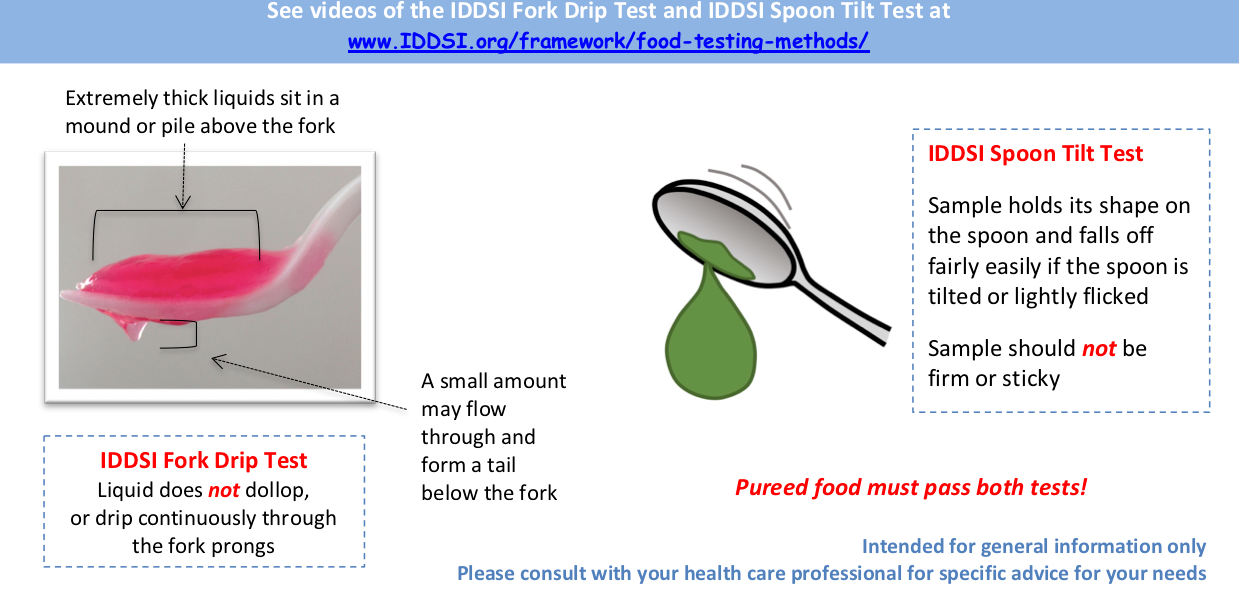
Where can I find out more information?
The International Dysphagia Diet Standardisation Initiative 2019
https://
Contact us
If you have any queries relating to this information, please contact the Speech and language therapy service.
About this information
Service:
Speech and language therapy
Reference:
VV/004
Approval date:
20 September 2024
Review date:
1 July 2027
Click ‘show accessibility tools’ at the bottom of the page

Then click ‘select language’

Alternative formats
You can use the accessibility toolbar at the bottom of your screen to:
-
Change the text size
-
Adjust the font
-
Modify the colour contrast
-
Use the translate function
If you would like this information in another format, such as Braille, audio, or easy read, please speak to a member of staff.
You can also print as well as download as PDF using the “Print this page” button at the end of the page.
Staff will print a copy for you on request
Important note
This page provides general information only. It is developed by clinical staff and is reviewed regularly every 3 years for accuracy. For personal advice about your health, or if you have any concerns, please speak to your doctor.