

Advice after your nerve block for surgery
On this page…
Categories:
This page contains information about fractured ribs and other chest wall injuries.
Rib fractures are a very common injury. In the elderly, they are often caused by a fall (either from a height or a standing position) whereas in the younger population, they are often caused by road traffic collisions or sports.
Rib fractures normally take about 4-6 weeks to heal, but during this time they can be very painful. One of the main reasons is your chest wall is always moving as you breathe, and unlike other parts of our body, it is difficult to rest.
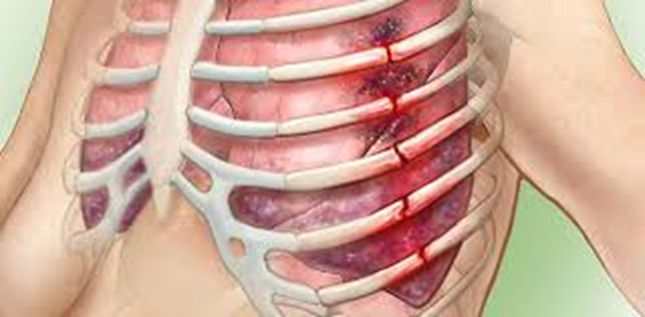
Complications of rib fractures
Chest Infections
One of the most common complications after rib fractures is a chest infection. When people are in pain, they tend to take more shallow breaths and struggle to cough up sputum (phlegm). Combined with the fact that most patients tend to be slightly less mobile, this can mean that you are more prone to developing a chest infection.
It is very important that your pain is well controlled in order to be able to take a deep breath and cough. It is essential that you take regular painkillers to minimise discomfort.
If these painkillers do not control your pain, or we think it is necessary, a specialist doctor called an anaesthetist will see you and offer you an epidural or nerve block (paravertebral block) to numb the pain from your fractured ribs.
Pneumothorax
This is when air gets into the space between the chest wall and the lung. This causes the lung to collapse. This may cause shortness of breath. A small tube (called a chest drain) may need to be inserted between the ribs to remove the air and improve your breathing.
Haemothorax
This is when blood collects in the space surrounding the lung. This can make the lung collapse. This may cause shortness of breath. A chest drain may be required to remove the blood and improve your breathing.
Surgical emphysema
This is when air leaks from your lung into the space under your skin. This can cause the skin of your chest to look swollen and sound crackly when pressed.
How are rib fractures diagnosed?
Most people are diagnosed with rib fractures after having a chest x-ray or a CT scan.
How do you treat rib fractures?
There is no specific treatment for rib fractures. The most important thing is controlling your pain and preventing a chest infection.
You will be offered painkillers, anti-sickness medication. Some people require extra oxygen to help with breathing.
The doctors, nurses and physiotherapists will monitor your closely for any signs of an infection, including a raised temperature or a change in the colour of your sputum.
How can I avoid getting a chest infection?
In order to prevent a chest infection, you must do the following:
- Ensure your pain is well controlled - this will enable you to take deep breaths and cough up your sputum and carry out physiotherapy. You will receive painkillers from nursing staff on a regular basis and can ask for more if required. If you have pain between these times, you can request extra painkillers. Painkillers include tablets (such as paracetamol, ibuprofen, codeine), oral liquids (such as morphine), an intravenous morphine pump allowing you to receive a dose at the press of a button, and plasters with a numbing medicine called lidocaine. If you feel that your pain is not well controlled, or if you think you are unable to tolerate the side effects of the painkillers, it is important that you tell a nurse or doctor. You may be offered a chest wall block to help control your pain, discussed below.
- Mobilise - it is essential that you sit out of bed and walk regularly. If you require some assistance the nursing staff and Physiotherapists will help. This is the most effective way of preventing a chest infection.
- Take deep breaths - it is important that every hour you take 5 deep breaths that fill to the bottom of your lungs. This keeps the lungs inflated and allows air to get behind any secretions that need clearing.
- Cough - try to cough up any sputum that is on your chest. You can support the painful area with a pillow or towel.
- Complete daily shoulder exercises (included within this leaflet). This will stop stiffness and maintain full upper limb function.
- Stop smoking – if you are a smoker it is important to stop smoking altogether. Please ask us for help if you need support with stopping smoking. More information can be found at:
Do not:
- Stay in bed or sit still for a long period of time. This will not allow your lungs to fully expand and will put you at a risk of a chest infection.
- Lift anything heavy that could make your pain worse.
Chest wall nerve blocks
Depending on the location and severity of your injuries, and any other medical problems you may have, you may be offered a chest wall nerve block. In general, this involves the injection of a medicine called local anaesthetic at the site of your injuries, or to the nerves that carry the pain signals from there. This can be done as a ‘one off’ injection for short-term pain relief, or by leaving a small tube called a nerve catheter in place so additional doses of local anaesthetic can be given over a number of days. You can still have other painkilling medications alongside the nerve block.
What are the benefits?
- Can provide excellent pain relief
- Reduce the need for strong painkillers, which can have side-effects such as confusion or constipation
What are the potential risks and side effects?
The side effects will depend on the exact technique chosen and will be discussed with you beforehand. In general, these include:
- The block not working
- The catheter being removed or blocked inadvertently
- Bleeding or infection at the site of injection
- Injuring the lining of the lung (pneumothorax)
- Having an allergic reaction to the local anaesthetic (very rare)
What are the different types of chest wall blocks?
The technique suggested to you will depend on the nature or location of your injuries. All involve using an ultrasound machine to identify where to inject the local anaesthetic. The main options are:
- Serratus anterior block – with you lying on your back or side, local anaesthetic is injected on the side of your rib cage around the serratus anterior (chest muscle).
- Erector spinae block – this may be done with you sat up, lying on your side or on your front. Local anaesthetic in injected underneath your erector spinae, long muscles that run parallel to your backbone and help keep you upright.
- Paravertebral block – as you sit up or lie on your side, local anaesthetic is injected into a space between one side of you backbone and your lung. There is a small additional risk that it may cause your blood pressure to drop.
- Thoracic epidural – this is usually only done if you have extensive injuries to both sides of your chest. Similar to what some women have in labour, a small tube called a nerve catheter is inserted into a space just outside your spinal cord. This can be very effective at providing pain relief but can temporarily cause low blood pressure and heavy legs
Going home
Once you have gone home, it is important that you stay mobile and continue with your deep breathing exercises and shoulder exercises until you are at your normal level of fitness.
If your job involves a lot of heavy lifting or manual handling, it is advisable to talk to your employer about your duties until your chest wall is pain free and you can mobilise comfortably.
Deep Breathing Exercises
- Take 5 deep breaths every hour to fill the bottom of your lungs with air. You could also add a 3 second hold at the top of your breath if possible.
- Repeat a cough as many times as needed to clear any sputum. If your cough is strong and dry, then you do not need to repeat the cough. If you are struggling to cough because of pain, then please let a member of the ward team know.
It is extremely important that you complete daily exercises for your shoulder and thoracic spine (the upper part of your spine) to ensure that you maintain full range of movement and function.
The following exercises must be repeated 2-3 times a day.
Aim for 10-15 repetitions of each.
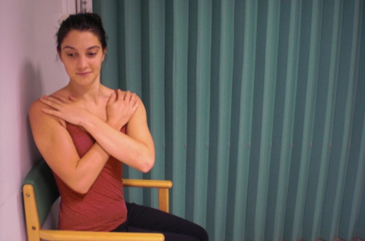
1. Thoracic rotations Sit in an upright position with your hands on opposite shoulders.Slowly turn to one side as far as you can and hold for a few seconds. Return to your starting position and then slowly turn to the other side.
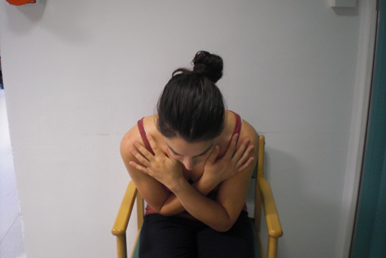
2. Thoracic flexion In the same starting position as exercise 1, gently lean forward as far as you can. Hold for a few seconds and then slowly return to your starting position.
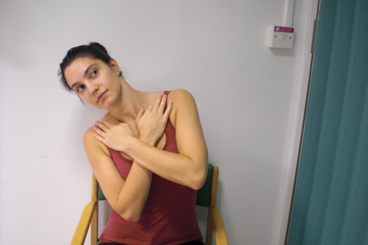
3. Thoracic side flexion In the same starting position as exercise 1, gently lower your elbow down your side as far as you can go. Hold for a few seconds and then return to your starting position. Repeat on the other side.
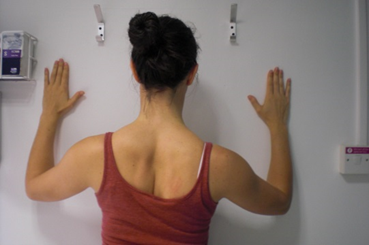
4. Scapular setting Stand facing a wall with your feet apart. Place your palms flat on the wall so your hands are at eye level. Squeeze your shoulder blades back and together. Hold for 5-10s and release.
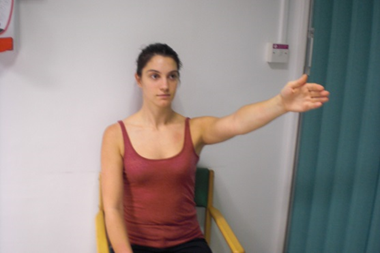
5. Shoulder flexionSit in an upright position. Gently raise your arm up in front of you as far as you can go without causing pain. Hold for a few seconds at the top and then slowly lower your arm down. Repeat on the other side.
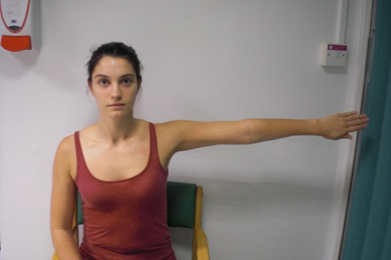
6. Shoulder abduction Sit in an upright position. Gently raise your arm out to the side as far as you can go without pain. Hold for a few seconds and then gently lower your arm. Repeat on the other side.
If you are struggling with any of these exercises, please let your ward physiotherapist know.
If you are experiencing any of the following symptoms, please contact your surgical team
- Worsening shortness of breath
- High temperature
- Increased pain
- Green/yellow sputum
- Feeling unwell
If you were a patient at Wexham Park Hospital
Call 07468 354436 available Monday to Friday 9am to 5pm
07826 921319 available 10pm to 7am
If you were a patient at Frimley Park Hospital
Call 07990 528061 available 24 hours
If you cannot get in contact, please call 111
If you feel seriously unwell, call 999 or go to the nearest Emergency Department
Contact us
If you have any queries relating to this information, please contact the General surgery service.
About this information
Service:
General surgery
Reference:
Y/056
Approval date:
1 June 2026
Review date:
1 June 2029
Click ‘show accessibility tools’ at the bottom of the page

Then click ‘select language’

Alternative formats
You can use the accessibility toolbar at the bottom of your screen to:
-
Change the text size
-
Adjust the font
-
Modify the colour contrast
-
Use the translate function
If you would like this information in another format, such as Braille, audio, or easy read, please speak to a member of staff.
You can also print as well as download as PDF using the “Print this page” button at the end of the page.
Staff will print a copy for you on request
Important note
This page provides general information only. It is developed by clinical staff and is reviewed regularly every 3 years for accuracy. For personal advice about your health, or if you have any concerns, please speak to your doctor.