

Advice after your nerve block for surgery
On this page…
Splint wear
- If necessary, your splint will be remoulded to a straighter position, you will need to wear it at night and for protection in busy places during the day.
- If you have no pain, swelling or contracture developing, you can continue to wear your buddy strap / Bedford splint for a further two weeks.
Swelling
-
It can take many months for the swelling to resolve which may reduce the movement of the finger.
Scar Tissue
-
As the volar plate heals it produces scar tissue which can cause the joint to be larger than before.
Function
-
You are advised not to begin heavy lifting or contact sports until 8 weeks after your injury.
Exercises
Please complete without splint.
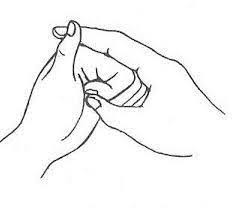
Passive flexion: Using your other hand, tuck your fingers as fully as possible into your palm. Hold for a count of 5 then relax and straighten fingers.
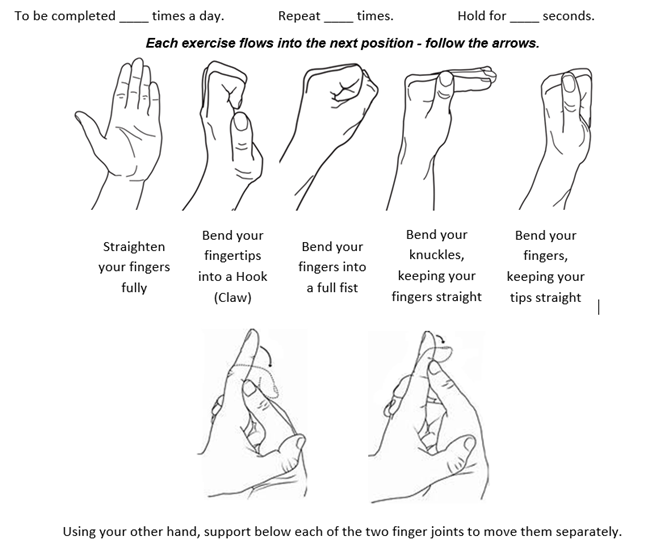
What outcome can you expect after a volar plate injury?
Most volar plate injuries heal in about 6 weeks. However the swelling, pain or discomfort may take several months to settle completely. The volar plate and soft tissue can take up to 3 months to heal fully. Most simple injuries will return to normal function after 3 months. Your finger may become stiff due to lack of movement. It is important that you exercise your finger as you are advised by your Therapist. It may take 2 months or sometimes longer to regain full movement in your finger. You may find your hand weaker when you start to use it. It may take a few months to get your strength back.
Activities
It is important to avoid heavy lifting or contact sports during the initial healing process. This is because of the risk of the splint coming off and causing further damage to your finger.
It is advised not to begin heavy lifting or contact sports until 8 weeks post injury, and to gradually build up the use of your finger to allow the ligament to heal.
Driving
It is recommended that you contact your car insurance company to clarify if you are insured to drive whilst wearing a splint. You should not drive while you are in a splint. You should not return to driving if you have significant pain or if you have reduced grip function that affects your ability to drive safely and perform an emergency stop manoeuvre. We cannot give you permission to drive. It is your responsibility to ensure that you are safe to drive and you are in control of the vehicle
Complications
Most volar plate injuries heal without any complications. Associated fractures involving a joint may have a greater tendency to become stiff. The following complications may also occur:
- Chronic swelling – extremely common
- Flexion contracture
- Joint stiffness
- Instability or recurrent dislocation
- Post traumatic arthritis
- A pain syndrome
Appointments
Please contact the hand therapy department if you are unable to attend an appointment.
In an emergency, seek medical advice from a GP or local accident or minor injuries unit.
Hand therapy department telephone numbers:
Frimley Park Hospital: 0300 6133396
Heatherwood Hospital: 0300 6140540 Option 3
Wexham Park Hospital: 0300 6140540 Option 2
Contact us
If you have any queries relating to this information, please contact the Hand therapy service.
About this information
Service:
Hand therapy
Reference:
UU/006
Approval date:
19 February 2026
Review date:
1 February 2029
Click ‘show accessibility tools’ at the bottom of the page

Then click ‘select language’

Alternative formats
You can use the accessibility toolbar at the bottom of your screen to:
-
Change the text size
-
Adjust the font
-
Modify the colour contrast
-
Use the translate function
If you would like this information in another format, such as Braille, audio, or easy read, please speak to a member of staff.
You can also print as well as download as PDF using the “Print this page” button at the end of the page.
Staff will print a copy for you on request
Important note
This page provides general information only. It is developed by clinical staff and is reviewed regularly every 3 years for accuracy. For personal advice about your health, or if you have any concerns, please speak to your doctor.