

Advice after your nerve block for surgery
On this page…
Introduction
The aim of this leaflet is to give you a general understanding of shoulder instability and what happens before and after your Latarjet Stabilisation surgery. It is designed to help you to prepare for your operation and after care once you go home.
The Shoulder
The shoulder is the most mobile joint in the human body. It is formed between the ball shaped bone at the top of your arm (humeral head) and a slightly curved surface on your shoulder blade that forms a socket (the glenoid). The joint relies heavily on the surrounding muscles (the rotator cuff), a rim of cartilage on the glenoid (the labrum) and surrounding ligaments and capsule to maintain its stability.
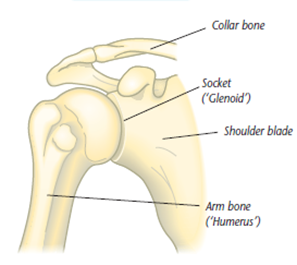
Figure 1: Diagram to show the bones of the shoulder.
Shoulder instability – what is it?
Shoulder instability describes any problem where the control of the ball in its socket is abnormal. Shoulder instability can occur after a dislocation, particularly in people under the age of 25. Dislocations are more common in younger patients and are often a result of injury, such as when playing contact sports. Symptoms of instability can include pain, reduced movement due the shoulder feeling unstable and repeated dislocations or ‘subluxations. Most dislocations are forwards and/or downwards. Approximately 10% of dislocations are backwards. Dislocations can result in damage to the cartilage (labrum) causing it to separate from the bone. The ligaments and capsule surrounding the joint can also become stretched or torn. In some instances, there can also be damage to the bone on the socket (socket) and this is known as a bony Bankart, all these issues together can result in the shoulder becoming unstable.
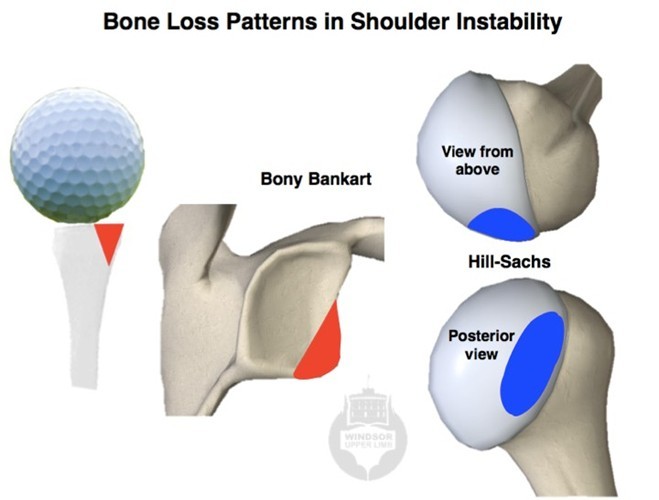
Figure 2: Diagram to show the bone loss patterns in instability. The red is the bony socket injury (Bony Bankart) and the blue is the dent in the humeral head (Hill-Sachs)
Latarjet stabilisation surgery reconstructs the bony damage on the socket of your shoulder. It also brings in a muscular sling for the shoulder as tendons remain attached to the moved piece of bone. This effectively restores the ‘broken golf-tee’ of the joint and makes it hard to dislocate.
Latarjet stabilisation surgery – What is it?
You have been listed for a Latarjet stabilisation procedure. This may have been offered because you have instability with significant loss of bone on the shoulder socket (glenoid) and/or high risk of failure from a soft tissue (keyhole) surgical repair.
Latarjet is a mini-open procedure, meaning you will have a small scar (about 5-7cm) at the front of the shoulder.
The surgery is performed under a general anaesthetic and usually also with a regional nerve block to your arm.
A piece of bone at the front of your shoulder blade (coracoid process - and its’ attaching muscular tendons) is cut, repositioned and secured to the front of the shoulder socket. This restores the lost bone on the glenoid socket and helps provide a new muscular sling to the front of the shoulder to provide stability to the shoulder when in elevated positions. In addition, the ligaments and capsule of the shoulder are repaired and re-tensioned.
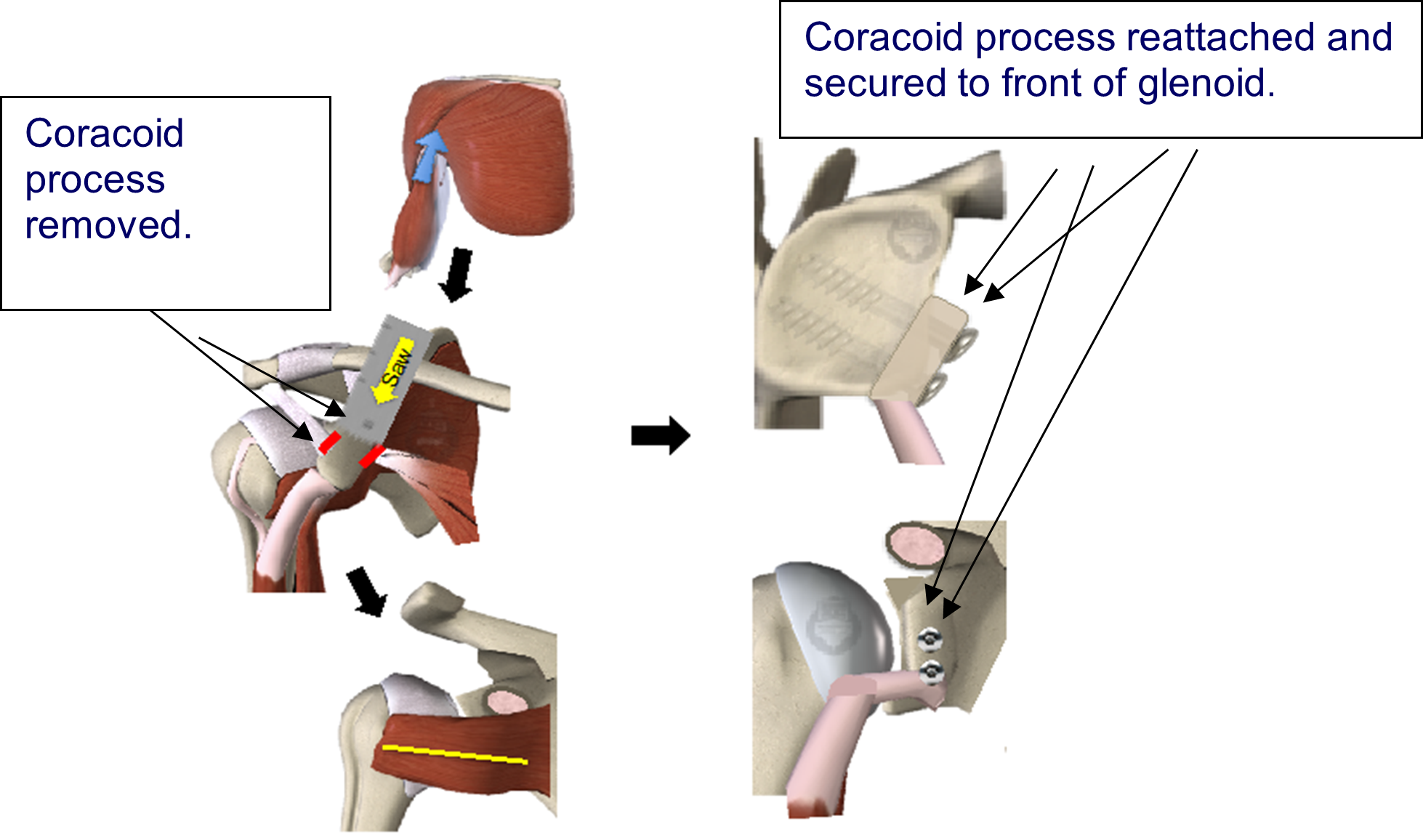
Figure 3: Diagram to show the Latarjet surgical procedure. Blue arrow depicts the path to the shoulder between the muscles. The yellow line shows where the subscapularis muscle in front of the shoulder joint is split to allow access to the joint. The graft is usually fixed to the shoulder with titanium screws.
What happens before your admission to hospital?
You will be contacted by the bookings team to arrange your surgery date. You will need to attend the pre-operative assessment clinic to assess your fitness for surgery.
At the time of listing for surgery, you will have been given information regarding your surgery, and an opportunity to ask questions. This information leaflet should also help you to understand the pathway.
We recommend you source Benzoyl Peroxide 5% gel from your pharmacist. This is an over-the-counter acne cream. You should rub a pea sized amount over the front of your shoulder and towards your armpit once a day for the three days prior to your operation. This has been shown to reduce levels of a certain bacteria that sometimes causes infection in shoulder surgery.
Coming into hospital
You will be told when to arrive at the hospital on the day of your surgery. Please do come on time so we can get you ready in time for your operation.
Please do not eat any food for 6 hours prior to your surgery. You can drink water until your surgery. You may be given a small carbohydrate drink 2 hours prior to your surgery when you are with us.
You will normally go home on the same day as your surgery. There are many advantages to being in your own environment, reducing the risk of complications and being in control of your own recovery. In some rare cases, your consultant may ask you to stay overnight and go home the following morning. If this if required, you will be made aware of this prior to your admission.
You will need to arrange for someone (e.g., a family member or a friend) to bring you to and from the hospital as you will not be able to drive home after your operation.
What do I need to do after my surgery?
Pain relief
A regional nerve block is normally used during surgery which means your limb may feel numb immediately after your operation. It is normal to feel some pain as the block wears off and you will be provided with painkillers to help with this. It is important to take your painkillers as prescribed to keep pain to a minimum. If you are struggling with pain post operatively and it is impeding your ability to sleep or be comfortable, please get in touch with the nursing team on 0300 614 4130 / 0300 614 4131.
Ice
Ice can be helpful to reduce pain/swelling. Protect your dressings from getting wet with a plastic bag. Wrap a bag of ice/frozen peas in a damp towel and apply for 10-15 minutes. This can be repeated every 3-4 hours.
Wound care
Following your operation, your closed wound at the front of the shoulder will be covered with a dressing. This needs to be kept clean and dry until the wound has healed (usually about 14 days). The nursing staff will provide you with more information about wound care on discharge. At 2 weeks after your operation, you will attend a nurse physio/led clinic for your wound to be checked and the dressing usually removed.
Rehabilitation
A physiotherapist will see you on the day of your operation to go through some early exercises and sling use with you.
You will also be seen by a physiotherapist to monitor progress at your week 2 review.
You will be given an appointment for outpatient physiotherapy to start 4-6 weeks post operation. At this stage you will be able to remove your sling. It is vital that you work with your therapist to maximise the outcome of your surgery. Your therapist will check how you are progressing with your exercises but will also help you to regain your motion.
Sleeping positions
Sleep is important in your recovery and can be a bit of a challenge after an operation. Here are some tips that may help.
- Take your painkillers just before bed.
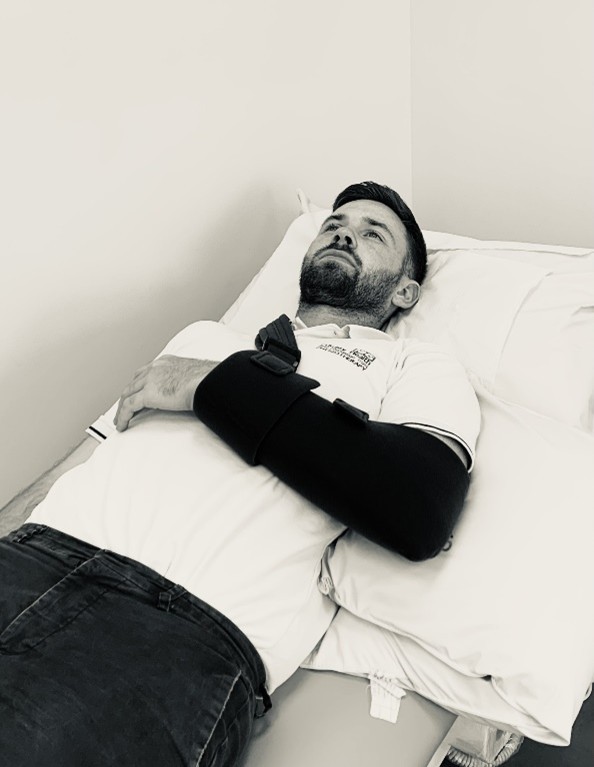
- You may find the sleeping position below helpful - place pillow behind arm.
When can I resume normal activities?
When can I return to work?
If you have a desk job, you can return to work when you feel ready (using the sling). If you have job that requires heavy lifting/duties, you will be signed off for at least 3 months.
When can I drive?
You can normally return to driving at 6-8 weeks.
When can I return to sporting activities?
Your physiotherapist will give you guidance on this throughout your rehabilitation as your mobility and strength improves. You will be off contact sports for at least 4 months and studies have shown return to contact sport normally takes 5-7 months.
What are the risks and possible complications?
Shoulder surgery is generally very safe. The risks of complications are low, but may include:
Failure of bony union of the graft (< 10%)
- It is important that your bony reconstruction is protected during the early stages, hence the sling and restrictions you’ll be given.
- Stable non-bony (fibrous) healing occurs occasionally: this is fine as long as you feel stable.
- Rarely, the graft does not unite, and it displaces. Revision surgery may then be needed.
Re-dislocation or on-going instability symptoms
Latarjet is very effective in stabilizing the shoulder. Studies report failure rates between of approximately 5% at two years. If you do develop recurrent instability, revision surgery may be required.
Stiffness (5%) – Most patients will lose a very small amount of terminal elevation and external rotation after Latarjet. This is seldom noticed by patients. Functionally relevant stiffness is rare.
On-going pain. About 5% of patients will experience persistent pain in their shoulder, despite it being stable and functioning well. A cause for this cannot always be found.
Uncommon (1-2%)
Infection
Infection in a joint is a serious complication. It is therefore important that you do not have any infections prior to surgery, for example, skin, chest or urinary tract infection. Should you have an infection prior to your surgery, please inform the pre-assessment staff. Everything that can be done to minimise infection will be done. Please inform staff if you have allergies to antibiotics or skin disinfectants (e.g. iodine).
Wound healing problems
Dissolvable sutures are typically used. It is rare for the wound not to heal nicely, but occasionally this may occur. If you notice excess discharge, an offensive odour, or surrounding redness then please contact the nursing team on 0300 614 4130 / 0300 614 4131.
Anaesthetic risks
Modern surgical practice is very safe. Complications from anaesthetics are very rare. Shoulder stabilisations require a general anaesthetic and normally a nerve block (to numb the whole arm to reduce peri-operative pain). There are small risks associated with anaesthetics and these risks are increased for those patients with significant pre-existing medical problems. The nerve block is also very safe and the risks of these will be explained to you by the anaesthetist.
Screws in the joint requiring removal
The bone graft is usually fixed to your shoulder using small titanium screws and a washer, these are low profile and designed to be left in place. They will not corrode. It is very rare for them to break, move or cause problems that require removal.
Rare (less than 1%)
Major Bleeding
Normally there is minimal blood loss during this operation. It is rare extremely rare to require a blood transfusion. You may see bruising around your shoulder, the front of your chest and down to the elbow. This will subside and should not require any treatment.
Nerve injury
Whilst rare, injury to the nerves around the shoulder can occur during surgery. If nerve injury does occur, it may cause weakness of the shoulder or arm muscles. Normally, nerve injury is the result of a stretch to the nerves and will recover with time; but permanent injury can (very rarely) occur.
Fracture
This is very rare. If such an event did occur, your surgeon would normally be able to deal with it during the operation.
Post-op blood clots (DVT)
The risk is very low (less than 1%) and is reduced as much as possible by early mobilisation, compression device pumps, and exercises. We do not routinely prescribe post-operative blood thinners for patients undergoing Latarjet procedure.
Questions
If you have further questions, do feel free to ask your surgeon, who can explain things for you. You will see them on the day of your surgery.
Useful Contacts
Heatherwood Hospital:
- Orthopaedic pre assessment 0300 614 7778 / 0300 614 7147
- Arthroplasty Nurse Heatherwood 07789927177
- Nurses Station Treetops Heatherwood 0300 614 4175
- Physio/OT Office Treetops Heatherwood 0300 614 4178
Frimley Park Hospital:
- Frimley Park Physiotherapy 07570 974390
- S2 Elective Ward Frimley 0300 613 3781 / 0300 613 3783
- Elective Helpline Frimley 0300 613 2556
Wexham Park Hospital:
- Ward 1 Wexham Park 0300 615 3010 / 0300615 3012
- Outpatient Physio Wexham 0300 615 3501 / 0300615 3500
- Wexham Park Physiotherapy 07717 199851
Contact us
If you have any queries relating to this information, please contact the Orthopaedics service.
About this information
Service:
Orthopaedics
Reference:
N/066
Approval date:
13 May 2025
Review date:
13 May 2027
Click ‘show accessibility tools’ at the bottom of the page

Then click ‘select language’

Alternative formats
You can use the accessibility toolbar at the bottom of your screen to:
-
Change the text size
-
Adjust the font
-
Modify the colour contrast
-
Use the translate function
If you would like this information in another format, such as Braille, audio, or easy read, please speak to a member of staff.
You can also print as well as download as PDF using the “Print this page” button at the end of the page.
Staff will print a copy for you on request
Important note
This page provides general information only. It is developed by clinical staff and is reviewed regularly every 3 years for accuracy. For personal advice about your health, or if you have any concerns, please speak to your doctor.