

Advice after your nerve block for surgery
On this page…
This procedure is contraindicated for patients with Nickel allergy
Glossary of terms
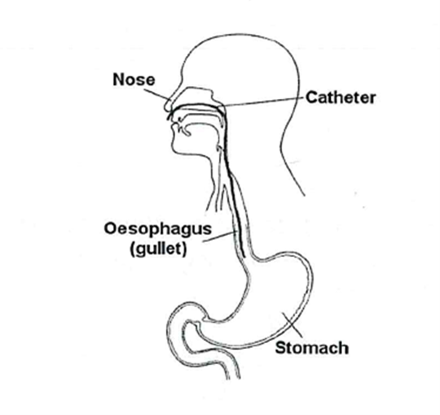
Oesophagus: The oesophagus or gullet is a muscular tube, about 24cm long, which extends from the throat to the stomach.
pH: A scale between 1 and 14 that indicates the strength of acid or alkali.
24-hour oesophageal pH test: A 24-hour test during which acidity and alkalinity (pH) of the oesophagus is measured / recorded.
Catheter: Flexible plastic tube.
Reflux: Retrograde flow of stomach contents into the oesophagus.
Acid measuring catheter: Catheter with a pH sensor attached to its tip to measure acidity and alkalinity.
Why do I need the test?
The test measures the amount of acid that wells up (refluxes) from your stomach into your oesophagus (gullet) and will help you find out if your symptoms are caused by acid reflux.
What to expect before the test:
- You should continue taking all medications as normal.
- You should not eat or drink anything in the four hours before your test, apart from sips of water.
- You are advised to wear a separate top and skirt or trousers as the catheter is inserted under your top and attached to the machine, which is worn on a belt around your waist.
- You are advised to wear loose-fitting comfortable clothes as you will be sitting up on a couch for 20-30 minutes during the test period, and tight-fitting clothes can interfere with the test.
Medications
You do not need to stop any medications prior to the test. Your doctor has asked for you to have this test whilst still taking your acid-suppressing medication.
What to expect on arrival
The GI Physiology practitioner will explain the procedure to you and ask you to sign a consent form. This is to ensure that you understand the test and its implications.
The practitioner will also ask a series of questions regarding your symptoms and the medication you have taken for them. This will help with the interpretation of the results. Please bring a list of your medications with you.
What to expect during the test
You will be made comfortable on the chair, sitting upright. The practitioner will then pass a very fine acid-measuring catheter (flexible tube) through your nose and into your oesophagus. You will not be asleep or sedated in any way, as the procedure should not be painful, and you will only feel a slight discomfort.
The catheter will remain in place for the duration of the test (about 24 hours) and is attached to a recording machine, worn around your waist. You will be asked to complete a diary during the period of the test.
How do I complete the diary sheet?
The practitioner will explain this further to you during your visit. Most importantly, we want you to record your mealtimes and when you experience your symptoms, e.g., heartburn, regurgitation etc.
Will I be able to feel the catheter?
You will be aware of the catheter in the back of your throat when it is fixed in position, but most patients find they become less aware of it with time and this sensation fades into the background.
Will I be able to eat and drink?
Yes, there are no restrictions of the types of things you can eat and drink during the test. We especially want you to continue with your normal diet throughout the test as we need to see what happens during a normal day. Please do not chew gum. The catheter may move very slightly as you eat, and it may feel strange, but we would like you to persevere as it is important to know what happens after mealtimes.
Will I be able to sleep?
You should be able to sleep as normal during the test. When going to bed, it is preferable to keep the recorder under your pillow or next to you on your bed or bedside table. Again, it is important that you sleep in your normal position and record any symptoms that disturb you during the night.
Can I drive while wearing it?
The medical advice is that you should not drive during the test as you may be distracted. If you are coming by car to the hospital, please make sure you are accompanied by a driver.
Will I be able to go to work?
If possible, please follow your normal daily routine. However, if you feel it inappropriate to remain at work, try to be as active as you normally would at home.
Will I be able to bathe or shower?
The recorder must not get wet so you must not take a bath, shower, or go swimming.
Damage to the equipment:
Please treat the equipment with care. The catheter is particularly vulnerable and if it catches on a door handle for example, it will be irreversibly damaged. We recommend that you wear loose top over the recorder and catheter to protect it from snagging.
What if I can’t tolerate the catheter?
Lots of patients tolerate this procedure for the full 24hrs and you will be given instructions of how to remove the catheter at the end of your test. In the unlikely event you cannot last for the full 24hrs, you can follow the end of test instructions and remove the catheter yourself. Please dispose of the catheter and return the recorder and diary to the unit. Obviously, if this happens, we will gain less information about your condition.
What happens at the end of the test?
At the end of the test, the catheter needs to be removed. This is a very simple procedure, and the practitioner will teach you how to do it. The recorder and diary need to be returned promptly in person. This allows us to download your data and produce a report promptly but also allows the recorder to be used for our next patient.
When will I know the result?
The results are sent back to the referring doctor or consultant. You should allow two weeks for the results to reach them.
Contact us
If you have any queries relating to this information, please contact the Endoscopy service.
About this information
Service:
Endoscopy
Reference:
H/063
Approval date:
17 February 2026
Review date:
1 February 2028
Click ‘show accessibility tools’ at the bottom of the page

Then click ‘select language’

Alternative formats
You can use the accessibility toolbar at the bottom of your screen to:
-
Change the text size
-
Adjust the font
-
Modify the colour contrast
-
Use the translate function
If you would like this information in another format, such as Braille, audio, or easy read, please speak to a member of staff.
You can also print as well as download as PDF using the “Print this page” button at the end of the page.
Staff will print a copy for you on request
Important note
This page provides general information only. It is developed by clinical staff and is reviewed regularly every 3 years for accuracy. For personal advice about your health, or if you have any concerns, please speak to your doctor.