

Advice after your nerve block for surgery
On this page…
For 6 weeks following a Total Hip Replacement, Hemi-arthroplasty, or Birmingham Hip Replacement, you are at risk of dislocating your new hip. There are three movements that increase the risk of dislocation that you should avoid.
1. NO BENDING
- The angle between your leg and your trunk should never be less than 90° (an “L” shape).
- When sitting, your legs should slope downwards towards your knees.
- Do not reach forwards, or down to your feet or the floor
- Sitting on a seat that is too low for you will bend your hip past 90°
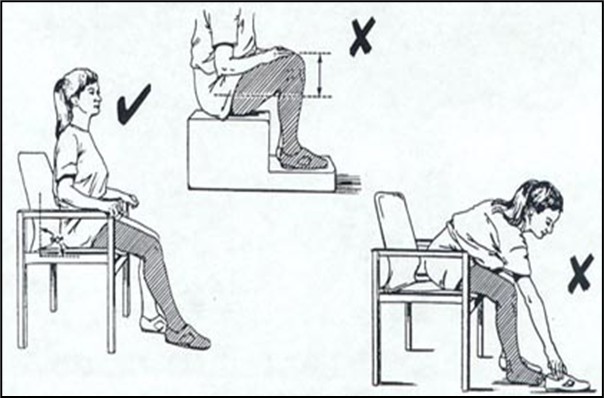
2. NO CROSSING
- Do not cross your legs at your knees or ankles
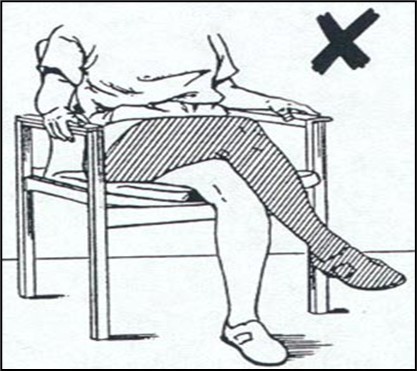
3. NO TWISTING
- Do not twist sideways when sitting or standing
- Take small steps when turning
Moving About
Sitting and Standing
- Move your operated leg forwards before sitting or standing.
- Do not try to sit or stand with your crutches or walking frame in hand.
- Always place both hands on the armrests/bed/toilet seat to lower yourself slowly.
Getting in and out of Bed
- Get into bed with un-operated leg leading.
- Get out of bed with operated leg leading.
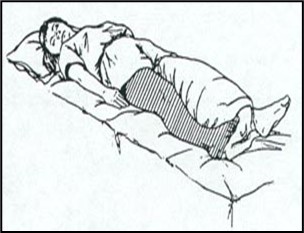
- Sleep on your back for 6 weeks, not your side.
- Use a pillow between your legs to avoid crossing and rolling in your sleep.
Your physiotherapist will advise you further about walking and managing stairs
Activities of Daily Living
Toileting
- Most people will need a raised toilet seat to raise the height of the toilet.
- Be careful not to twist when cleaning yourself. You may find it easier to stand and lean forwards for this.
Strip-Washing
- You may find it easier to sit at the sink to reduce fatigue.
- Use long handled aids to avoid bending below your knees or have help.
Showering and Bathing
- Do not get the wound wet until it has healed over, to reduce the risk of infection.
- A cubicle shower may be used, as long as the step into it is low.
- Showers that are over a bath, or have a high step, increase the risk of twisting and are not suitable after surgery.
- Do not attempt to sit in a bath, to avoid bending.
- Use non slip mats to reduce risk of slips.
Dressing
- Dress your operated leg first, undress it last.
- You should remain seated to dress.
- Use long handled aids to avoid bending.
Cooking
- You will find that you tire quicker than normal. Plan for meals that are simple to prepare and have a seat nearby to rest on.
- Do not bend down to appliances/cupboards that are below waist height.
- Do not stretch up to appliances/cupboards that are above chest height.
- While using walking aids you will not have a free hand to carry items. Consider sitting to eat in your kitchen.
- Ask your occupational therapist for more advice if you feel this will be a problem.
Housework and shopping
- To avoid twisting you should not vacuum, iron, change the bed linen, hang laundry or push shopping trolleys. You will need to arrange assistance.
- You may wish to consider having your shopping delivered or stocking-up in advance.
General Tips
- Get up and walk around every hour or so to prevent stiffness.
- Walk slowly and do not rush to answer the phone/door.
- Take your equipment with you if you visit other people/places and use disabled bathrooms if in town.
- Remove rugs to avoid tripping on them.
- Do not use swivel chairs to avoid twisting.
- Do not drive for 6 weeks, unless advised otherwise by your surgeon.
- Continue using walking aids until otherwise instructed by your Physiotherapist.
Contact us
If you have any queries relating to this information, please contact the Occupational therapy service.
About this information
Service:
Occupational therapy
Reference:
UU/050
Approval date:
23 June 2025
Review date:
23 June 2028
Click ‘show accessibility tools’ at the bottom of the page

Then click ‘select language’

Alternative formats
You can use the accessibility toolbar at the bottom of your screen to:
-
Change the text size
-
Adjust the font
-
Modify the colour contrast
-
Use the translate function
If you would like this information in another format, such as Braille, audio, or easy read, please speak to a member of staff.
You can also print as well as download as PDF using the “Print this page” button at the end of the page.
Staff will print a copy for you on request
Important note
This page provides general information only. It is developed by clinical staff and is reviewed regularly every 3 years for accuracy. For personal advice about your health, or if you have any concerns, please speak to your doctor.