

Advice after your nerve block for surgery
On this page…
What is Gestational Diabetes?
Gestational Diabetes is a type of diabetes that occurs in pregnancy, usually in the second or third trimester. It happens when the body is unable to control blood sugar (glucose) levels and is thought to be a result of the hormones produced during pregnancy, blocking the action of insulin in the body.
When you eat foods containing carbohydrates, the body breaks down the carbohydrates into glucose, which is then released into the blood. The body needs a certain amount of glucose for energy. Carbohydrates have the greatest impact on blood glucose levels. You can directly improve your blood glucose levels by reducing the amount of carbohydrates and changing to slower release ones.
Dietitians can support you to make changes that will enable you to manage your gestational diabetes. Ask for a referral if you have not been offered one.
When to check your blood glucose level
Test your blood glucose upon waking and one hour after each meal. Blood glucose should be below 5.3mmol/l before breakfast and below 7.8mmol/l one hour after meals.
How Does Gestational Diabetes Affect My Baby?
If your blood glucose levels are too high, the excess glucose passes to your baby, who in turn produces extra insulin to cope with this. This extra insulin can make your baby grow bigger than normal, potentially making delivery more difficult.
What is the Treatment for Gestational Diabetes?
The aim of treatment is to keep your blood glucose levels carefully controlled. You may be able to achieve this by making changes to your diet and lifestyle. Some people may also need tablets (Metformin) or injections of the hormone insulin.
Important Points
- Aim to have a regular meal pattern to help achieve a consistent supply of glucose in your blood stream. Adapt your usual meals to match the plate diagram shown overleaf
- Include a source of starchy carbohydrate with each meal such as rice, pasta, potatoes, oats or seeded bread, but keep the portion of these foods to around one quarter of your plate
- Experiment with portion sizes if you need to in the first week of diagnosis
- Aim for half of your plate to be vegetables/salad, this includes vegetables added in to dishes such as curries, or bolognaise
- Include a source of protein at each meal such as meat/chicken/fish/eggs/pulses/lentils/Quorn/tofu. Aim for these to make up a quarter of your plate. If you are hungry then increase your portion of protein containing foods
- Combine carbohydrate foods with high protein foods. This will help to reduce rise in blood glucose levels
- Aim for 3 portions per day of dairy foods such as milk and yoghurt
- Reduce foods and drinks with a high sugar content. The table below can be useful, but it is important to consider the total amount of carbohydrate alongside sugar content as it will all affect your blood glucose
| per 100g | Low | Medium | High |
| Sugars | 5g or less | >5g - <22g | More than 22.5g |
(Adapted from 'Traffic lights' - Food Standards Agency)
- • Use ‘diet’ drinks, ‘no added sugar’ squash and low carb sweeteners such as Hermesetas, Truvia, Sweetex instead of sugar
Portion Size Recommendation
Balance your intake of foods from each food group to reduce the impact on your blood glucose levels. Try to base your meals as shown below:
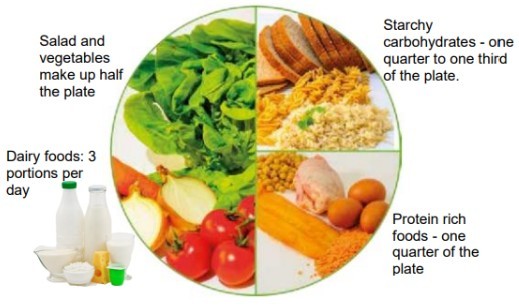
Starchy Carbohydrates
Include one portion of these at every meal. Limit this to a quarter of your plate if you need to. One portion is the equivalent of:
- 3-4 egg sized potatoes
- 5-6 level tablespoons (or 2-3 heaped tablespoons) of cooked rice/pasta
- 1 slice of medium thickness bread
- 1/2 a medium pitta bread
- 30-40g of breakfast cereal
- 30-40g of porridge oats
You may find some starchy carbohydrates causes a bigger rise in your blood glucose than others. Try swapping for a different type of starchy carbohydrate if this is the case. For example, you may find that breakfast cereals cause a bigger rise in blood glucose at breakfast than 1 slice of bread eaten with a source of protein such as eggs.
Carbohydrate Swaps List
Choose slow release, low glycaemic index (low GI) carbohydrates. These are often higher in fibre, which is also good for healthy gut bacteria.
| Types of starchy carbohydrate | Choose | Limit portion of: |
| Pasta, noodles | Wholewheat, 50-50 or white pasta |
Corn/rice pasta, gluten free pasta (unless coeliac disease) |
| Bread, pitta, chapatti |
Seeded/wholegrain/ granary/sourdough/rye |
White/brown/wholemeal bread, bagels, naan bread |
| Rice, grains, pulses |
Basmati/brown rice, pearl barley, quinoa, chickpeas, lentils |
White, instant, long grain, jasmine, sticky, instant easy cook rice |
| Potatoes/ tubers/ bananas |
Sweet or new potatoes, yams, cassava, plantain, green bananas |
White potatoes (baked, mashed, boiled, roasted) |
| Cereal | High protein muesli, porridge |
Frosted/chocolate/cornflakes /puffs/fruit muesli/bran flakes |
Dairy Foods
Aim for 3 portions per day. Only choose lower fat versions if you are trying to limit weight gain. One portion is:
- 200 ml of milk (any type except rice and oat milk)
- 1 pot (150g) of Greek, natural, low sugar or high protein yoghurt
- 25g of cheese (cheese will not impact your blood glucose levels)
Unsweetened plant-based milks such as soya, nut and coconut milks are low in carbohydrate. Choose ones that are fortified with calcium and vitamin D. Avoid canned milks such as condensed or evaporated
Fruit, Vegetables and Salads
Eat a variety of different coloured fruit and vegetables. These provide you with vitamins, minerals and fibre:
- Aim to eat at least 5 portions per day and include more vegetables and salads
- At main meals, aim to fill half of your plate with vegetables or salad
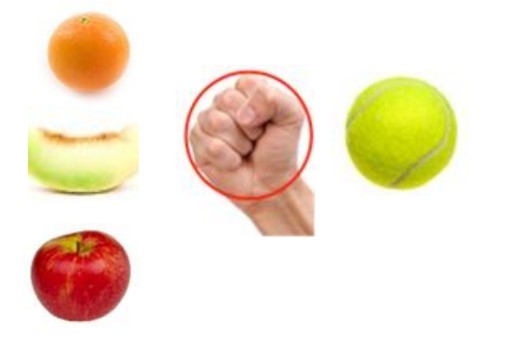
- Have 1 portion of fruit at a time (one portion fits into the palm of your hand) such as 1 apple, 1 orange, 2 apricots, a handful of berries, and do not have more than 2-3 portions a day
- Avoid fruit juice and fruit/milk-based smoothies (both homemade and shop bought) as these are high in natural sugar
Fruit Portion Sizes
Meat, Poultry, Fish, Eggs and Vegetarian/Vegan Alternatives
These are good sources of protein, iron and minerals, include these at each mealtime and cover a quarter of your plate. Choose lower fat versions if you are trying to limit weight gain and be wary of anything with added carbohydrate such as batter/breadcrumb coatings, added potato/wheat to meat alternatives such as vegetarian sausages, burgers, ‘fish-less’ fingers. Consider this as part of your overall carbohydrate portion for the meal.
Snack Ideas Containing Low or No Carbohydrate
As you may have reduced your portion size of carbohydrate containing foods at mealtimes, you might feel hungrier between meals. Choose snacks that are lower in carbohydrate such as those listed below:
| 1 handful of berries with high protein yoghurt |
1 apple/1 pear/2 kiwis/2 apricots plus handful of nuts |
Sliced vegetables with cheese/dip/salsa/ guacamole/hummus |
| 2 rich tea or digestive biscuits with cheese cubes |
Nuts or seeds | 2 Boiled eggs |
| Olives/Avocado | 20g plain or salted popcorn | Cheese with 2 crackers (cream cracker size) |
| Pasteurised, cooked meats - ham/salami/chicken/ turkey |
2 breadsticks with hummus |
1-2 oatcakes with cheese/salsa/peanut butter |
| 1 apple and peanut butter |
1 fun sized banana and some nuts |
Sugar-free jelly |
| 1 small chapatti/roti with sliced, cooked meat |
1 mini vegetable samosa |
1 small vegetable pakora |
| 1 pot (150g) Greek/high protein yoghurt |
2 scoops of high protein ice cream |
1 cheese straw with Babybel |
Exercise
- Regular exercise will help control your blood glucose levels
- If possible, walk for 15 - 30 minutes daily
- Aim to be active after meals rather than sitting down
See NHS choices website for more information:
www.
Are You Drinking Enough?
- To meet your requirements, drink 8 to 10 cups of fluid every day
- ‘No added sugar’ squash/cordial is low in carbohydrate and does not
- need to be limited
What About Alcohol?
- The Chief Medical Officer (CMO) guidance is that pregnant women should not drink any alcohol at all
- If pregnant or planning a pregnancy, the safest option is not to drink alcohol. This is to keep the risks to baby to a minimum
Weight Gain During Pregnancy
(National Academy of Medicine 2009)
- 11-16 kg if normal weight for height pre-pregnancy (body mass index or BMI 18.5 - 24.9 kg/m2)
- 7 - 11 kg if overweight pre-pregnancy (BMI 25 - 29.9 kg/m2)
- Maximum 5 - 9 kg if very overweight pre-pregnancy (BMI more than 30kg/m2)
After you have recovered from having your baby, being a healthy weight for your height is the best way to reduce the risk of developing diabetes later in life.
Pregnancy is not the time to try and lose weight, but for people who were over-weight pre-pregnancy, it is better not to gain too much, and you will be advised by your Health Care Team.
NICE (National Institute for Health and Care Excellence) recommend a yearly blood test to check your average blood glucose levels, called HbA1c. This can be requested via your GP for the first five years after the birth.
Food Safety Advice
Some foods can contain bacteria such as listeria and salmonella, which can be harmful to an unborn baby. The table below shows suitable alternative foods to those best avoided:
| Foods which are best avoided | Suitable alternatives |
|
Soft mould-ripened cheeses like Unpasteurised milk/dairy |
Hard cheeses like Cheddar, Pasteurised milk/dairy products |
| Pâté (any type, including vegetable |
Peanut butter, yeast extracts, meat pastes |
| Undercooked meat, poultry, fish and ready meals. Game meat, liver and liver products such as faggots |
Well-cooked meat, poultry, fish and ready meals |
- Peanuts and foods containing peanuts can be included as part of a healthy balanced diet, unless you have a peanut allergy
- Too much vitamin A can be harmful around the time of conception and during pregnancy. Avoid high dose vitamin supplements such as fish liver oils and avoid eating liver and liver products such as pâté and faggots
- Some fish have been found to have high levels of mercury which can harm a baby’s developing nervous system. Avoid eating shark,swordfish and marlin
- Limit fresh tuna steak to 2 per week and cans of tuna to 4 medium cans (160g) a week; eat oily fish no more than twice a week
- Most eggs are produced under a food safety standard called the British Lion Code of Practice and have a logo stamped on their shell, showing a red lion which are very low risk for salmonella and are safe for pregnant women to eat raw or partially cooked. You can eat raw hen eggs or food containing lightly cooked hen eggs (such as soft-boiled eggs, mousses, soufflés and fresh mayonnaise) provided that the eggs are produced under the Lion Code
- Seaweed should be avoided due to the varying iodine content
- For more information, please visit Pregnancy and diet - BDA
Iodine Supplement
- If fish and/or dairy products are not eaten regularly, an iodine supplement is likely to be necessary - check with your Health Care Team and ensure that any supplement you take is suitable for pregnancy (for more information go to www.
bda.uk.com/ resource/ iodine.html
What Happens After Your Baby is Born?
Once your baby is born your blood sugar level will usually return to normal. However, women who develop gestational diabetes have an increased risk of developing diabetes later in life.
The best way to help prevent the development of diabetes is to avoid being overweight, to continue following a healthy diet that is low in fat, low in sugar and high in fibre, and by doing some regular exercise.
Your GP can refer you to the National Diabetes Prevention Programme, which will give you support and guidance around diet and lifestyle to help reduce your risk of developing type 2 diabetes. For more information on this please follow the links below.
NHS England - How to access the Healthier You: NHS Diabetes Prevention
Programme if you have gestational diabetes mellitus (GDM)
Useful contact details
Diabetes Midwives:
Tel: 0300 613 4880
Email: fhft.
If you would like to speak to a dietitian, please ask the Diabetes Midwives to refer you.
Contact us
If you have any queries relating to this information, please contact the Dietetics service.
About this information
Service:
Dietetics
Reference:
DT/018
Approval date:
1 December 2025
Review date:
1 December 2028
Click ‘show accessibility tools’ at the bottom of the page

Then click ‘select language’

Alternative formats
You can use the accessibility toolbar at the bottom of your screen to:
-
Change the text size
-
Adjust the font
-
Modify the colour contrast
-
Use the translate function
If you would like this information in another format, such as Braille, audio, or easy read, please speak to a member of staff.
You can also print as well as download as PDF using the “Print this page” button at the end of the page.
Staff will print a copy for you on request
Important note
This page provides general information only. It is developed by clinical staff and is reviewed regularly every 3 years for accuracy. For personal advice about your health, or if you have any concerns, please speak to your doctor.