

Advice after your nerve block for surgery
On this page…
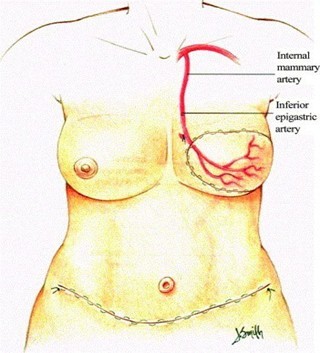
What is a DIEP?
One form of reconstruction is the Deep Inferior Epigastric Perforator Flap, known as a DIEP Flap.
The DIEP utilizes blood vessels, fat, tissue, and skin from the abdomen to reconstruct a new breast
The muscle is preserved for strength and integrity to avoid complications in the future.
As a part of the informed consent process
A patient information will be to give to you for a better understanding of the procedure itself
This will answer specific questions in relation to the surgery.
What are the advantages of the operation?
The operation will be explained to you in detail by the consultant looking after you. The benefits of this type of operation include the following
- The breast is reconstructed from your own skin and tissue; therefore, no implant is needed.
- The appearance of the new breast is good and has a very natural feel to it.
- The breast also moves and feels like a normal breast.
- There is not always a need for symmetry surgery as there is enough skin and tissue to match the other side.
- The muscle is left intact, removing the risks of a hernia and post op complications
- A very good option for patients who have had radiotherapy.
- You can buy bras and clothes that fit and do not worry about wearing prosthesis.
- It gives you self-confidence and enables you to come to terms with issues related to body image.
What are the disadvantages?
The disadvantages of this operation can include the following:
- The operation can take anything from 4-6 hours.
- There is a 5% chance of flap failure. The main reason for this is a lack of blood supply to the breast, which can lead to infection and a breakdown of the wound,
- If this happens you will need further surgery and will be taken back to the theatre to help restore the breast flap.
- Some Afro Caribbean and Asian women may experience some raised scarring; although this is not a common outcome of the operation, it is important to be aware of the possibility.
What does the operation involve?
You will be sent for a CT scan in preparation for the surgery this determines the perforators and blood vessels which will supply the flap
You will need general anaesthetic for this operation.
The surgeon will mark where the incisions are to be made.
Skin and fat will be taken from the tummy
The skin and tissue will be taken and Connected to the blood vessel in the chest under the rib cage
The abdominal scar lies low within the Bikini line hip to hip.
The mastectomy scar is used to lay in the flap which can vary depending on the technique used by the surgeon.
What would happen if I did not have the operation?
If you decide that you do not want to have this operation, then there may be alternatives available. This can be discussed with your consultant or nurse practitioner.
Are there any alternatives?
Yes, there are two other main types of reconstruction available
- Implant only – silicone implant to reconstruct the breast
- Latissimus Dorsi flaps with or without an implant. This is when the muscle, skin and fat from your back is taken and brought round to reconstruct a breast.
What happens when I agree to have the surgery?
- You will be asked to attend a pre-assessment appointment before your operation where you will have a blood test and tracking your heart
- Photos taken of your breasts
- Vitals recorded as a baseline
- You will be advised when to stop eating and drinking.
- Please bring all your medication with you. This is a nurse-led clinic so you will not see a doctor on this day.
- You will be given a blood thinning injection into your arm or thigh the evening before surgery.
- The Consultant and anaesthetist will see you on the day of your operation and the consultant will ask you to sign a consent form.
We advise you to stop smoking at least six weeks before the surgery. Smoking inhibits the blood supply to the breast and delays wound healing lack of blood supply can potentially cause flap failure
What happens after the operation?
You will be nursed in Recovery overnight and transferred to ward 11 the next day where you will have one-to-one nursing for 48rs. You will be nursed in a private room with an en-suite bathroom and toilet.
Will I be in pain after the operation?
Immediately after the operation you will be attached to a (PCA (Patient controlled analgesia) pump. There is also a pain relief anaesthetic going directly into your tummy where the flap was taken so that you have little pain after the surgery and can recover quickly.
This administers a pain killer intravenously to keep you comfortable. Until you can take tablets orally. Holistically everyone has a different threshold for pain
How long will I be in hospital?
3-5 Days
When can I start eating and drinking after the operation?
You will be able to eat and drink as soon as you are fully alert and awake and safe to do so.
What happens when I return to the ward?
Once you return to the ward you will be nursed in a warm room. This helps increase the blood flow to the new breast.
Your arm will be tilted at a 45-degree angle with a pillow to prevent any pressure on the artery that supplies the blood to the flap.
The Nursing team will:
• Monitor and examine the new breast as instructed
• Record and maintain the flap chart
• Pain control
• Urine output
• Record your Vitals
• Monitor drainage from the redivac bottles
• Prescribed medication as instructed
You will also have special stockings (TEDs, also known as anti-embolism stockings) and Flotron boots whilst you are in bed to help prevent a clot in your legs
You will be assisted to get out of bed the next day and gradually build on what you can do
You will have suction drains these collect any excess fluid or blood and are normally removed 24-72 hrs later
What activities will I be able to do afterwards?
You will be limited in the things you can do for a couple of weeks after the operation.
- Avoid anything too strenuous. No heavy lifting, shopping, hoovering, Exercise, swimming etc. for 6-8 weeks after the operation
- Advised Not to drive for 2-3 weeks, you should be able to perform an emergency stop without any pulling or discomfort. Please check with your insurance company before doing so
- On discharge you will see the Breast Care Nurse who will check your dressings and go through your discharge.
- You will then see her in the clinic for a wound review I week post-surgery. An appointment will be made before discharge.
- We advise you not to shower until your first dressing check.
- Stitches are dissolvable, but if you do have any removable stitches, these will be removed as instructed by the consultant.
- Light exercise sheet will be given to you by the physiotherapist
When do I start wearing a Bra?
The Breast care nurse will advise you on
• The correct size to buy
• The type of Bra needed
• When to wear it
• Where to buy it
When can I return to work?
This depends a lot on what type of work you do. We normally say 4-6weeks recovery period.
This does not apply to everyone so please bear in mind that everyone is different, and some may take longer than others. If you do not feel ready to go back to work for any reason, you can discuss this with your GP On discharge, the ward can give you a sick certificate for up to two weeks.
Where should I seek advice or help?
Lead Advanced Nurse Practitioner 03006 153031/3127 Tuesday – Friday (7.30am -3.30)
Ward 11 03006154631 - 0300 6154632 and ask to speak to the sister or Nurse in Charge.
Plastic surgery Dressing Clinic 03006 153031 (8-4pm)
Plastic surgery Urgent care clinic 0300 6151091(8-4)
Parapet King Edward hospital 0300 6136292
Other resources you may find helpful
British Association of Plastic, Reconstructive and Aesthetic Surgeons Procedure Guides: Breast Reconstruction
http://
Macmillan Cancer Support
Tel: 0808 800 1234 Web: www.
Provide information and support to anyone affected by cancer.
Cancer Research UK
Web: www.
Contact us
If you have any queries relating to this information, please contact the Plastic surgery service.
About this information
Service:
Plastic surgery
Reference:
T/013
Approval date:
5 March 2026
Review date:
1 March 2029
Click ‘show accessibility tools’ at the bottom of the page

Then click ‘select language’

Alternative formats
You can use the accessibility toolbar at the bottom of your screen to:
-
Change the text size
-
Adjust the font
-
Modify the colour contrast
-
Use the translate function
If you would like this information in another format, such as Braille, audio, or easy read, please speak to a member of staff.
You can also print as well as download as PDF using the “Print this page” button at the end of the page.
Staff will print a copy for you on request
Important note
This page provides general information only. It is developed by clinical staff and is reviewed regularly every 3 years for accuracy. For personal advice about your health, or if you have any concerns, please speak to your doctor.