

Advice after your nerve block for surgery
On this page…
Developmental Dysplasia of the Hip
One or two babies in every hundred are born with some kind of hip problem.
Developmental Dysplasia of the Hip (DDH) describes a variety of conditions in which the ball and socket of the hip joint do not develop properly. For example, the socket may fail to grow deep enough or the ball may be displaced out of the socket
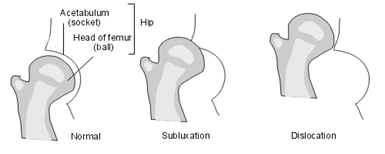
Some of these babies will grow out of the problem without any treatment.
Some babies will need treatment in a Pavlik Harness.
Hip Ultrasound Scans
Ultrasound scans of the hip joint allow the radiology team to measure how deep the hip socket is and how the ball is sitting within the socket.
If the ultrasound scan shows developmental dysplasia of the hip they will refer you to the plaster room at Wexham Park where your baby will be fitted with a Pavlik harness.
Treatment: the Pavlik Harness
A Pavlik harness will be fitted under your baby’s clothes; it is hand made in cotton and is designed to keep the knees bent and the hips flexed, as shown in the diagram below.
This soft splint simply fits under your child’s clothes and keeps the knees and hips bent and in a good position for forming the joint. We suggest that you leave this harness on your baby all the time as this keeps the head of the femur in the correct place and prevents it from sliding out of the joint.
During the initial phase of treatment when the harness is worn 24 hours per day your baby will not be able to have a bath so they will need to be ‘top and tailed’ instead, take extra care to clean and dry behind the knees and in any skin creases.
Babies tolerate the harness very well, there is minimal disruption to activities such as feeding and nappy changes.
They may need to wear slightly larger clothes and please avoid putting your baby in tight fitting lower garments and do not swaddle them.
The midwife or Health Visitor may be concerned about weighing your baby as the harness shouldn’t be removed. The approximate weights of different sized harnesses are:
Extra small 100g Small 120g
Medium 140g Large 160g
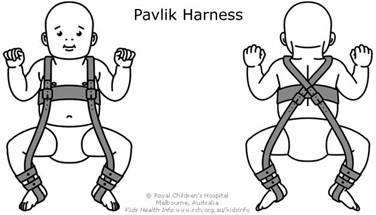
For the majority of babies the hip joint will form really well with this simple treatment.
Your baby will be seen again in plaster room after one week to check the harness fitting. You can contact the team there for follow up checks and appointments as often as you wish.
Your baby will be monitored with scans every four weeks and these scans will be reviewed by our Paediatric Orthopaedic Consultant, Mr Shah.
Once the scans show the hip is improving and is within ‘normal’ limits the harness can be gradually removed using our harness weaning pathway. Plaster room will give you the weaning pathway after the final scan.
Following the completion of time in the harness, the consultant, Mr Shah, will do a clinical examination of your baby’s hips and then arrange an appointment for your baby when they are around 11 months old. At this appointment an X-ray of the hips will be taken as a final check.
Contact Details
If you have any problems or questions about your child’s treatment please contact the Plaster Room at Wexham Park Hospital on
Tel: 0300 615 4058
Mon/Tue/Thurs/Fri: 9:00– 17:00, Wed: 09:00 – 13:00
Other Sources of Help and Advice
Further advice and help, including a film about the Pavlik Harness, can be found on the website of
www.
Contact us
If you have any queries relating to this information, please contact the Plaster room service.
About this information
Service:
Plaster room
Reference:
N/038
Approval date:
31 July 2023
Review date:
1 July 2028
Click ‘show accessibility tools’ at the bottom of the page

Then click ‘select language’

Alternative formats
You can use the accessibility toolbar at the bottom of your screen to:
-
Change the text size
-
Adjust the font
-
Modify the colour contrast
-
Use the translate function
If you would like this information in another format, such as Braille, audio, or easy read, please speak to a member of staff.
You can also print as well as download as PDF using the “Print this page” button at the end of the page.
Staff will print a copy for you on request
Important note
This page provides general information only. It is developed by clinical staff and is reviewed regularly every 3 years for accuracy. For personal advice about your health, or if you have any concerns, please speak to your doctor.