

Advice after your nerve block for surgery
On this page…
Categories:
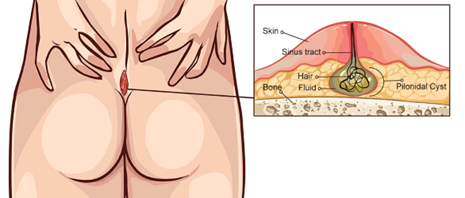
What is a pilonidal sinus?
This is an abnormal scarred tunnel in the skin between the buttocks, often associated with hair and skin debris.
They can discharge fluid from time to time, and can become troublesome if they block and cause an abscess.
What are the causes?
It is thought to be due to a disorder of the skin glands, and is more common in hairy people, those who spend time sitting (taxi or truck drivers, IT experts), and those who are obese.
Can it be treated?
Yes, though surgical wounds in this area can be difficult to heal.
Treatment aims are two-fold:
- to treat your symptoms
- to maintain soft tissue coverage over your tail bone.
What are the treatment options?
If the sinus causes you no problems, it is best to stay as you are, avoiding the risks of an operation.
The only way of curing this condition is with surgery. These are done as a day case with general anaesthetic.
There are a few different approaches:
Lay open
A superficial sinus can sometimes be opened up to the surface with an incision, letting it heal from the base outwards. This leaves a scar.
Endoscopic treatment
Some tracts may be suitable for keyhole treatment to clean out the tract. This avoid the need for large incisions, and recovery is usually very quick. This can reduce the discharge from the tract and cause it to scar and shrink.
Excision and closure
Some tracts are large and complex, and may require excision of the affected skin and fat to treat them. The incision will be closed in a specialized fashion to reshape the contour of the buttock crease. This will leave a scar. You may have a small drain left in the wound for a week.
The main risk of this surgery is failure of the wound to heal, and can happen in up to 40% of cases. Healing is then very difficult, can take a long time, and may require further surgery to correct.
How do I manage at home after my operation?
You will usually be sent home the same day, with instructions.
- It is likely that you will have local anaesthetic around the wound, so some areas may be numb. This will wear off, and it is important to take regular paracetamol and/or ibuprofen for the first 5 days.
- It is important that follow instructions about wound care, and when to have the dressing removed, changed or checked.
- You may go home with a surgical drain, which is a sterile tube allowing fluid to escape from underneath the wound. It is normally removed in clinic one week after the operation. If it falls out, then discard it.
- Follow instructions about activities to avoid. Sometimes you might be asked to avoid sitting for 2 weeks after the operation, particularly if you have had a large incision and flap reconstruction. In this case, lying or standing will be perfectly safe.
Further sources of information
- NHS website: https://
www. nhs.uk/ conditions/ pilonidal-sinus/ - NICE website: https://cks.nice.org.uk/topics/pilonidal-sinus-disease/
Contact us
If you have any queries relating to this information, please contact the General surgery service.
About this information
Service:
General surgery
Reference:
Y/053
Approval date:
31 July 2023
Review date:
1 July 2027
Click ‘show accessibility tools’ at the bottom of the page

Then click ‘select language’

Alternative formats
You can use the accessibility toolbar at the bottom of your screen to:
-
Change the text size
-
Adjust the font
-
Modify the colour contrast
-
Use the translate function
If you would like this information in another format, such as Braille, audio, or easy read, please speak to a member of staff.
You can also print as well as download as PDF using the “Print this page” button at the end of the page.
Staff will print a copy for you on request
Important note
This page provides general information only. It is developed by clinical staff and is reviewed regularly every 3 years for accuracy. For personal advice about your health, or if you have any concerns, please speak to your doctor.