

 Breakfast Foods
  Meat and Meat-based Meals
 Fish and Fish-based Meals
 Starchy Carbohydrate Foods
 Puddings, Ice Cream & Cakes
 Biscuits and Cereal Bars
 Milky Drinks
 Savoury Snacks
 Chocolate and Sweets
 Sauces and Pickles
Advice after your nerve block for surgery
On this page…
What is the Pancreas?
The pancreas is an organ that sits just below your stomach in your body. 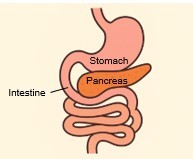
It has two main jobs:
- It releases digestive enzymes into your small intestine to help break down food.
- It makes insulin, which helps control blood sugar.
Digestive enzymes are special proteins your body makes to help break food down into smaller parts, so these nutrients can be absorbed into your blood.
There are three main types of enzymes released by the pancreas:
- Amylase – breaks down carbohydrates (starchy foods).
- Lipase – breaks down fats.
- Protease – breaks down proteins.
What Happens in Cystic Fibrosis (CF)?
In CF, thick mucus blocks the small tubes that carry enzymes from the pancreas to the intestine. Because the enzymes can’t get through, they don’t reach the intestine to help with digestion. This means food is not properly broken down, so your body cannot absorb it well. As a result, you may get runny or fatty stools, wind, bloating, stomach pain, and weight loss.
Taking pancreatic enzyme capsules with your food replaces the enzymes your body can’t release. This is known as Pancreatic Enzyme Replacement Therapy or PERT.
The enzymes that break down carbohydrates and protein are produced by the pancreas but are also present in the stomach and saliva. The enzymes that break down fats are mainly made in the pancreas so without replacement enzymes, fat is not absorbed and will be lost by the body in your stools. This is why replacement enzyme doses should vary according to the fat content of your food and drinks.
How Many Pancreatic Enzymes Do I Need?
There is no single dose that works for everyone so you may need to try different doses with different foods to find out what works for you. The dose of enzymes will change depending on how much fat you eat or drink.
Foods high in fat (e.g. fried foods, takeaways, cheese, chocolate, ice cream, full fat milk) will need more enzymes than low fat foods. Some foods do not require enzymes at all as they do not contain any fat.
This booklet includes guidance on the fat content of common foods to help you know when enzymes are needed. This information can also be found on the food label, on supermarket or product websites and even using AI. Consider your portion size and how the food has been cooked (fried foods will contain more fat). Don’t forget about fats added to the food such as oil, butter/margarine, salad dressings and mayonnaise.
The commonly used pancreatic enzymes are available in 3 different strengths and from 2 different brands:
- Creon 10,000,
- Nutrizym 22,000
- Creon 25,000
The numbers refer to the amount of lipase (to break down fat) contained in the product.
If you find you are taking a large number of capsules, your doctor or dietitian may suggest switching to a higher strength enzyme so you can take fewer capsules
Pancreatic enzyme medicines are made from pork, and there are no other effective alternatives. For people whose religion normally does not allow pork, religious organisations have said these medicines are permitted because they are taken for health reasons. The Vegetarian and Vegan Societies have also confirmed that using these medicines is acceptable.
How Do I Take My Pancreatic Enzymes?
For pancreatic enzymes to be effective, take them just before you begin eating or with the first few mouthfuls of food. They only work when mixed with food.
If you are not sure how much you are going to eat, you can spread your enzymes evenly throughout your meal or split the dose of your enzymes by taking half at the start of the meal and the rest halfway through. It may also be necessary to split your enzyme dose as across the meal if you are having a more than one course or if a meal lasts more than 30 minutes.
Remember to include puddings and milky drinks when working out how many enzymes you need to take.
Most snacks will require less enzymes than a meal, but there are some very fatty snacks that require the same amount as a meal.
Enzymes should always be swallowed whole. Never chew the capsules or mix them with meals.
Take enzymes with a cold drink. Hot drinks can reduce how effective they are.
Pancreatic Enzymes and CFTR Modulator Drugs
It is recommended that CFTR modulator drugs (e.g. Alyftrek, Kaftrio, Kalydeco, Symkevi) are taken with fat-containing food or drinks AND pancreatic enzymes, to ensure they are fully absorbed.
If you are experiencing reflux...
Sometimes people with CF produce too much stomach acid and this can make enzymes less effective. If you are experiencing reflux or heartburn, please discuss this with your CF team.
What Happens if I Don’t Take Enough Enzymes, or if I Take Too Many?
If you do not take enough enzymes, you may get bloating, cramping, wind, and frequent, loose or oily stools. Your stools may also become orange, yellow or pale brown. They may be smelly and float, making them difficult to flush. If you do not take enough enzymes to break down food, you will not absorb the nutrients which can result in weight loss and low vitamin levels.
If you take too many enzymes, you may not have any problems, but if you continually take too much, your stools may become hard and difficult to pass, leading to constipation.
Speak to your dietitian if you aren't sure your enzyme dose is right for you.
When are Pancreatic Enzymes Not Needed?
- Enzymes should not be taken on an empty stomach.
- With foods that do not contain any fat.
- With tea/coffee containing only a dash of milk (less than ½ cup)
- With fruit juice, squash/cordial and fizzy drinks
- With very small quantities of food, for example an individual chocolate (such as Roses or Quality Street) or one small biscuit.
The following foods do not require any enzymes:
- Fruit (except avocado and coconut)
- Vegetables (if not cooked in oil, butter, margarine, roasted or fried)
- Honey, jam, marmalade, syrup or sugar
- Jelly
- Boiled or chew sweets
- Ice lollies
The following pages contain lists of foods and the amount of fat they typically contain. This information can help you decide how many enzymes to take with different foods and drinks you consume.
Please note that these lists are a guide only and there will be variations between different products. If you can check the food label for the product you buy, this will be more accurate. If you need help with this, please ask your dietitian.
|
|
Fat (g) |
|
Wheat biscuits e.g. Weetabix (2 biscuits), made with 100ml full fat milk |
5 |
|
Porridge (typical sachet 27-36g), made with 100ml full fat milk |
5 - 6 |
|
Granola (45-50g) made with 100ml full fat milk |
10 - 15 |
|
Special K (30g) made with 100ml full fat milk |
4 |
|
Chocolate snaps e.g. Coco Pops (30g) made with 100ml full fat milk |
5 |
|
White/brown bread, medium slice |
1 |
|
White/brown toast with butter |
5 |
|
Toast with chocolate spread (5g) and butter (5g) |
6 |
|
Toast with butter (5g) and honey or jam (5g) |
5 |
|
Toast with peanut butter (5g) |
7 |
|
Beans on toast x 2 (with 5g butter per slice) |
10 |
|
Bagel, plain |
2 |
|
Sweet Waffles x 2 |
12 |
|
Scotch Pancakes x 2 |
4 - 6 |
|
Croissant |
10 |
|
Pain au chocolate |
15 |
|
Bacon, 1 rasher (grilled) |
4 |
|
Sausage (thick) |
12 |
|
Egg, boiled |
5 |
|
Egg, fried |
9 |
|
Egg, scrambled (with milk) |
10 |
|
|
Fat (g) |
|
Roast beef, 2 slices (125g) |
14 |
|
Roast chicken with skin (125g) |
9 |
|
Grilled chicken breast without skin (200g) |
4 |
|
Ham, 2 slices (60g) |
2 |
|
Chicken and vegetable pie, 1 medium slice (120g) |
6 |
|
Shepherd’s pie, medium portion (360g) |
32 |
|
Beef stew, medium portion (175g with 90g dumplings) |
20 |
|
Spaghetti bolognese, medium portion (270g) |
13 |
|
Spaghetti Carbonara, medium portion (260g) |
22 |
|
Chicken Fajitas (2 wraps, fried meat, peppers and onions) |
25 |
|
Stir-fry (chicken, veg, noodles), medium portion (275g) |
5 |
|
Chilli con carne, medium portion (250g with 163g rice) |
14 |
|
Lasagne, medium portion (330g) |
32 |
|
Homemade Chicken Curry, med portion (260g with 98g rice) |
7 |
|
Vegan and Vegetarian Foods and Meals |
Fat (g) |
|
Tofu (fried), medium portion (80g) |
14 |
|
Quorn chicken-style pieces, medium portion (100g) |
3 |
|
Quorn burger (fried, patty only) |
4 |
|
Quorn burger (grilled, patty only) |
2 |
|
Veggie burger (fried, patty only) |
14 |
|
Veggie burger (grilled, patty only) |
10 |
|
Quorn sausage (fried) |
6 |
|
Quorn sausage (grilled) |
4 |
|
Veggie sausage (fried) |
9 |
|
Veggie sausage (grilled) |
5 |
|
Cauliflower cheese, side portion (100g) |
7 - 11 |
|
Macaroni cheese, medium portion (304g) |
26 |
|
Vegetarian lasagne, medium portion (340g) |
12 |
|
|
Fat (g) |
|
Fish fingers x 2 |
4 |
|
Fish cake (salmon), 1 |
12 |
|
Breaded scampi, oven baked (140g) |
18 |
|
Fish pie, potato topping, medium portion (380g) |
18 |
|
Cod fillet, baked (125g) |
1 |
|
Salmon fillet, baked (130g) |
15 |
|
Prawns / King prawns (50 – 100g) |
0 |
|
Tinned tuna in brine, 1/2 tin (70g) |
1 |
|
Tinned tuna in oil, 1/2 tin (70g) |
4 |
|
Pasta bake (tuna, sweetcorn, cheese) medium portion (285g) |
11 |
|
Fast Food and Ready Meals |
Fat (g) |
|
Beef burger, small, fried (100g) |
24 |
|
Beef burger, grilled (100g) |
20 |
|
Fried chicken, 1 drumstick with bone (140g) |
13 |
|
Chicken nuggets x 4 (68g) |
10 |
|
Chicken Tikka ready meal (370g) |
36 |
|
Lamb rogan josh curry (350g) |
32 |
|
Fish in batter, fried (135g) |
19 |
|
Chips, fast food, medium portion (130g) |
11 |
|
Cornish pastie, beef, medium (162g) |
29 |
|
Pizza, pepperoni, 1/4 Pizza |
21 |
|
Pizza, vegetarian, 1/4 Pizza |
10 |
|
Milk and Dairy Products |
Fat (g) |
|
Full fat milk, 1/2 pint (284 ml) |
10 |
|
Semi-skimmed milk, 1/2 pint (284ml) |
5 |
|
Soya milk, sweetened, 1/2 pint (284ml) |
6 |
|
Single cream, 1 tablespoon (15ml) |
3 |
|
Double cream, 1 tablespoon (15ml) |
8 |
|
Butter or margarine, 1 pat (10g) |
8 |
|
Yoghurt, fruit (full fat), 1 pot (125g) |
4 |
|
Greek yogurt (full fat), 1 pot (125g) |
13 |
|
Cheese, cheddar (25g) |
9 |
|
Babybel cheese (20g) |
5 |
|
Soft cheese (25g) |
6 |
|
|
Fat (g) |
|
Pasta, cooked, medium portion (166g) |
2 |
|
White rice, boiled, medium portion (163g) |
1 |
|
Brown rice, boiled, medium portion (155g) |
1 |
|
Egg-fried rice, medium portion (170g) |
8 |
|
Boiled potato 1 medium (65g) |
0 |
|
Roast potato 1 medium (38g) |
2 |
|
Baked potato, medium (220g) |
0 |
|
Potato mashed with butter (120g) |
5 |
|
Oven chips, medium portion (168g) |
7 |
|
Fried chips, medium portion (100g) |
14 |
|
White or wholemeal bread, 1 slice |
1 |
|
Seeded bread, 1 slice |
2 - 4 |
|
Cheese and pickle sandwich (160g) |
23 |
|
Egg mayonnaise sandwich (120g) |
13 |
|
Bacon lettuce and tomato sandwich (170g) |
20 |
|
Yorkshire Pudding (80g) |
7 |
|
|
Fat (g) |
|
Custard, (120g) |
2 |
|
Slice apple pie (160g) |
24 |
|
Ice cream, vanilla (2 scoops) |
7 |
|
Ice cream (cornetto-style) |
9 - 14 |
|
Sticky toffee pudding, medium portion (100g) |
16 |
|
Chocolate mousse (100g) |
7 |
|
Bakewell tart, 1 |
8 |
|
Chocolate brownie, 1 (45g) |
14 |
|
Victoria sponge, 1 slice (77g) |
15 |
|
Fruit cake, 1 slice (121g) |
15 |
|
Chocolate cake, 1 slice (70g) |
17 |
|
Swiss roll, 1 slice (35g) |
6 |
|
Custard tart, 1 (92g) |
13 |
|
Mince pie, 1 (60g) |
9 |
|
Jam Doughnut, 1 (71g) |
9 |
|
Blueberry muffin (102g) |
20 |
|
|
Fat (g) |
|
Chocolate Digestive biscuit, 1 |
4 |
|
Plain Digestive biscuit 1 |
3 |
|
Hobnob/oat biscuit, 1 |
3 |
|
Bourbon cream, 1 |
3 |
|
Custard cream, 1 |
2 |
|
Ginger nut, 1 |
2 |
|
Rich tea biscuit, 1 |
1 |
|
Jaffa cake, 1 |
1 |
|
Shortbread finger, 1 |
5 |
|
Chocolate biscuit bar, 1 |
5 |
|
Flapjack, 50g |
11 |
|
Tracker bar, chocolate chip, 1 |
6 |
|
Nutri-grain bar, 1 |
3 |
|
Eat Natural Cereal Bar |
9 - 15 |
|
|
Fat (g) |
|
Full fat milk cappuccino, medium |
6 |
|
Full fat milk latte, medium |
9 |
|
Hot chocolate with full fat milk and cream |
21 |
|
Hot chocolate with full fat milk, no cream |
13 |
|
Milkshake (powder and full fat milk) |
10 |
|
Milkshake (powder and semi-skimmed milk) |
5 |
|
Iced coffee frappe with cream |
11 |
|
|
Fat (g) |
|
Peanuts, salted, 1 small bag (25g) |
12 |
|
Trail Mix, 1 small bag (25g) |
5 - 11 |
|
Crisps, ready-salted, 1 bag (35g) |
9 - 13 |
|
Hula hoops, 1 packet (30g) |
8 |
|
Kettle chips, 1 packet (28g) |
9 |
|
Popcorn, microwave, 1 small portion (25g) |
1 |
|
Popcorn, shop bought with toffee, 1 small portion (25g) |
2 |
|
Wotsits, 1 packet (21g) |
7 |
|
Tortilla chips (50g) |
11 |
|
Quavers, 1 packet (20g) |
6 |
|
|
Fat (g) |
|
Milk Chocolate, 6 squares (25 – 30g) |
12 - 17 |
|
Dark Chocolate, 3 squares (25 – 30g) |
9 - 12 |
|
Crunchie, 1 bar (42g) |
7 |
|
Kit Kat, 1 4-finger bar (49g) |
10 |
|
Maltesers, 1 bag (37g) |
9 |
|
Minstrels, 1 bag (42g) |
9 |
|
Snickers, 1 bar (58g) |
13 |
|
Twix, 1 2-finger bar (56g) |
12 |
|
Mars bar, 1 bar (57g) |
11 |
|
Smarties, 1 tube (38g) |
7 |
|
Skittles, 1 packet (45g) |
2 |
|
Starburst, 1 tube (45g) |
3 |
|
|
Fat (g) |
|
Mayonnaise, 1 tablespoon |
10 |
|
Tomato ketchup, 1 tablespoon |
0 |
|
Salad cream, 1 tablespoon |
4 |
|
Caesar Salad dressing, 1 tablespoon |
9 |
|
Vinaigrette style salad dressing, 1 tablespoon |
4 - 8 |
|
Pickle, e.g. Branston’s pickle, 1 tablespoon |
0 |
|
Guacamole, 1 tablespoon |
2- 3 |
|
Sour cream, 1 tablespoon |
3 |
|
Salsa, 1 tablespoon |
0 |
Contact us
If you have any queries relating to this information, please contact the Dietetics service.
About this information
Service:
Dietetics
Reference:
DT/014
Approval date:
1 April 2026
Review date:
1 April 2029
Click ‘show accessibility tools’ at the bottom of the page

Then click ‘select language’

Alternative formats
You can use the accessibility toolbar at the bottom of your screen to:
-
Change the text size
-
Adjust the font
-
Modify the colour contrast
-
Use the translate function
If you would like this information in another format, such as Braille, audio, or easy read, please speak to a member of staff.
You can also print as well as download as PDF using the “Print this page” button at the end of the page.
Staff will print a copy for you on request
Important note
This page provides general information only. It is developed by clinical staff and is reviewed regularly every 3 years for accuracy. For personal advice about your health, or if you have any concerns, please speak to your doctor.