

Advice after your nerve block for surgery
On this page…
Introduction
Pan retinal photocoagulation (PRP) laser treatment is a treatment recommended to proliferative diabetic retinopathy (PDR) patients.
What is proliferative diabetic retinopathy (PDR)?
Diabetes can damage small blood vessels in the retina. This can lead to poor circulation (ischemic retinopathy). In some cases, the damage can be so extensive that the retina attempts to heal itself. Damaged retinal cells can produce special chemicals (growth factors) which can lead to new blood vessels growing into the retina. New blood vessels, unfortunately, are fragile. They can leak, releasing proteins that cause scarring. Sometimes these vessels can break and bleed. These processes can cause severe damage to the retina, leading to vision loss, and in some cases, blindness.
How can PDR be treated?
If the condition is mild, it is sometimes possible to treat PDR by improving diabetic care such as blood sugar levels, blood pressures and blood fat (lipid) levels. In most eyes, however, PDR must be treated with pan retinal photocoagulation (PRP) laser treatment. In some cases, where laser has not been effective, surgery may become necessary.
What is laser treatment?
There are many different types of lasers used for a variety of eye conditions. The treatment for PDR is different to that used for correcting short-sightedness. Laser for PDR is a well-established and effective treatment. The laser causes changes within the retina that reduce or stop the production of growth factors. In many cases, this causes the new blood vessels to regress.
How effective is this treatment?
It is important to remember that no treatment is effective in 100% of cases. The main aim of treatment is to stop new vessel growth, and to get rid of existing new vessels. Laser is about 70 - 80% effective. Where laser fails, in some cases, surgery can successfully treat the problem. Even with eyes that eventually become blind, laser can often slow down the process, delaying severe damage.
Possible complications
- Common, but non-serious complications:
- Laser is extremely bright light, and your eye will be dazzled (like looking directly at a camera flash) for a while.
- Each laser spot damages a very small, microscopic part of the retina. In the first few days after treatment, you might notice small dark spots in your sight. This will settle and will not cause any noticeable problems.
- More serious complications include:
- This treatment will usually cause some damage to your peripheral vision. Most people will notice that their night vision is reduced.
- About 1 in 5 patients having PRP will have a reduction of the area of sight (visual field loss). This could lead to loss of the driving license. If you have had laser treatment for diabetic eye disease, the DVLA might ask you to have special test (visual field test) at an accredited optician to determine if you fulfil the visual standards for holding a license.
- Rarely, accidental damage to the centre of the retina (macular burn) could lead to severe visual loss. This is very rare, occurring in less than 1:1000 cases.
Important: In some eyes, vision can deteriorate very rapidly due to PDR. Sometimes, this can happen soon after laser, either because there has not been enough time for the laser to work, or because the laser has been ineffective. This rapid loss of sight is not due to the laser, but to PDR.
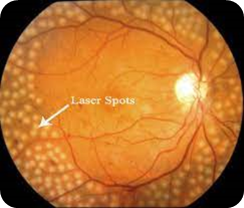
How much treatment will I need?
Laser is an outpatient procedure. Laser to control PDR is extensive. About 2500 to 3000-minute laser burns must be applied to each eye. Usually, this is done over two or three sessions. After this initial treatment, your eyes will be re-examined. More treatment might be required if the initial treatment does not cause resolution of PDR, or the condition recurs.
Is the treatment painful?
PRP laser is usually not painful, and it is extremely bright light. The doctor will instil some anaesthetic drops to numb the surface of your eye before placing a special contact lens to focus the laser onto the retina. If your eyes are extremely sensitive to light (photophobic) and find it difficult to tolerate the laser, or even find it painful, it is possible to administer a more complex local anaesthetic (sub-tenon’s anaesthesia) to dull your vision for a while and make the procedure painless. This same, more complex anaesthetic might be used if you are unable to keep your eyes still during the procedure as this makes safe treatment difficult.
What about aftercare?
There is no special aftercare. Your sight will be affected for a couple of hours due to the dilating eye drops and the bright laser light, so you should not drive on the treatment day. This will improve by itself. You do not need to rest afterwards and can carry on with your normal diet and activities.
How will I know if the treatment has been effective?
PRP is done to prevent further damage to the eye. Therefore, you will not notice any improvement in vision and, as mentioned before, you might notice worsening of night vision and peripheral sight. Your specialist will re-examine your eyes, usually about 2 months after treatment. Further laser treatments might be needed if the condition has not responded, or responded poorly, or because the condition has recurred.
Can I improve PDR or prevent it recurring?
Yes. Like all complications of diabetes, good control of your blood sugar levels, blood pressure and blood lipids can improve PDR and reduce the risk of recurrence. With blood sugar, you must try to get the long-term sugar test (HbA1c) result under 7% and not to have too much fluctuation of the daily sugar levels. Where possible, your blood pressure should be at or under 120/80. If your lipids are elevated, you should be on treatment for this. Please be guided by your GP, diabetologist or diabetic specialist nurse. Do not try to change your treatments yourself. Sudden changes in sugar levels can sometimes worsen eye disease.
If you have any of the following symptoms after the treatment:
- Excessive pain
- Sudden onset of flashes and floaters
- Loss of vision, or part of the vision
- Increasing redness of the eye
Please contact the eye treatment centre on the following numbers:
| From 9am to 5pm Monday to Friday: | 0300 373 5884 |
| From 5pm to 9am and at weekends: | 0300 614 5000 and ask for the eye doctor on call |
Contact us
If you have any queries relating to this information, please contact the Ophthalmology service.
About this information
Service:
Ophthalmology
Reference:
QQ/060
Approval date:
1 July 2024
Review date:
1 July 2027
Click ‘show accessibility tools’ at the bottom of the page

Then click ‘select language’

Alternative formats
You can use the accessibility toolbar at the bottom of your screen to:
-
Change the text size
-
Adjust the font
-
Modify the colour contrast
-
Use the translate function
If you would like this information in another format, such as Braille, audio, or easy read, please speak to a member of staff.
You can also print as well as download as PDF using the “Print this page” button at the end of the page.
Staff will print a copy for you on request
Important note
This page provides general information only. It is developed by clinical staff and is reviewed regularly every 3 years for accuracy. For personal advice about your health, or if you have any concerns, please speak to your doctor.