

Advice after your nerve block for surgery
On this page…
What is a Latissimus Dorsi?
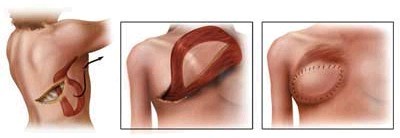
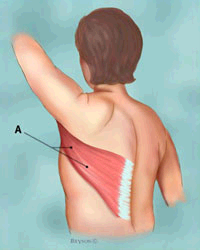
Latissimus Dorsi is a flat muscle in the back supplied by a large blood vessel that enters the muscle in the armpit.
This is a type of breast reconstruction where an area of skin and tissue is rotated around to the front and used to make a new breast, the blood supply stays intact.
Occasionally a breast implant may be used with the skin and muscle which provides a natural shape and contour.
The aim is to create a new breast that maintains its shape and texture
What are the advantages of the operation?
- A good cosmetic result.
- Strong durable flap
- Most suited for small breasted women
- You can buy bras and clothes that fit you and do not worry about the prosthesis that you once had to wear.
- This gives you self-confidence and will help you to come to terms with issues related to body image and change
What are the disadvantages?
- Radiotherapy may change the feel of the skin, and the implant can become hard and painful over the years
- The implant can cause scar tissue around the breast known as a capsule. If this becomes painful further surgery may be needed,
- You may need a reduction or uplift on the other side to have reasonable symmetry.
- Scars, are permanent but to fade with time, it can take anything up to 2 years for the scars to mature
What are the risks?
- Wound breakdown is more common in patients who smoke
- Infection
- Bleeding
- Hematoma (blood clot)
- Asymmetry (unequal breast size), although this is usually slight this can be corrected later
What are the Alternatives?
Yes. However, these are not suitable for all and the appropriate type of reconstruction most suited to the individual will be discussed in clinic.
Alternatives include:
• Implant (only) - Silicone implant used for breast reconstruction
• Diep breast reconstruction, Tummy Flap where the skin and tissue is removed and reconstructed into a breast
What happens when I agree to have surgery?
You will be invited to attend a pre-operative assessment clinic. This is nurse led, so you will not see a doctor on the day. This appointment involves routine tests carried out by a nurse in preparation for your surgery. You will have a blood test and a tracing of your heart (ECG). Your blood pressure, pulse, height, and weight will be recorded, and photos will be taken of your breasts and back (you will need to consent for these). Please bring your current medications with you. If you are a smoker we advise you to stop smoking at least six weeks before the operation. Smoking decreases the blood supply to the breast which may cause the flap to fail.
What does the operation involve?
On the day of your surgery your consultant and the anaesthetist will talk you through the operation and ensure that you are happy to proceed. Your consultant will need to mark your skin with a special surgical pen to show where the incisions will be made.
We advise you to stop eating six hours prior to surgery however you can drink water only up to two hours before.
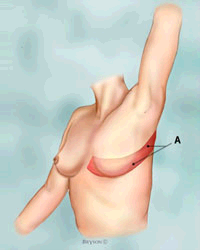
The procedure involves skin and muscle being ‘tunnelled’ to the front of the chest wall to create the new breast. The blood supply is kept intact and ensures that the skin and muscle continue to live in their new location. If you decide to have an implant, the muscle will be draped over it to create the new shape of the breast.
 |
 |
What happens when I come back to the ward?
Once you return to the ward you will be nursed in a side room.
The arm next to the reconstructed breast must be elevated on a pillow at a 45% angle to prevent any pressure on the flap.
The nurses will monitor the flap, monitor your pain and change your dressings as needed,
You may have drains which are removed before we discharge you
You will get out of bed the next day and increase your activities as you recover.
You will be in hospital for 2-4 days.
Will I be in pain after the operation?
Surprisingly, patients do not complain of any undue pain, apart from slight discomfort and tightness across the chest. You will be given enough pain relief to keep you comfortable.
What activities will I be able to do after the operation?
You will be limited in the things that you can do immediately after the surgery.
You should avoid anything too strenuous such as heavy lifting, hoovering, exercise, or swimming
You will be seen in clinic by the consultant 4-6 weeks after your operation.
How do I look after my wound?
You will have a wound on the back (Donor site) and breast
You will see the team before you go home with the relevant information
Wound-care instructions on discharge
Stitches are usually dissolvable
You will have a dressing clinic in a week
Do not shower till your dressings have been removed and you have been advised to do so.
Bra Advice
Please buy a cotton sports bra, Non seamed, Non wired. You will need a supportive/comfortable bra 4-6 post surgery, this will not only support your breasts but help with posture and any discomfort you may have.
When can I start to massage the wound?
We encourage you to start massaging the wounds once they are completely healed and robust.
This increases the blood supply and aids healing, softens and flattens the scars.
We advise you not to use anything too perfumed, as this may irritate the wound and cause sensitivity
Keep it simple
Examples Vaseline, bio-oil, aqueous cream, nivea, E45
When will I be able to drive?
We advise you not to drive for 2 weeks after the surgery.
Please check with your insurance company regarding cover post-surgery
When can I return to work?
This depends on the type of work you do.
Please bear in mind that everyone is different and some people may take longer to recover than others.
Normally 2 weeks after surgery
We will give you a sick note, if you need longer than 2 weeks you can obtain one from your GP.
Where should I seek advice or help?
If you have any worries, however small, please contact Kamal Paul, Clinical Lead Nurse for Breast and Plastic Surgery on 03006153127
Plastic surgery urgent care clinic 03006153031
You can also email and send us photos via email to fhft.plasticsurgentcare@
If you are unable to attend the hospital, please contact your G.P (General Practitioner). or the NHS 111 service.
Other sources of information
Macmillan Cancer Support
http://
Patient Information Guides from the British Association of Plastic Reconstructive and Aesthetic Surgeons (BAPRAS) on Breast and Chest procedures
http://
Contact us
If you have any queries relating to this information, please contact the Plastic surgery service.
About this information
Service:
Plastic surgery
Reference:
T/004
Approval date:
28 April 2026
Review date:
1 April 2029
Click ‘show accessibility tools’ at the bottom of the page

Then click ‘select language’

Alternative formats
You can use the accessibility toolbar at the bottom of your screen to:
-
Change the text size
-
Adjust the font
-
Modify the colour contrast
-
Use the translate function
If you would like this information in another format, such as Braille, audio, or easy read, please speak to a member of staff.
You can also print as well as download as PDF using the “Print this page” button at the end of the page.
Staff will print a copy for you on request
Important note
This page provides general information only. It is developed by clinical staff and is reviewed regularly every 3 years for accuracy. For personal advice about your health, or if you have any concerns, please speak to your doctor.